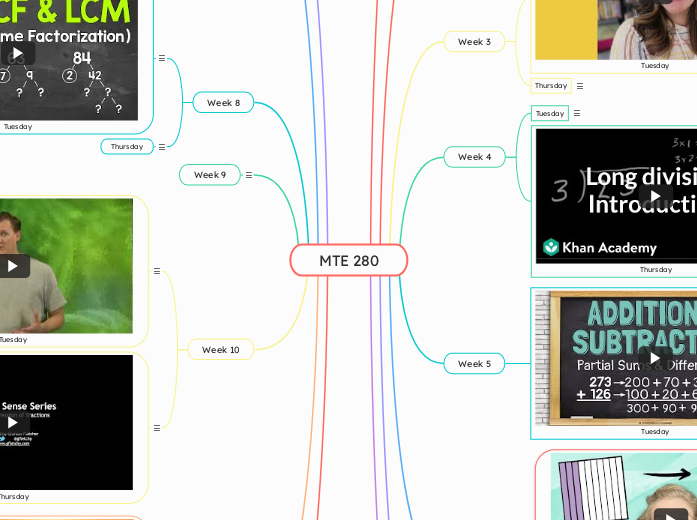
MTE 280
Week 12
Multiplying numbers with decimals
Use logic and reasoning to place the decimal; otherwise, multiply like normal
Don't need to line up the decimals, line up the numbers instead
Teaching why and place value is super super important when teaching children to multiply numbers with decimals
Division for numbers with decimals
Use the long division algorithm
Most teachers teach to bring the decimal point up and continue with the normal algorithm, but it doesn't teach them why, which is that it represents the place value
Word Problems with Percentages
A studetn takes a test with 46 questions and gets 37 questions right. What is their percent on the tst.
37 is what % if 45
37 = n x 45 n=37/45
cross multiply and divide 45/37 and 100/x
x = (37/100)/45
Week 11
Class spent working on Mind Map project and reviewed homework for test.
Problem Solving with Fractions Using Diagrams
Jim, Ken, Len, and Max have a bag of miniature candy bars from trick-or-treating together. Jim took ¼ of all the bars, and Ken and Len each took ⅓ of all the bars. Max got the remaining 4 bars. How many bars were in the bag originally? How many bars did Jim, Ken, and Len each get?
Jim got 12 bars
Ken got 16 bars
Len got 16 bars
Max got 4 bars
Jim, Ken, Len, and Max have a bag of miniature candy bars from trick-or-treating together. Jim took ¼ of the bars. Then Ken took ⅓ of the remaining bars. Next, Len took ⅓ of the remaining bars, and Max took the remaining 8 bars. How many bars were in the bag originally? How many bars did Jim, Ken, and Len each get? How is this problem (with regard to fractions) different from Problem 1?
Jim got 6 bars
Ken got 6 bars
Len got 4 bars
Max got 8 bars
These questions are different because the first question has each person taking a different fraction of the whole. The second question has each person taking fractions of the remainder of what is left.
I used different visual models using a rectangle for both questions. I attempted to attach an image of my model, but that is a paid feature on Mindomo
Week 10
Notes From Video
1st Grade
- Students learn the word partition (dividing shapes into parts).
- Focuses on halves and quarters (fourths).
- Students learn terms like "half" "fourth" or "quarter"
2nd Grade
- Introduced to thirds
- They learn that different-looking shapes can have the same area when divided equally.
3rd Grade
- First-time students see fractions written with numerators and denominators.
- Heavy use of visual models
- Connect fractions to whole numbers:
- Example: 4 is made of 1+1+1+1.
- Learn to use a number line
- Learn counting by fractions
- Use number lines to show equivalent fractions.
- Students must learn that the size of the whole number stays the same, only the fractions can change.
- Students learn that whole numbers can also be written as fractions
- Understanding common denominators and numerators when determining greater than and less than
4th grade
- Students learn whatever is done to the numerator must be done to the denominator. Students should discover this pattern instead of being told.
- Learn benchmark fractions, like using one half to help determine greater than or less than.
- Use visual models to help students understand equivalent fractions
My Response to Video
1. I did not realize how early children start learning about fractions. I always thought of it as a 3rd or 4th-grade skill. I do not remember doing partitions or learning fractions in school before 3rd grade. As a teacher, I will follow the timeline laid out in the video as I think something similar would have helped me.
2. I like how much the video emphasizes the importance of visual models. When I was in school, I remember using the number line but not other visual models, and I think it would have helped my understanding. I always hated fractions because they were confusing, but that may have helped fix that confusion.
3. The strategy of having students fold paper in order to see equivalent fractions is the same activity we did in class before spring break. While I already understood the concept, I found that this method made it much easier to explain fractions and lead the students to their own understanding. This is a method I will definitely use in the future, and I think solidifies students understanding.
Adding and Subtracting Fractions
- If the denominators are the same, add the numerators.
- When the denominators are different, find equivalent fractions, the LCM is often the best choice.
- Factor in the value of the whole when comparing fractions.
- Remember the a/a=1 rule when converting mixed numbers into improper fractions.
Multiplying Fractions
- Multiply straight across, denominator x denominator, numerator x numerator
- There is no need for a common denominator
- When multiplying fractions, the result is smaller because it is a part of a part.
- ex. 1/2 of 1/2 equals 1/4
Dividing Fractions
- Change the problem into a multiplication problem
- Keep, Change, Flip
- Multiplying a fraction by one "gets rid of" the denominator.
- Every number has a denominator, it is just generally ignored if it is a whole number.
Week 9
Spring Break
Week 8
Meanings of Fractions
- A fraction is a way to express a part of a whole.
- Quotient ex. 3 divided by 6 is the same as 3/6
- Ratio ex. 5 girls and 7 boys, 16 total, the ratio of boys/girls is 7/9 or 7:9, the ratio of girls/boys is 9/7 or 9:7
When teaching fractions
- Models: area (pattern block, shading), length (number line, folding paper), sets or groups (demonstrating with groups)
The most important rules
- When the numerator and the denominator are the same, it equals one. (this is important!!)
- The more pieces my whole is divided into, the smaller the pieces get.
- When we talk about fractional parts, we are talking about equivalent parts.
Prime Factorization and Prime factor trees
- 24: 1, 2, 3, 4, 6, 8, 12, 24
- Prime tree for 24- 4 and 6, the result is 24= 2x2x2x3
- It doesn't matter which 2 factors you choose for a tree, they will always end with the same base prime numbers
- express the prime factorization as 24= 2x2x2x3, you have to express this through multiplication
Greatest Common Factor, GCF, and Least Common Multiple, LCM
- Multiples go on forever and are a number multiplied like 2: 2,4,6,8,10, etc.
- Divide each side of the fraction by a common number (factor) to work on simplifying the fraction
- Ex. 25/100 to simplify divide by 25 which is a common factor to get 1/4
- If you cant divide, you have to multiply by a common multiple
- Ex. ½+⅙ have the multiple 6 in common, the smallest, so you can multiply to become 3/6 +1/6 = 4/6
Methods for GCF and LCM:
List method:
Find GCF
24: 1,2,3,4,6,8,12,24
36: 1,2,3,4,6,9,12,18,36
The GCF is 12, because it is the biggest factor in common
Find LCM
24: 24, 48, 72
, 96 …
36: 36, 72,
The LCM is 72 because it is the smallest multiple in common
Prime Factorization Method:
(using prime trees)
24= 2x2x2x3
36= 2x2x3x3
GCF= 2x2x3=12
LCM= GCF x 2x3
= 12x2x3=72
Week 7
Number theory and divisibility rules
- Divisibility rules involve numbers where the result is a whole number.
- All numbers can be divided by each other
- A is divisible by b if there is a C that meets the requirement cxb=a
- Ex. 10 is divisible by 5 because there is a number 2 that meets the requirements (2x5=10) therefore, all the numbers are divisors and factors
Rules by Number
5 is a factor of 10
2 is a factor of 10
2 is a divisor of 10
5 is a divisor of 10
10 is a divisor of 2
10 is a divisor of 5
-end of the number
By 2: 0,2, 4, 6, 8
By 5: 0,5
By 10, 0
-sum of the digits
By 3: if the sum of digits is divided by 3
Ex. 24, 2+4=6 6 divided by 3= 2
By 9: if the sum of digits is divided by 9
By 6: if it’s divisible by both 2 and 3
-last digits
By 4: if the last 2 digits are divisible by 4
By 8: if the last 3 digits are divisible by 8
By 7: double last digit
Subtract from the remaining number
Repeat
By 11: the “chop off” method
- Chop off the last 2 digits
- Add them to the remaining number
- Repeat
Ex: 29,194 divided by 11
29,194 to 291+94 = 385
385 to 3+85=88
Composite and Prime Numbers
- Numbers with a lot of factors are called composite numbers
- Numbers with only 2 factors, 1 and itself, are called prime numbers
- Ex, 13 factors are (1, 13)
- The numbers 1 and 0 are neither prime numbers nor composite numbers.
- 0 is the additive identity elements
- 1 is the multiplicative identity element
Class Cancelled
Week 6
Reveiwed Test #1
Took Test #1
Week 15
Positive and Negative Numbers
- Positive numbers: greater than 0
- Negative numbers: less than 0
- Zero (0): neutral value, separates positives and negatives
Number Line:
- Typically shown horizontally in school
- Vertical number line is more effective:
- Acts like an elevator (0 = ground level)
- Easier to relate to place value
- Positive = up, Negative = down
Chip Method:
- Used for:
- Addition
- Subtraction
- Probability
- Number families
- Chips represent integers:
- One side = positive
- Other side = negative
- On tests, draw chips using:
- "+" inside a circle for positives
- "−" inside a circle for negatives
- When a positive and a negative chip are together, they form a zero pair
- Always circle zero pairs
- To subtract, add zero pairs if needed and remove as instructed
- Leaves remaining chips as final answer
Multiplying Integers
- Use commutative property when multiplying positive and negative integers
- Remember integer sign rules:
- Positive × Negative = Negative
- Negative × Negative = Positive
- Positive × Positive = Positive
No Class
Week 14
Percentages Continued
Think of percentages, decimals, division, and fractions as proportions.
Ex:
- 37/45 = 45/45 = 100%
- 45/37 = 100/? → Use cross multiplication to solve.
Cancel out common factors when dividing.
Focus on reasonable thinking:
Percentages
- “Per cent” literally means “out of 100” (from Latin root cent = 100).
- A percentage is a way to show a part of a whole using 100 as the total.
- Example:
- 30% off means you save $30 for every $100 you spend.
Important:
- Percentages over 100% are only used when something increases beyond the original amount (like "150% of the goal").
- You can't say things like “110% off”, that doesn’t make sense.
- In elementary math, always round percentages to 2 decimal places or fewer.
Types of Problems:
3 common types of problems
a) What percent of _ is _?
- The answer will be a percentage
- Formula is n = a ÷ b
Ex:
8 is what percent of 22?
n = 8 ÷ 22 = 0.36 (repeating)
b) _ % of _ is what number?”
- The answer will be a number
- Formula is n = a × b.
Ex:
8% of 22 is what number?
n = 0.08 × 22 = 1.76
c) _% of what number is _?
- The answer will be a number (the original whole)
- Formula: n = b ÷ a
Ex:
8% of what number is 22?
n = 22 ÷ 0.08 = 275
Things to remember:
- “is” = equals (=)
- “what” = the unknown (use n)
- "of” = multiply (×)
- Always convert percentages to decimals before calculating
- (Ex: 8% = 0.08)
Week 13
Adding, Subtracting, Multiplying and Dividing Decimals
- Line up the decimal points/place values.
- Subtraction is like borrowing in fractions . use visuals (ex. break $1 into 10 dimes, then into pennies).
Multiplying Decimals
- Estimate to place the decimal at the end.
- Focus on the multiplication first, then figure out where the decimal goes using place value.
- Ex: multiply as if there are no decimals, then count decimal places in the original numbers.
Dividing Decimals
- Use long division; bring the decimal straight up in the answer.
- Use real-world examples like sharing money.
- If the divisor is a decimal, move the decimal point to the right in both numbers to make the divisor a whole number.
- The answer stays the same even if you do this.
Fractions to Decimals
- Easiest when the denominator is 10 or 100.
- If not, find an equivalent fraction with a power of 10.
- Example: 2/5 → 4/10 → 0.4
- Remember: fractions = division problems.
- Turn the numerator into a decimal by dividing.
- Add zeros if needed and divide (e.g., 5/6 → 50/60 → divide out).
Decimals
Decimals are another way to show parts of a whole, like fractions.
Use a 100-block grid:
- The whole block = 1
- Rods = tenths (1/10)
- Small squares = hundredths (1/100)
Ex:
- 1/10 of 1/10 = 1/100
- 3/10 = 30/100
Place Value:
- Each place to the right gets 10 times smaller.
- Each place to the left gets 10 times bigger.
- Example: 10 → 375.75
Money Example:
- $111.11 = 111 dollars and 11 cents
- $375.35 = 375 dollars and 35 cents
- 1 penny = 0.01 or 1/100
Common Mistakes:
- Thinking more digits mean a bigger number (e.g., 0.9 is more than 0.51)
- Not understanding place value
Decimal Point:
- Separates whole numbers from parts
- Read as “and” (e.g., 111.11 = "one hundred eleven and eleven hundredths")
Zeros:
- Sometimes zeros can be left out (e.g., 0.50 = 0.5), but they can help with understanding
Week 5
Addition Algorithms
1. American Standard Algorithm
- Adds from right to left.
- Standard method everyone is taught.
2. Partial Sums Method
- Add each place value separately (ones, tens, hundreds).
- Combine all partial sums to get the final answer.
- Example:
- 348 + 275 → (300 + 200) + (40 + 70) + (8 + 5) = 623.
3. Lattice Method
- Draw a grid
- Add digits and place results in the grid,
- Add the numbers diagonally to get the final answer.
4. Expanded Notation Method
- Break each number into place values before adding.
- Example:
- 346 + 275
- (300 + 40 + 6) + (200 + 70 + 5)
- Add each place value: (300 + 200) + (40 + 70) + (6 + 5) = 623.
5. Partial Sums with Place Value
- Similar to the Partial Sums method, but it keeps numbers in place value columns.
- Each place value is added separately in order from left to right.
- This is the best method to teach children first as it focuses on maintaining place value
6. Left-to-Right Addition Method
- Work from left-to-right
- This makes sense for children as that is the direction we read in the United States.
- Essentially the same as the American Standard algorithm, except it is worked the opposite direction
Subtraction Algorithms
1. American Standard Algorithm
- Subtract from right to left.
- The standard method commonly taught in schools.
2. Lattice Method for Subtraction
- Uses a grid to do subtraction, helps students line up place value, however, does not necessarily help them understand the role of place value when subtracting.
3. Expanded Notation Method
- Break numbers into place values before subtracting.
Example:
- 543 - 278
- (500 + 40 + 3) - (200 + 70 + 8)
- Subtract each place value separately and then subtract.
4. Integer Subtraction Algorithm
- Subtracting where instead of borrowing, there are negative numbers.
- It is not a good method to teach elementary students, however, could be fun and effective for middle schoolers learning negative numbers.
5. Reverse Indian Algorithm
- Subtracts from left to right instead of right to left.
- Borrowing is done in advance before starting subtraction.
Week 4
The Standard American algorithm for long division:
- Divide – Check how many times the divisor fits into the first part of the dividend.
- Multiply – Multiply the divisor by the quotient (the number you just wrote).
- Subtract – Subtract the result from the dividend section you used.
- Bring down – Bring down the next digit of the dividend.
- Repeat – Continue dividing, multiplying, subtracting, and bringing down until there are no more digits left.
Properties of Multiplication
1. Commutative Property
- The order of the numbers does not change the product.
- Example: 3 × 4 = 4 × 3
2. Associative Property
- The grouping of numbers does not change the product.
- Example: ( 2 × 3 ) × 4 = 2 × ( 3 × 4 )
3. Distributive Property
- A number outside parentheses multiplies each term inside.
- Example: 5 × ( 3 + 2 ) = ( 5 × 3 ) + ( 5 × 2 )
4. Identity Property
- Any number multiplied by 1 stays the same.
- Example: 7 × 1 = 7
Week 3
Numeration Systems
Bases 1-10
Base 3 (digits 0-2)
ones- 3^0
threes- 3^1
nines- 3^2
twenty-sevens- 3^3
Base 4 (digits 0-3)
ones- 4^0
fours- 4^1
twelves- 4^2
sixty-fours- 3^3
Base 5 (digits 0-4)
ones- 5^0
fives- 5^1
twenty-fives - 5^2
one-twenty-fives - 5^3
Base 6 (digits 0-5)
ones- 6^0
sixes- 6^1
thirty-sixes - 6^2
two-hundred-sixteens - 6^3
Base 7 (digits 0-6)
ones- 7^0
sevens- 7^1
forty-nines - 7^2
three-hundred-forty-three - 7^3
Base 8 (digits 0-7)
ones- 8^0
eights- 8^1
sixty-fourths - 8^2
five-hundred-twelve - 8^3
Base 9 (digits 0-8)
ones- 9^0
nines- 9^1
eighty-ones - 9^2
seven-hundred-twenty-nines - 8^3
Base 10 (digits 0-9)
ones- 10^0
tens- 10^1
hundreds - 10^2
thousands - 10^3
Numeration Systems
Base 5 to Base 10
- Multiply each digit by 5 raised to its place value.
- Then add them together
Example: Convert 13 base 5 to base 10
( 1 × 5^1 ) + ( 3 × 5^0 )
( 1 × 5 ) + ( 3 × 1 ) = 5 + 3 = 8
Converting Base 10 to Other Bases
- Make a representation of each digit of base 10 which needs to be converted, for this example it is 12.
- Remove the number from the base is. For example, for base 9, remove 9. It counts as the equivalent of 10 for that base. 9 in base 9 is equivalent to 10 in base 10.
- Count the remainder, and it becomes the second digit in the number.
Example: Convert 12 in base 10, to base 7,8, and 9
12 base 10 = xxxxxxxxxxxx = 13 base 9
12 base 10 = xxxxxxxxxxxx = 14 base 8
12 base 10= xxxxxxxxxxxx = 15 base 7
Week 2
Thursday
Numeration systems
People use symbols to indicate a quantity (numbers)
Our system is a base 10 system, because there is a consistent 1-10 relationship, and is a decimal system that uses a base of 10
Positional system, numbers get their value from the place where they sit, in a number, there is the hundred spot, the tens spot, and the ones spot in a ten system
This 1-10 relationship is always there, no matter how big or small the number is, including into decimals, each place is a multiple of 10 or a division of 10.
375= 300+70+5
= (3x100)+(7x10)+(5x1)
= (3x10^2)+(2x10^1)+(5x10^0)
Base 5 is a way of counting that only uses the digits 0, 1, 2, 3, and 4. Instead of counting in groups of ten (like we do in base 10), we count in groups of five.
Each place in a number represents a power of 5, just like in base 10 each place represents a power of 10.
For example, in base 10:
- The first place is ones (1).
- The second place is tens (10).
- The third place is hundreds (100).
In base 5:
- The first place is the ones (1).
- The second place is the fives (5).
- The third place is the twenty-fives (25).
Tuesday
A Cartesian product is when you take two groups and pair each item from the first group with each item from the second group. This creates all possible combinations. The total number of pairs is found by multiplying the number of items in each group.
Example:
Dan has 3 shirts and 3 pairs of pants, how many possible combinations of shirts and pants does he have?
3 x 3 = 9
Problem Solving
Make problem solving problems as physical as possible when teaching. Base 10 blocks and props will help facilitate their understanding.
Week 1
Thursday:
Problem solving
Problem solving is not a content, it is a developable skill/component similar to critical thinking.
Students must first understand a problem and what it is looking for before they can start problem solving.
- Understand the problem
- Develop a plan and strategies
- Implement the plan
- Check work
George Polya created this strategy in a book called “How to Solve it”
A Mathematical Tug-of-War
Use the information given to determine who will win the third round in a tug-of-war.
Round 1: On one side are four acrobats, each of equal strength.
On the other side are five grandmas, each of equal strength.
The result is dead even.
Round 2: On one side is Ivan, a dog. Ivan is pitted against two of the grandmas and one acrobat. Again, it’s a draw.
Round 3: Ivan and three of the grandmas are on one side and the four acrobats are on the other.
George Polya created this strategy in a book called “How to Solve it”
Four acrobats and five grandmas are equal in strength.
This means the total strength of four acrobats is the same as the total strength of five grandmas.
4A = 5G 4A = 5G
4A = 5G
To find one acrobat’s strength in terms of grandmas, I divided both sides by 4:
A = 5/4G
This told me that one acrobat is equal to 5/4 of a grandma’s strength.
Ivan, the dog, is placed against two grandmas and one acrobat, and it ends in a tie.
This means Ivan’s strength is equal to the strength of two grandmas plus one acrobat:
I = 2G+A
So I used substitution
I = 2G+5/4G
I converted everything to have a denominator of 4:
I = 8/4G + 5/4G
I = 13/4G
To express everything with a denominator of 20 I multiplied by 5:
I = 65/20G
Total strength of Ivan's team
I + 3G = 65/20G + 60/20G = 125/20G
Total Strength of the 4 Acrobats
4A = 4 X 25/20G = 100/20G
125/20 > 100/20
Therefore Ivan's team is stronger