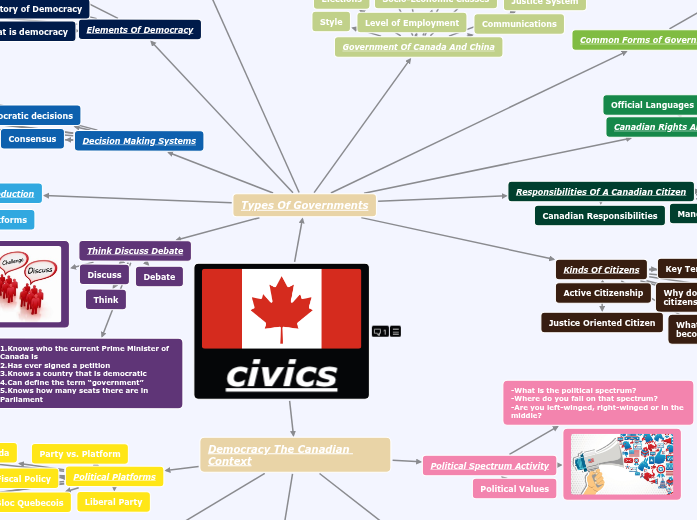
civics
lkxjcsjcs
very nice app
Democracy The Canadian Context
Political Spectrum Activity
-What is the political spectrum?
-Where do you fall on that spectrum?
-Are you left-winged, right-winged or in the middle?
Political Values
Branches Of Government
-Aboriginal Affairs
Jane Philpott
-Foreign Affairs
Chrystia Freeland
-Climate Change
Catherine McKenna
-Finance
Bill Morneau
Governor general represents the queen
Swears in:
-Prime minister
-Chief Justice of Canada
-Cabinet ministers
3 branches work together to govern Canada:
-Executive – Enforce laws
-Legislative (Parliament) – Make laws
-Judicial – Interpret laws
Senate
Current Cabinet Ministers
Cabinet Ministers
Governor General duties
Branches of Government
Electoral Systems
-Electoral System – a system that determines the process of how someone is elected.
-First Past the Post (F.P.T.P.)
-Proportional Representation System
-Preferential Ballot System
1.The Call
2.The Nominations
3.The Voters’ List
4.The Campaign
5.The Voters
6.The Decision
7.The Count
8.The Winner
Preferential Ballot System
Proportional Representation System
Voting Strategically
Voting Strategically Example
Other Problems with FPTP
First Past the Post (F.P.T.P.)
The Election Process
Democracy
1.Election – The process of voting to choose government
representatives.
2.Responsible Government – A democratic system of government in which citizens vote for representatives who make decisions on their behalf (i.e. Canada).
Roles of an MPP:
-House Leader
-Party Whip
-Cabinet Ministers
-Parliamentary assistants
-Committee Chairs
-Critics
-Backbenches
Who’s your MP?
MPP responsibilities
Democracy Characteristics
Other terms
Parliament of Canada
What do MPs Do?
What is democracy?
Representation by Population
Who’s your MPP?
Political Platforms
-Justin Trudeau
- Andrew Scheer (recently elected)
- Jasmeet Singh
- Martine Ouellet
- Elizabeth May
-Conservative
-Liberal
-NDP (New Democratic Party)
-Bloc Quebecois
-Green Party
1.Social Policy: Guidelines for dealing with
social issues (abortion, drugs, capital
punishment, immigration, etc.).
2.Fiscal Policy: Government policy for
expenditure (money) i.e. the budget.
Green Party
Bloc Quebecois
NDP
Conservative Party
Liberal Party
(The main) Parties of Canada
Social Policy vs Fiscal Policy
Party vs. Platform
Types Of Governments
Kinds Of Citizens
-Works and pays taxes
-Obeys laws
-Recycles
-Acts responsible in the community
-Active member of community organizations
-Organizes community efforts to promote development
-Votes in elections
-A citizen who takes an active role in their
communities.
-When citizens exercise their democratic rights and responsibilities.
-Someone who makes their voice heard.
How to be an active citizen
Justice Oriented Citizen
Responsible Citizen
Active Citizenship
What factors are needed to
become active citizens?
Why do we need to all be active
citizens?
Responsibilities Of A Canadian Citizen
1.Citizen - a legally recognized subject or national of a
state or commonwealth, either native or naturalized
2.Right – Things you are morally and/or legally entitled to
have or to do.
3.Responsibility - the state or fact of being accountable or
to blame for something.
-To respect the rights and freedoms of others
-To obey Canada's laws
-To participate in the democratic process
-To respect Canada's 2 official languages and multicultural heritage
Canadian Responsibilities
Key Terms
Mandatory or not?
Canadian Rights And Freedoms
1.Right to life, liberty and security of the person
2.Right to be secure against unreasonable search or seizure
3.Right not to be arbitrarily detained or imprisoned.
4.Governments must respect the basic principles of justice
-Fundamental rights
-Democratic rights
-Mobility rights
-Legal rights
-Equity rights
-Official languages (equal status of French / English)
-Minority language educational rights
Floating topic
Official Languages of Canada
Majority rule vs. Minority Rights
Minority language educational rights
Equity rights
Legal rights
Mobility rights
Fundamental Freedoms
Categorized
Rights and Freedoms
Common Forms of Government
-Monarchy
-Dictatorship
-Oligarchy
-Aristocracy
-Theocracy
-Anarchy
-Democracy
Classroom Activity
Types of Government
Government Of Canada And China
Canada
-93-95% Employment
China
-100% Employment
Canada
-Free elections every
4-5 years
-Party system
-Secret ballot
China
-Limited elections
-One party system
Canada
- Democratic
- Mixed/Capitalist
China
-Totalitarian
-Communist
Justice System
Communications
Style
Elections
Level of Employment
Socio-Economic Classes
Communism And Fascism
-Benito Mussolini (Italy)
-Adolf Hitler (Germany)
-Francisco Franco (Spain)
-Augusto Pinochet (Chile)
-Suharto (Indonesia)
1.Karl Marx
2.Vladimir Lenin
3.Communist countries today
Differences between Communism
and Fascism
History of Fascism
Fascism Characteristics
Communism
Fascism
History of Communism
Elements Of Democracy
-Rule of Law
-Political Equality
-Common Good
-Personal Freedoms
-Human Dignity
-Political Freedoms
-Being Informed & Getting Involved
-Respect
1.Ancient Greece (800 – 146 B.C.)
2.Roman Republic (509 – 27 B.C.)
3.Modern Democracies (Liberal Democracies):
History of Democracy
What is democracy
Decision Making Systems
1.One person, or a small group of people, has been given the power to make all decisions.
2.The leader(s) tell others what to do; very intimidating.
3.Individuals have to accept decisions of the leader(s).
1.Defined by the decision making process, values, how rulers are chosen and how rulers maintain power
2.Democracy, Autocracy, Oligarchy, Theocracy and
Anarchy
3.Types of decision making process: Democratic,
Autocratic, Consensus, Laissez-faire
Autocratic Decisions
Laissez-faire
Consensus
Democratic decisions
Civics Introduction
Levels of Government:
1.Federal
2.Provincial
3.Municipal
1.Citizens 18+ have the right to vote
2.Current voting system: “First past the post”
3.Trudeau was going to change to: “Proportional Representation”
1.Democracy – All citizens have political power
2.Autocracy – One Person has power over all: Dictatorship
or Monarchy
3.Oligarchy – A small group of people has all the power
1.Freedom of speech
2.Health care
3.Diversity
Political platforms
Leadership styles
Electing a leader
How we Govern
What Rights do we have? (Think, pair,
share)
The constitution
Think Discuss Debate
1.Knows who the current Prime Minister of Canada is
2.Has ever signed a petition
3.Knows a country that is democratic
4.Can define the term “government”
5.Knows how many seats there are in Parliament
Debate
Discuss
Think