Explicit and implicit teaching
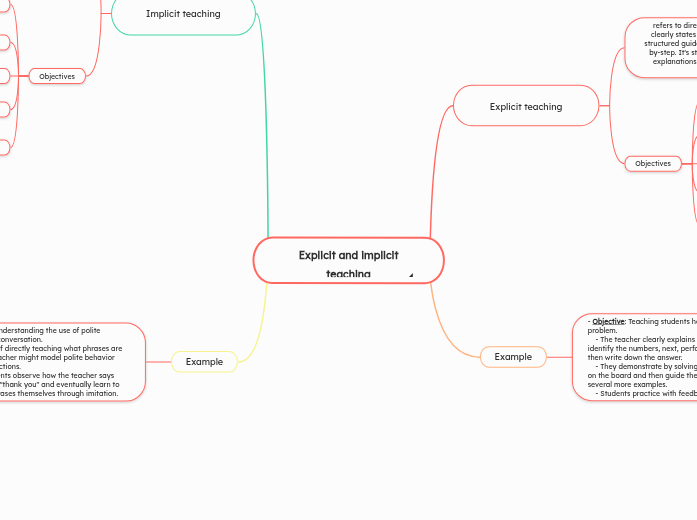
-Objective: Understanding the use of polite language in conversation.
- Instead of directly teaching what phrases are polite, the teacher might model polite behavior during interactions.
- The students observe how the teacher says "please" and "thank you" and eventually learn to use those phrases themselves through imitation.
Implicit teaching
Foster Creativity and Adaptability
Help learners think flexibly and apply knowledge in various situations, as they learn by observing or experimenting, rather than following rigid steps.
Encourage Engagement and Exploration
Foster a deeper engagement with the material, as students actively participate in the discovery process
Contextual Learning
Promote learning in real-life or meaningful contexts, making it more relatable and transferable
Develop Social and Cognitive Skills
Through observation and experience, students develop interpersonal, linguistic, or conceptual skills naturally
Encourage Critical Thinking
Allow students to discover and infer rules or concepts on their own, fostering independent thought and problem-solving skills
on the other hand, involves learning that is less direct. It happens through exposure, modeling, or discovery, where learners figure out concepts or skills without being directly told. The focus is on learning through context or experience.
Example
- Objective: Teaching students how to solve a math problem.
- The teacher clearly explains the steps: first, identify the numbers, next, perform the addition, then write down the answer.
- They demonstrate by solving a sample problem on the board and then guide the students through several more examples.
- Students practice with feedback.
Explicit teaching
Objectives
Efficiency
Teach content in a direct and time-efficient manner, which is especially useful for complex topics or foundational skills
Consistent Outcomes
Ensure that all students reach the same learning outcome through a systematic approach.
Immediate Feedback
Provide real-time feedback and correction to ensure students understand the material.
Skill Mastery
Help students master specific skills or concepts through structured, step-by-step guidance.
Clarity and Precision
Ensure that students have a clear understanding of the learning objectives and the steps to achieve them.
refers to direct instruction where the teacher clearly states the learning objective, provides structured guidance, and explains concepts step-by-step. It's straightforward, focusing on clear explanations and demonstrations of skills or concepts.