by bethany tan 3 years ago
179
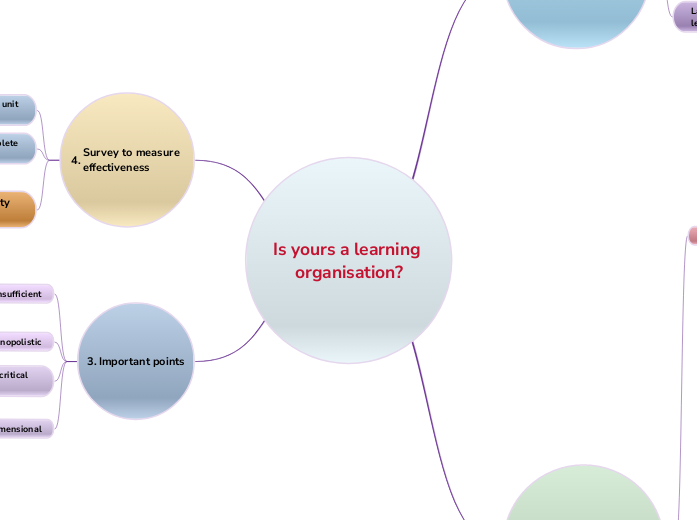
Is yours a learning organisation?
by bethany tan 3 years ago
179
More like this
What problem do you want to solve?
Type in the box.
E.g.
Create a plan of how to solve the problem.
High scores conveys limited information about performance in other segments
What actions will you take?
Organization with a concrete size tend to score between in the leadership segment, indicating there is room for improvement in other segments.
What is the expected effect of this action related to your problem?
Now it's time to execute your plan.
You can also:
Thanks for Mind Mapping!
This branch will guide you to think about the possible solutions available to your problem.
Think about your problem and complete the sentence
How might we ...
Type in the answers
Pushed employees to think critically and was involved in the process of the discussion rather than the outcome
Activities done within company more likely to flourish
Employees are more confident and comfortable in speaking out
Example: US Army's After-Action Review (AAR)
After the action is done, it is reviewed through a sanctioned website which is then codified and reviewed by the Center for Army Lessons Learned (CALL)
Lateral knowledge sharing: systematic briefing after every session
The debriefing involves 4 questions- What did they set out to do, what happened, why did it happen and what to do next time
Vertical knowledge sharing
Obtain constant feedback from others
Able to gain new perspectives and come up with new ideas that is essential to company's growth
Lateral knowledge sharing
Allow generation of new information that could be essential to the company's growth
Focus on their tasks and fully express their view without interruptions and objections which may cause self-doubt
Think of important people from your life.
What would people who you admire think about your problem?
Note: These persons can be real persons or famous people from history
Results in productive discussions and conflict
They have a formal process that collects information systematically. Able to identify key decisions that surround problems
Develop and test new products, services and intelligence gathering
"Errors and investigation" -> "Accidents and Analysis"
Workers are able to express their view freely, able to work together to suggest changes to improve wellbeing of patients
Take time out to critically analyse their work, reduce amount of sub-standard work being submitted
Have the opportunity to step out of the box and review their own performance
Able to take risks and explore a new idea that may be uncommon in their field of practice
People will not resist untried approaches
Learn to appreciate other's viewpoints
Differences raised are usually in a group setting rather than a private one
Even if view is not consistent with others', it is still valued
May spark fresh thinking that will motivate them to look into an alternative view
What potential opportunities lay hidden in this problem?
Think of something positive caused by this problem.
Allow them to improve their self-confidence
Should be comfortable with expressing their views even if they are contrdicting
Able to gain more information on what works , mistakes made will not be held
To understand your problem this branch will guide you to:
Describe your problem in detail
Press the next below to continue.
What is the cause of this problem?
Describe the current situation of the problem.
What is happening now?
Type your answer in the box.