por Aholibama Garcia 4 anos atrás
667
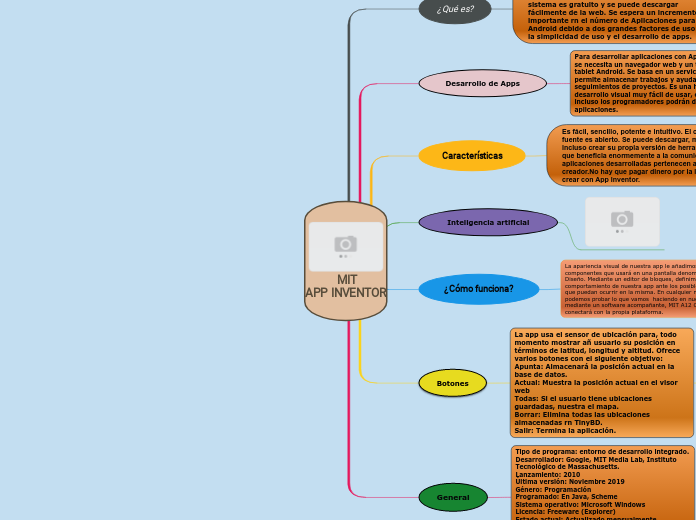
⠀⠀⠀ MIT APP INVENTOR
por Aholibama Garcia 4 anos atrás
667
Mais informações

por Nicol Sofia Castrillon 901
por Gemma Veronica Salinas Rosas
por Anita R.G
por Alexis reyes Samora
The Solar System is the gravitationally bound system of the Sun and the objects that orbit it, either directly or indirectly. Of the objects that orbit the Sun directly, the largest are the eight planets, with the remainder being smaller objects, the dwarf planets, and small Solar System bodies.
Earth is a water world, with two-thirds of the planet covered by oceans.
It's the only world known to harbor life.
Earth's atmosphere is rich in nitrogen and oxygen.
Its name originates from 'Die Erde,' the German word for 'the ground.'
Earth may once have had two moons, nowadays it has just one.
Venus is Earth's twin in size and has no moons.
Its surface has various mountains and volcanoes. Because of its thick, toxic atmosphere that's made of sulfuric acid clouds, Venus is an extreme example of the greenhouse effect. The average temperature on Venus' surface is 900 F (465 C).
Venus spins slowly from east to west, the opposite direction to most of the other planets.
The Greeks believed Venus was two different objects — one in the morning sky and another in the evening. Because it is often brighter than any other object in the sky, Venus has generated many UFO reports.
Our Solar System has eight “official” planets which orbit the Sun.
Each planet is at a different distance from the sun. Name its position.
Mercury is the smallest, only a little bit larger than Earth's moon. Mercury has no moon.
It experiences dramatic changes in its day and night temperatures: Day temperatures can reach a scorching 840 F (450 C), which is hot enough to melt lead. Meanwhile, on the night side, temperatures drop to minus 290 F (minus 180 C).
It also has a very thin atmosphere of oxygen, sodium, hydrogen, helium, and potassium and can't break-up incoming meteors, so its surface is pockmarked with craters, just like the moon.


