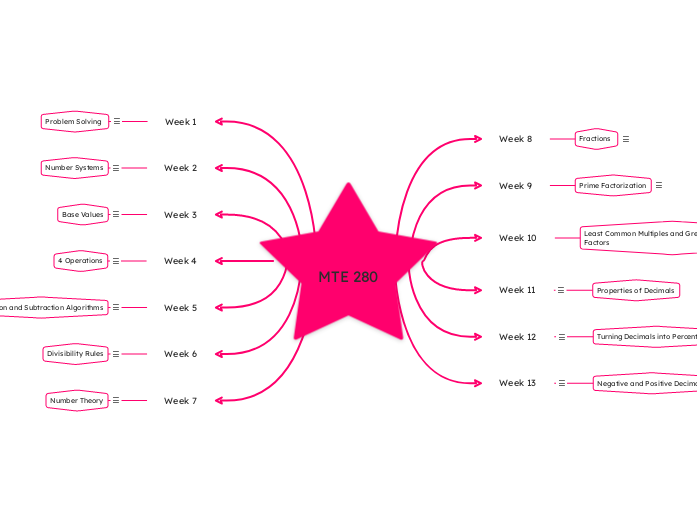
MTE 280
Week 7
Number Theory
- Types of numbers
- Divisibility rules
- Factors- multiples - (fraction work)
Divisibility Rules:
-Endings:
By 2: 0,2,4,6,8
By 5: 0,5
By 10: 0
*Prime numbers only have two numbers that go into itself: one and the number itself.
*1 and 0 are neither prime nor composite numbers!!
*The number 1 is the identity of the multiplication element
*The number 0 is the identity of an addition element
*Divisible means that when you divide by a number, you will have no remainder left over
- A is divisible by B if there is a number c that meets this requirement: BxC=A
For example, 10 is divisible by 5 because 2x5=10
- 5 and 2 are factors of 10 - 5x2=10
- 5 and 2 are divisions of 10 - 10/2=5
- 10 is divisible by 2 and 5 - 10/5=2
- 10 is a multiple of 2 and 5
Week 6
Divisibility Rules
Endings ( If these numbers end in..., then it's divisible by ...)
Last digit
- by 4: The last two numbers are divisible by 4. For example, 316 is divisible by 4 by 16 can be divided into 16
- by 8 ,, three ,, by 8
- If a number is divisible by both 3 and 2 then it's divisible by 6
- 9 and 3 if the sum of digits is divisible by 3 or 9 then it's divisible of 3
- By 7- you take the last digit of the number and multiply it by two and then you subtract that from the remaining digits of the number, and if it is divisible by 7, then it is divisible by 7
- 11- you chop off the last two digits of the number and subtract I by the last 2 digits you chopped off then if you divide it by how many digits are left over, and if that final number is divisible by 11, then it is divisible by 11 as well
Week 5
Addition and Subtraction Algorithms
1.) Political sums:
-Right to left
5|7|6
|1|5
1|4|
7| |=
855
2.) Partial sums with place value:
-Right to left
5|7|6
2| 7|9
|1 |5
1| 4| 0
7| 0| 0+
855
3.) Left to right:
-Left to Right
576
+279
+700
+140
+15
855
4.) Expanded notation:
-Right to left
576= 500+70+6
+279= 800+50+5
855 = 800+50+5
5.) Lattice
Subtraction:
1.) American Standard
-Right to left
576---> cross out 7 and turn in 6 change 6 to 16
-289 ---> cross out 6 and turn to 16
287
2.) Reverse Indian
-Left to right
576
-289=
3
2
9
8 7
287
3.) Left-to-right
-Left to right
576
-289 =
300
200
90
80
7=
287
4.) Expanded notation
-Right to left
576 = 500+ 70+ 6= 400+ 160+16
-289 = 200+ 80+ 9= 200+ 80+ 9
287 = 200+ 80+ 7
5.) Integer subtraction (+ and - numbers)
-Right to left
576
-289=
-3 ^
-10 |
+ 300 |
=
287
Week 4
4 Operations
1. Identity:
A+0=a
With the identity operation, the identity of the number never changes when you add 0 to any number the dignity will never change
2. Communicative property:
A+B= B+A
The order you add numbers doesn't matter, they are all the same, and you will get the same order no matter what order you write the numbers in
1. Associative property:
( A+B) + C= A + (B+C)
Groups of 3 can be written in any order and mean the same thing
Subtraction
1. Take away: 5-2=3
2. Comparison: Anna has 5 books and Ted has 3. How many more books does Anna have? Is it not an addition or subtraction problem, just looking and comparing
3. Missing addend: 3+ ?=7. Not a takeaway problem/trial and error
Multiplication
3 Different types of counting
- Count as a whole
- skip counting 2,4,6
- group counting
1. Identity property: Ax1=A
multiplying by 1 the identity of the number doesn't change
2. Zero property: Ax0=0
When multiplying by o the product is always zero
3. Commuative proppant: AxB=BxA
When multiplying doesn't matter, the answer is the same no matter what.
4. Assostive property: (AxB) x C= Ax (BxC)
Groups of 3 can be written in any order and mean the same thing
Division
- 3 parts to a division problem: the quotient, the divisor, and the dividend
Week 3
Base Values
- In America, we use the base ten number system but there are many more systems used around the world
- In base 10 we use the number 0,1,2,3,4,5,6,7,8,9
- We don't include the number 10 because we can't have more ones than the base we are in.
- When we write the number 10 in base ten this means was have 1 10 and 0 ones this rule applies to every base you are using
- More examples of this are when we are using base 5 the numbers we use are 0,1,2,3,4,
- If we have the number 124 in base 5 there is a way to convert this into our base 10 value
The first step we would take would be to break down each part we would first we would take the 1 and in base 5 this 1 is 25 because it is the 25's place then we would look at the 2 and this is really 2 5's and that we would lastly take the 4 ones and we would all them all together. it would be like this
=(1x5to the 2nd power) + ( 2x 5 to the 1st power) + (4x 5 to the zero power)
=25+10+4
=39
so the number 124 in base 4 is 39 in base 10
Another example:
153 in base 5
If you notice that there is a 5 in the 5's place this is important because we are unable to do anything since it isn't possible to have a 5 in base 5 this rule applies to all bases not just 5 you can't have a number higher than the base your in
For example:
the number 123 in base 2 doesn't work because in base 2 we can only use 0,1
- we can also take numbers in base 10 and covert them into different bases
For example:
if we had the number 12
the number 12 in base 9 would be 13
How we would do this is by taking the number 12 and figuring out how it would be written in base 9. Since we can take 1 9 out of 12 we would pit a 1 in the 9's place and since would only have 3 left which isn't enough to make another 9 we would put the remaining 3 ones in the ones place making 12 in base 10, 13 in base9
Week 2
Number Systems
- There is more than just one number system, with that being said one thing could have different meanings are you shift between each new design.
- As you say the number you read is the value of each symbol
- Expanded notation is where we write the number as common parts
Example:
347 is the same as
300+50+7 and this is also the same as
(3x100)+ (5x50)+ (7x1) and this is also the same as
(3x10 to the 2n power)+ (5x10 to the 1st power)+ ( 7 x10 to the zero power)
*All these result in the same thing and have the same value
Week 1
Problem Solving
George Rolya has a 4 set processes when it comes to the problem-solving process:
Step 1. Read the problem
Step 2. Plan- ( using problem-solving strategies) This is the longer step and takes the most amount of time
Step 3. Implement the plan- ( due to prior work in step 2 this step is a lot easier)
Step 4. Look back and look to see if the answer is reasonable
*It is important to remember what the problem is asking you!
Week 13
Positive and Negative Decimals:
- When adding and subtracting positive and negative numbers, we use the chip method
- With the chip method, the red side of the chip represents the negative number, and the yellow side represents the positive numbers
- When you have both a positive and a negative chip, it creates a zero pair, and they cancel each other out
Addition:
(+5)+(+1)= +6
+++
++ +<-- Add one positive chip
Subtraction:
(+5) - (-1)= 6
+++++
-+ <-- add a zero pair so you can take a negative chip out
Multiplication:
(-3) x (+2)= --> use community property
(+2)x(-3)=-6
- - -
- - -
Division:
(+3) x (+2)= 6
/ \
(+6) / (+3)= (+2) (+6) / (+2)= (+3)
Negative and Positive Decimals
Week 12
Turning Decimals into Percentages:
- There are two different types of decimals
- repeating- this is when there will never be a 0, and you will continue to get the same number or numbers in an endless loop
- or terminating decimals are decimals where there is an ending and there is no repeating pattern
- When solving problems where you turn decimals, %, you must think critically and think about whether the answer you get makes sense
- You only need to change a % into a decimal when you are writing an equation
- When reading a problem, you must keep this key in mind to help you figure out how to write out the problem: key
% problem solving
is -> =
of -> x
what -> n ( variable)
% -> decimals
Example:
What is 11% of 45
0.11 x 45 = n
45
x .11
--------
45
+ 450
---------
4.95
Turning Decimals into Percentages
Week 11
Addition of Decimals
Before you add the decimals, make sure you line up the decimals we line them up because of the place value
7.9
+
2.5
---------
10.4
Subtraction of decimals
10
/\
5.00 ---> 4.90 <----- This is still $5 no matter how you split it up
-
1.75 ----> 1.75
----------------------
3.25
Division of decimals
- You can't divide by a decimal, you can only divide if you are dividing by a whole number
- If your number is in a decimal form, then move the decimal to the other side to make it a whole number, but since you did it to the decimal, you must also do it to the number you are dividing by.
3.1/ 369.33
3.1 x 10
369.33 x 10
These two are the same thing
31/ 3693.3
Multiplication of decimals
3.17 ->5/100/
x x > 5/1000
2.1 -> 1/10/
------------
+ 315
6300
----------------
6.315 --> Move the decimal where it makes the most sense
Properties of Decimals
Week 10
Least Common Multiples and Greatest Common Factors
Least Common Multiples ( LCM) and Greatest Common Factors (GCF)
- To find each of the LCM and GCF, we use 2 methods, to find each with are the list method and the prime factorization method
- The list method for finding gcf is where you list all the factors of the 2 numbers to find what is the tighter number in common that they have for example, for 6 and 3 you would write out
- 6: 1,2,3,6 and 3: 1,3 the largest common factor that these two have is 3 the GCF for (6,3)=3
- The prime factorization method is when you do the tree and find the prime factorization, and you are going to pair the common prime numbers each has in common, and it is going to be your GCF for using the prime factorization method
- The list method for LCM is when you take 2 numbers and you skip count and list the factors of each number until you hit the fit number in common factor two For example
- 6,12,18 3,6,9,12,15,18, so the LCM for 6 and 3 is 18
- For the prime factorization method for LCM, you will first need to find both the GCF and the prime factorization for the number, and once you find them, you are going to set them equal to the number and multiply them by one another
Week 9
Prime Factorization
*Prime factorization is the "fingerprint" or "DNA" of every composite number; these numbers are always the same
*Students find the prime factorization for a number by using a prime factorization tree
-Example:
24
/ \
6 4
/ \ /\
3 2 2 2
24= 2x2x2x3
In order to determine the prime factorization in this problem, we initially selected two factors out of 24 and continued to decompose them until we arrived at a prime number that was no longer reducible. You can know you have reached the prime factorization of a number when you are left with only prime numbers. Since that is the prime factorization for 24, we set it to equal 24 by taking all the prime numbers and multiplying them by each other. The prime factorization of a number is always the same for all numbers, regardless of the factors you pick.
Week 8
Fractions
Fractions=Meaning models
- Fractions show the relationship between part and whole example ( 20 students 13 are girls and 7 are boys)
- 2/4 is a fraction is the symbol and shows that 2 is part of the whole 4 It also represents the surface area
- Ratios and proportions are also part of fractions, but it's difficult for students to understand
- You can also use price diagrams to represent and show fractions
- all parts to a fraction are eqivlemant parts( all parts of a whole are the same value)
- When solving a fraction problem, it's really helpful to use pictures so you can physically see the fraction