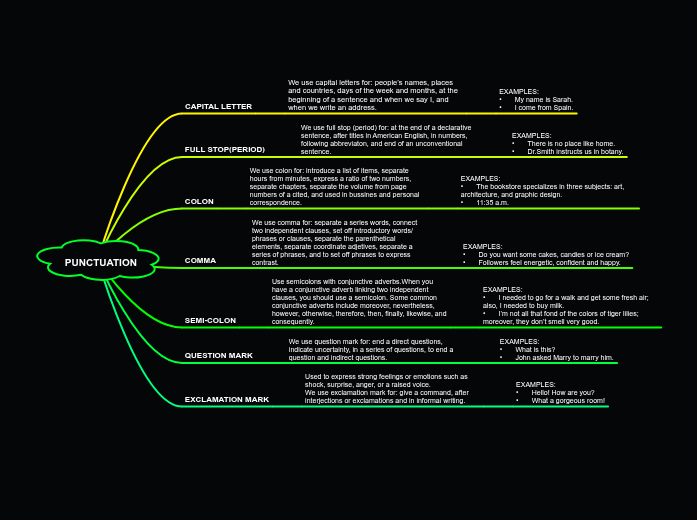
Used to express strong feelings or emotions such as shock, surprise, anger, or a raised voice. We use exclamation mark for: give a command, after interjections or exclamations and in informal writing.
EXAMPLES:
• Hello! How are you?
• What a gorgeous room!
QUESTION MARK
We use question mark for: end a direct questions, indicate uncertainty, in a series of questions, to end a question and indirect questions.
EXAMPLES:
• What is this?
• John asked Marry to marry him.
SEMI-COLON
Use semicolons with conjunctive adverbs.When you have a conjunctive adverb linking two independent clauses, you should use a semicolon. Some common conjunctive adverbs include moreover, nevertheless, however, otherwise, therefore, then, finally, likewise, and consequently.
EXAMPLES:
• I needed to go for a walk and get some fresh air; also, I needed to buy milk.
• I’m not all that fond of the colors of tiger lilies; moreover, they don’t smell very good.
COMMA
We use comma for: separate a series words, connect two independent clauses, set off introductory words/ phrases or clauses, separate the parenthetical elements, separate coordinate adjetives, separate a series of phrases, and to set off phrases to express contrast.
EXAMPLES:
• Do you want some cakes, candies or ice cream?
• Followers feel energetic, confident and happy.
COLON
We use colon for: introduce a list of items, separate hours from minutes, express a ratio of two numbers, separate chapters, separate the volume from page numbers of a cited, and used in bussines and personal correspondence.
EXAMPLES:
• The bookstore specializes in three subjects: art, architecture, and graphic design.
• 11:35 a.m.
FULL STOP(PERIOD)
We use full stop (period) for: at the end of a declarative sentence, after titles in American English, in numbers, following abbreviaton, and end of an unconventional sentence.
EXAMPLES:
• There is no place like home.
• Dr.Smith instructs us in botany.
CAPITAL LETTER
We use capital letters for: people’s names, places and countries, days of the week and months, at the beginning of a sentence and when we say I, and when we write an address.
EXAMPLES:
• My name is Sarah.
• I come from Spain.