
The English tenses demonstrate the time of actions centered around the subject of the sentence. Present tenses in English are: Present Simple, Present Continuous, Present Perfect Simple, and Present Perfect Continuous. Past tenses in English are: Past Simple, Past Continuous, Past Perfect Simple, Past Perfect Continuous. Future tenses in English are: Future Simple, Future Continuous, Future Perfect Simple, Future Perfect Continuous. Tenses demonstrate the time of actions centered around the subject of the sentence. These actions are called verbs and change according to tenses. There are four Future tenses: Future Perfect Simple is used for: Structure: Type in your own examples or you can also choose from the examples below. Structure: Type in your own examples or you can also choose from the examples below. Structure: Type in your own examples or you can also choose from the examples below. Future Perfect Simple is used for: Structure: Type in your own examples or you can also choose from the examples below. Structure: Type in your own examples or you can also choose from the examples below. Structure: Type in your own examples or you can also choose from the examples below. Future Continuous is used: Structure: Type in your own examples or you can also choose from the examples below. Structure: Type in your own examples or you can also choose from the examples below. Structure: Type in your own examples or you can also choose from the examples below. Future Simple is used: 'Going to' Future is used: Structure: Type in your own examples or you can also choose from the examples below. Structure: Type in your own examples or you can also choose from the examples below. Structure: Type in your own examples or you can also choose from the examples below. Future Simple with 'will'' is used: Structure: Type in your own examples or you can also choose from the examples below. Structure: Type in your own examples or you can also choose from the examples below. Structure: Type in your own examples or you can also choose from the examples below. There are four Past tenses: Past Perfect Continuous is used: Structure: Type in your own examples or you can also choose from the examples below. Structure: Type in your own examples or you can also choose from the examples below. Structure: Type in your own examples or you can also choose from the examples below. Past Perfect Simple is used for: Structure: Type in your own examples or you can also choose from the examples below. Structure: Type in your own examples or you can also choose from the examples below. Structure: Type in your own examples or you can also choose from the examples below. Past Continuous is used for: Structure: Type in your own examples or you can also choose from the examples below. Structure: Type in your own examples or you can also choose from the examples below. Structure: Type in your own examples or you can also choose from the examples below. Past simple expresses: Structure: Type in your own examples or you can also choose from the examples below. Structure: Type in your own examples or you can also choose from the examples below. Structure: Type in your own examples or you can also choose from the examples below. There are four Present tenses: Present Perfect Continuous is used: Structure: Type in your own examples or you can also choose from the examples below. Structure: Type in your own examples or you can also choose from the examples below. Structure: Type in your own examples or you can also choose from the examples below. Form of verb 'to have': Present Perfect is used for: Structure: Type in your own examples or you can also choose from the examples below. Form of word "to have": Structure: Type in your own examples or you can also choose from the examples below. Form of word "to have": Structure: Type in your own examples or you can also choose from the examples below. Form of verb 'to have': Present Continuous is used to indicate the ongoing time (now). Structure: Type in your own examples or you can also choose from the examples below. Form of word "to have": Structure: Type in your own examples or you can also choose from the examples below. Form of word "to have": Structure: Type in your own examples or you can also choose from the examples below. Form of verb 'to have': Present Simple is used for: Structure: Type in your own examples or choose from the examples below. Form of word "to have": Structure: Type in your own example or choose from the examples below. Form of word "to have": Structure: Examples Type in your own examples or you can also choose from the examples below. 思维导图可以帮助你集思广益,建立概念之间的关系,组织和产生想法。 然而,思维导图模板提供了一种更容易上手的方法,因为它们是包含特定主题信息和指导说明的框架。从本质上讲,思维导图模板确保了将特定主题的所有元素结合在一起的结构,并可作为个人思维导图的起点。思维导图模板是一种资源,可为创建特定主题的思维导图提供实用的解决方案,无论是用于商业还是教育。 Mindomo 为你带来智能思维导图模板,让你毫不费力地运作和思考。 您可以从Mindomo的商业或教育账户中选择各种思维导图模板,也可以从头开始创建自己的思维导图模板。任何思维导图都可以转化为思维导图模板,只需在其中一个主题上添加进一步的指导说明即可。关于此模板
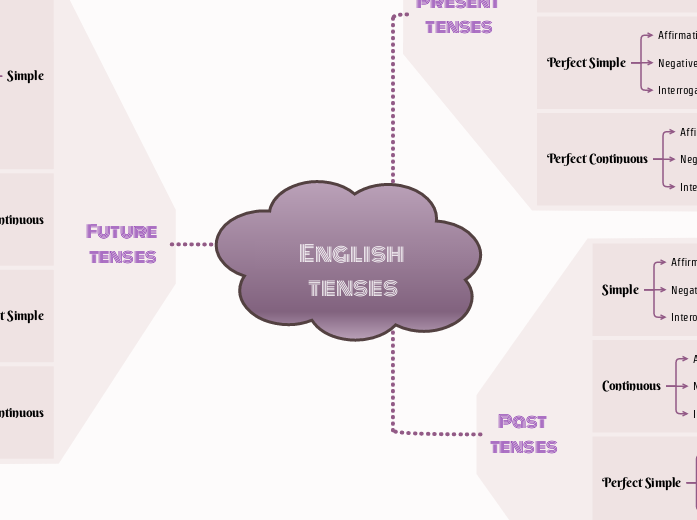
The English tenses
English tenses
Future tenses
Some adverbs used with Past Perfect Continuous for future actions:
Will + Subject + Have Been + Verb-ING
e.g. How long will they be working on that project next week?
Form of word "to be":
Form of word "to have":
Subject + Won’t Have Been + Verb-ING
e.g. They won’t have been working on that project for two years next week.
Form of word "to be":
Form of word "to have":
Subject + Will Have Been + Verb-ING
e.g. They will have been working on that project for two years next week.
Form of verb 'to be':
Form of verb 'to have':
Adverb used with Future Continuous:
Will + Subject + Have + Past Participle?
e.g. Will you have met your colleague by this time tomorrow?
Form of word "to be":
Form of word "to have":
Subject + Won’t Have + Past Participle
e.g. I won’t have met my friend form United States by this time tomorrow.
Form of word "to be":
Form of word "to have":
Subject + Will Have + Past Participle
e.g. I will have met my friend form United States by this time tomorrow.
Form of verb 'to be':
Form of verb 'to have':
Adverb used with Future Continuous:
Will + Subject + Be +Verb-ING?
e.g. Will you be having fun at the party?
Form of word "to be":
Form of word "to have":
Subject + Won’t Be + Verb-ING
e.g. He won’t be having fun at the party.
Form of word "to be":
Form of word "to have":
Subject + Will Be + Verb-ING
e.g. You will be having fun at the party.
Form of verb 'to be':
Form of verb 'to have': "Going to"
Some adverbs used with 'Going to' Future:
BE + Subject + going to + Infinitive Form of Verb?
e.g. Are you going to read the whole book over the weekend?
Form of word "to be":
Form of word "to have":
Subject + BE not + going to + Infinitive Form of Verb
e.g. He isn't going to spend his vacation in Hawaii.
Form of word "to be":
Form of word "to have":
Subject + BE (am/is/are) + going to + Infinitive Form of Verb
e.g. She’s going to be a professional dancer when she grows up.
Form of verb 'to be':
Form of verb 'to have': "Will"
Some adverbs used with Future Simple:
Will + Subject + V1(First Form of Verb)?
e.g. Will you see Mary when she comes back from Denmark?
Form of word "to be":
Form of word "to have":
Subject + Won’t (will not) + V1(First Form of Verb)
e.g. You won’t see Mary when she comes back from Denmark.
Form of word "to be":
Form of word "to have":
Subject + Will + V1(First Form of Verb)
e.g. I will see Mary when she comes back from Denmark.
Form of verb 'to be':
Form of verb 'to have': Past tenses
Some adverbs used with Past Perfect Continuous:
Had + Subject + been Verb-ING?
e.g. How long had they been living in London before moving here?
Form of word "to be":
Form of word "to have":
Subject + hadn’t been/had not been + Verb-ING
e.g. I was tired because I hadn't been sleeping.
Form of word "to be":
Form of word "to have":
Subject + had been + Verb-ING
e.g. They had been talking for over an hour before I arrived.
Form of verb 'to be':
Form of verb 'to have':
The Past Perfect tense is not normally used alone. It is used to denote the earlier of two past actions. We use Past Simple for the latter action.
Some adverbs used with Past Perfect Simple:
Had + Subject + Past Participle?
e.g. Had they met Sarah before the party?
Form of word "to be":
Form of word "to have":
Subject + hadn’t (had not) + Past Participle
e.g. They hadn’t met Julia before the party.
Form of word "to be":
Form of word "to have":
Subject + had + Past Participle
e.g. They had already met Julia before the party.
Form of verb 'to be':
Form of verb 'to have': Continuous
Some adverbs used with Past Continuous:
Was/ were + Verb-ING?
e.g. Were you studying when she called?
Form of word "to be":
Form of word "to have":
Subject + wasn’t (was not)/ weren’t (were not) + Verb-ING
e.g. You were not studying when she called.
Form of word "to be":
Form of word "to have":
Subject + was/ were + Verb-ING
e.g. You were studying when she called.
Form of verb 'to be':
Form of verb 'to have':
Some adverbs used with Past Simple: Interogative form
Did + subject + Base Form of the Verb?
e.g. Where did you meet her?
Form of word "to be":
Form of word "to have":
Subject + did not/didn’t + Base Form of the Verb
e.g. They didn’t like my food.
Form of word "to be":
Form of word "to have":
Subject + Verb in Past Simple (2nd form)
e.g. They lived in Spain three years ago.
Form of verb 'to be':
Form of verb 'to have': Present tenses
Perfect Continuous
Some adverbs used with Present Perfect Continuous:
Have/ has + Subject + been Verb-ING?
e.g. How long has he been learning German?
Form of word "to be":
Form of word "to have":
Subject + haven’t/hasn’t been + Verb-ING
e.g. She hasn’t been playing tennis for a long time.
Form of word "to be":
Form of word "to have":
Subject + have/ has been + Verb-ING
e.g. They have been learning French for two years.
Form of verb 'to be': Perfect Simple
Some adverbs used with Present Perfect:
Have/ has +Subject+ Past Participle?
e.g. Has she finished the letter?
Form of word "to be":
Subject + haven’t (have not)/ hasn’t (has not) + Past Participle
e.g. She hasn’t finished the letter.
Form of word "to be":
Subject + have/ has + Past Participle (3rd Form of the Verb)
e.g. She has finished the letter.
Form of verb 'to be': Cotinuous
Some adverbs used with Present Continuous:
BE + Subject + Verb-ING?
Are you eating now?
Form of word "to be":
Subject + BE not + Verb-ING
e.g. You are not eating now.
Form of word "to be":
Subject + BE (am/is/are) + Verb-ING
e.g. You are eating now.
Form of verb 'to be': Simple
Some adverbs used with Present Simple:Interrogative form
Do + Subject (I, You, We, They)+ V1 (First Form of Verb)?
Does + Subject (He, She, It)+V1 (First Form of Verb)?
e.g. Where does he work?
Form of word "to be":Negative form
Subject (I, You, We, They) + do not / don’t + V1 (First Form of Verb)
Subject (He, She, It) + does not / doesn’t + V1 (First Form of Verb)
e.g. He doesn’t work in a bank.
Form of word "to be": Affirmative form
Subject (I, You, We, They) + V1(First Form of Verb)
e.g. I usually go jogging at weekends.
Subject (He, She, It)+ V1(First Form of Verb) + s/es
e.g. She writes every day.
Form of verb "to be":
Form of verb "to have": 为什么使用 Mindomo 思维导图模板?
模板具有各种功能: