Oomycota
Charcateristic: Motile, heterotrophic or autotrophic, motile, large complex cells, move by cilia.
Ex. Crab, shrimp, any thing surrounding a little shell/ hard
PLANTS
Non Vascular
GYMNOSPERMS
Conifers
Christmas trees, Adaptation conserve H2O, needle or flat leaves reduce surface area, hold leaves all year long
Gnetophyte
Cycads
Ginkgo
SEED PLANTS
Anglosperm
Flowering plant, reproducing on land
SEEDLESS VASCULAR
Lycophytes
Pteridophytes
HORNWORTS
LIVERWARTS
MOSSES
Characteristic: Multicellular, contain chlorophyll, tissue, sexual fusion, develop from embryos, photosynthetic
CHORDATES
MAMMALS
PLACENTAL
Whose young nourished in the womb for an extended period of time
Ex. Bat, Rodents, Bear
MARSUPIALS
They give birth to relatively undeveloped young that often resides with the mother
Ex, Echidna, Ornithorhynchidae
Ex. Kangaroos, Koalas
MONOTREMES
Warm blooded, hair on body, produce milk, single bone lower jaw
Reptilia (Reptile) Amphabia ( Amphabians), Mammalia( Mammals) Aves ( Birds) Osteichthye ( Bony fish) Agnatha ( Jawless fish)
INTERBRATE: Discriptive without backbone
Vertabrate: Taxonomic With backbone
Characteristics: Hard exoskeleton made of ofchitin & protein, posses numerous jointed appendeges, must molt to grow.
ANIMALS
ARTHROPODS
Hexpods= Insects
Manadibles, Maxillia unironous, appendeges ( legs & Antenne)
Ex. Butterfly, bee, all types of insects
Chelicerats= Chelicerate
No antenne
Archid - Spiders, mite, Scorpion
Crustaceans = Malacotria
Mandibles
Uniramous Appendages- Legs, Antenne.
Maxipods- Mary legs
ECHINODERMS
We humans relate, 5 part symmetry, radial use to be bilateral, deuterostomes
Ex. star fish, sea urchin, brittle star fish
MOLLUSCA
Snails, squid, octopus, body plan, shells, foot
Ringed or segmented worms, earth worms, leeches
Annelids
NEMATODA
digestive system, body cavity, found in compose, mouth & anus, Solid builders.
Ex. ground worms
PLATYHELMINTHES
Bilateral, head and tail, nerve system, 3 tissue, no skeleton.
Ex. snails, flatworms
CNIDARIA
Radial symmetry, 2 tissue, 2 body forms, gastro cavity
Ex. jelly fish
PORIFERA
No mouth, pours, no symmetry, no tissue & skeleton lacking
Ex. sponges
FUNGI
BASIDIOMYCOTA
Spores bonne externally on a club shaped structure called basdium.
ASCOMYCOTA
Spores bonne externally in a sac called an ascus.
Sexual & asexual spores motile, with posterior flagella
ZYGOMYCOTA
Sexual spores are thick walled resting spores.
Characteristics: Eukaryotic, decomposers, non motile, no chlorophyll, related to animals.
Subtopic
CHYTRIDIOMYCOTA
PROTISTA
Plant Like
Euglanoids
Euglena
Rhodophyta
Red Algae
Fungi like
Watr Mold
Acellular slime mold: Rasberry slime mold
Cellular Sline Mold
Gly uga
The movement of cilia is paddle like, it sways back and forth for movement and fast beating of the cilia causes movement of the organism.
The movement in sarcodinians is by extending lobes of cytoplasm known as pseudopodia
the movement is When too much water collects in the cell, the vacuole move to the outer surface of the cell and squeezes out the water.
Animal Like
Sporozaoan
coccidia
Zooflagellates
Trypanosoma
Sarcodines: salt water of pseudopods, stand for false feet, reproduce, track food, 1 cell more advance. Ex: Amoeba proteus
Ciliates:paramecium, surrounded by tiny hair, very quick, food vacule move around. Ex. Mesodinium Chameleon
sporozoam: plasmodium, lives in the gut of a female, non motile. Ex plasmodium falciparum
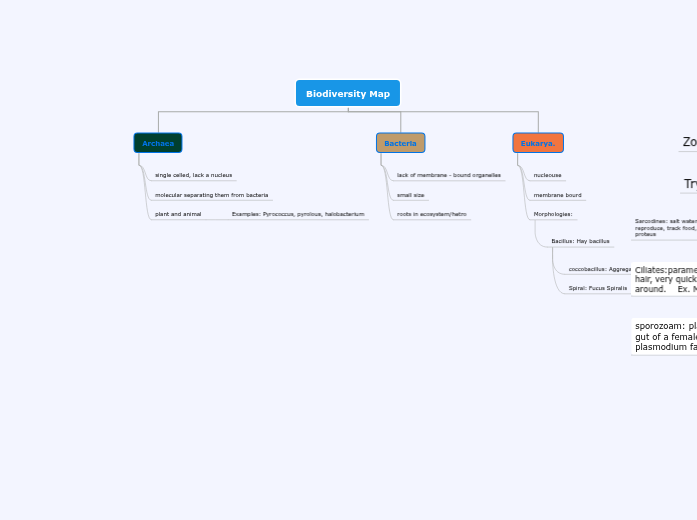
Biodiversity Map
Eukarya.
Morphologies:
Bacillus: Hay bacillus
Spiral: Fucus Spiralis
coccobacillus: Aggregatibacter
membrane bourd
nucleouse
Bacteria
roots in ecosystem/hetro
small size
lack of membrane - bound organelles
Archaea
plant and animal
Examples: Pyrococcus, pyrolous, halobacterium
molecular separating them from bacteria
single celled, lack a nucleus