In chemistry, reactions involve the breaking of existing chemical bonds and the formation of new ones. These reactions often start with reactants, which are the initial substances that undergo transformation, and result in products, the final substances formed.
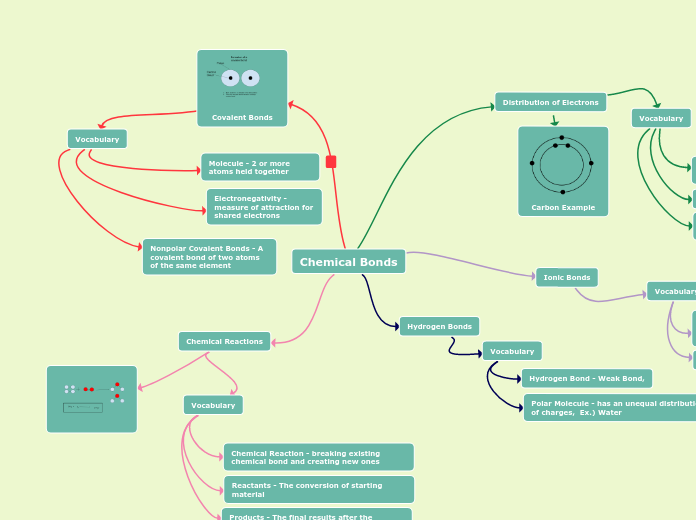
Nonpolar Covalent Bonds - A covalent bond of two atoms of the same element
Distribution of Electrons
Carbon Example
Hydrogen Bonds
Chemical Reaction - breaking existing chemical bond and creating new ones
Products - The final results after the conversion
Reactants - The conversion of starting material
Polar Molecule - has an unequal distribution of charges, Ex.) Water
Hydrogen Bond - Weak Bond,
Salt - Sodium Chloride
Electronegativity - measure of attraction for shared electrons
Molecule - 2 or more atoms held together
Covalent Bond - Shares electrons between them
Ionic Bond - the transfer of electrons
Chemical Bonds - Allow atoms to stay close together
Chemical Bonds
Chemical Reactions
Ionic Bonds
Ion- - an atom or molecule with an electrical charge resulting from - or + of 1 or more electrons