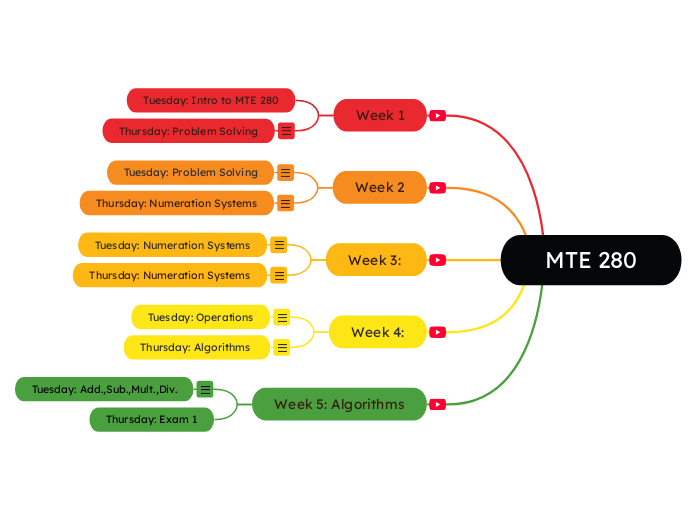
MTE 280
Week 5: Algorithms
Thursday: Exam 1
Tuesday: Add.,Sub.,Mult.,Div.
Addition algorithms
- American Standard
- right to left
- No reference to place value
- This is the last step
- Partial sums
- add the partial sums with Use of columns
- No reference to place value
- Right to left
- Add place value to partial sums
- talk about the Values being added
- Right to left
- Reference to place value with columns
- Left to right
- solve the equation from left to right using place values
- expanded notation
- use expanded notation and knowledge of place values to solve equation
- Lattice Method
- The numbers are written in columns to find the final sum
Subtraction algorithms
- American Standard
- reverse Indian
- left to right
- No reference to place value
- left to right
- add place value
- Adjust numbers for borrowing
- expanded notation
- use expanded notation and knowledge of place values to solve the equation
- integer sub algorithm
- using integers , Positive and negative numbers
- use place values
Multiplication algorithms
- American Standard
- Place value
- Expanded notation
- lattice Method
Week 4:
Thursday: Algorithms
Division:
there are three different signs to division
There is a divisor quotient dividend, and remainder
Long division algorithm:
Teach this when students can explain what they are doing with the method of place values with manipulative. you turn the remaining hundreds into tens and turn the remaining 10’s into 1’s
And alternative algorithm you can use is by asking yourself how many boxes can fit into the number given
Tuesday: Operations
Additional meaning and properties
Identity: a+o=a *When I add zero to any number, the number does not change
Commulative: a+b=b+a *The order does not matter
Associative: (a+b)+c = a+(b+c) * the way you group does not matter
Subraction:
- take away 4-3=1
- comparison
- missing addend
as adults, we subtract, as kids, we add
Multiplication
3x4: 3 groups of 4
3 and 4 are factors ,12 is the product
repeated addition:
telling time
SKIP counting
Cartesian product: combining groups
Properties:
- identity ax1=a when I multiply by one, the identity does not change
- Commutative: Order axb=bxa The order in which I multiply does not matter
- Associative: grouping (axb)xc=ax(bxc) The way we group the problems is not matter
- zero: Any number multiplied by zero equals zero
- distributive: When I multiply a number by the sum of two other numbers, it is the same as multiplying the number by each addend
Week 3:
Thursday: Numeration Systems
Continuation numeration systems
base-2:
ones-2^0
twos-2^1
fours-2^2
eights-2^3
sixteens-2^4
digits: 0,1
practice: 1111 base 2= (1x2^3)+(1x2^2)+(1x2^1)+(1x2^0)=15
- 43 base 3 > 25 base 5
- 4 base 5 = 4 base 6
- 111 base 2 = 7
- 100 base 2 < 18 base 9
Tuesday: Numeration Systems
Continuing numeration systems
base-3:
ones- 3^0
threes-3^1
nines-3^2
27’s-3^3
practice:
1222 base 3= ((1x3^3)+(2x3^2)+(2x3^1)+(2x3^0)=53
Base 5 Digits Used: 0, 1, 2, 3, 4 Expanded: ones 5^01 1 1 base 5 fives5^1| | ones 25s 5^2 l fives
125s
5^3 25s
111 base 5: (1×5^2) + (1 x511) + (1 x510)
111 base 5: (1 x 25) + (1 x 5) + (1 x 1)
111 base 5:25 + 5 + 1 = 31
1023 base 5: (1 x 513) + (0 x 5^2) + (2 x 511) + (3 x 510)
1023 base 5: (1 x 125) + (0 x 25) + (2 x 5) + (3 x 1)
1023 base 5: 125 + 0 + 10 + 3 = 138
Use Manipulatives to help you
XX XX XX XX
XX XX XX XX
XX X
Week 2
Thursday: Numeration Systems
Numeration Systems: A way of recording quantity
Base-10 system/decimal system
Numbers get value from the place they sit
- 1-10 relationship between places
- 1-10 relationship is always there
Digits used in Base-10: 0,1,2,3,4,5,6,7,8,9
 Expanded Notation: 375
300+70+5=375 =(3x100)+(7x10)+(5x1)= (3x10^2)+(7x10^1)+(5x10^0)
Example:
1078 = 1000 + 0 + 70 + 8
1078 = (1 x 1000) + (0 x 100) + (7 x 10) + (8 x 1)
1078= (1 x 10¹³) + (0x10^2) + (7×10¹¹) + (8 x 10¹⁰)
Base-5:
ones- 5^0
fives- 5^1
25’s- 5^2
125’s- 5^3
digits used in base-5: 0,1,2,3,4
Base-10:
ones- 10^0
tens- 10^1
100’s- 10^2
1000’s- 10^3
practice:
111 base 5: (1×5^2) + (1 x511) + (1 x510)
111 base 5: (1 x 25) + (1 x 5) + (1 x 1)
111 base 5:25 + 5 + 1 = 31
1023 base 5: (1 x 513) + (0 x 5^2) + (2 x 511) + (3 x 510)
1023 base 5: (1 x 125) + (0 x 25) + (2 x 5) + (3 x 1)
1023 base 5: 125 + 0 + 10 + 3 = 138
practice: 375. 25
Related to Money:
- 3 $100 bills
- 7 $10 bills
- 5 $1 bills
- 2 dimes
- 5 pennies (1/10 of a dime)
Tuesday: Problem Solving
Problem Solving:
George Polya “How to Solve it”
- understand
- Devise plan
- Carry out
- Look back
Use children in practice problem as manipulatives and act the problem out
one person cancels out every time
find patterns
make combinations
organize info to find patterns
Week 1
Thursday: Problem Solving
Problems Solving:
- understand
- devise plan
- implement plan
Practice Problems: Time and Manipulatives
- look back and ask if it is reasonable
- work backwards
Tuesday: Intro to MTE 280