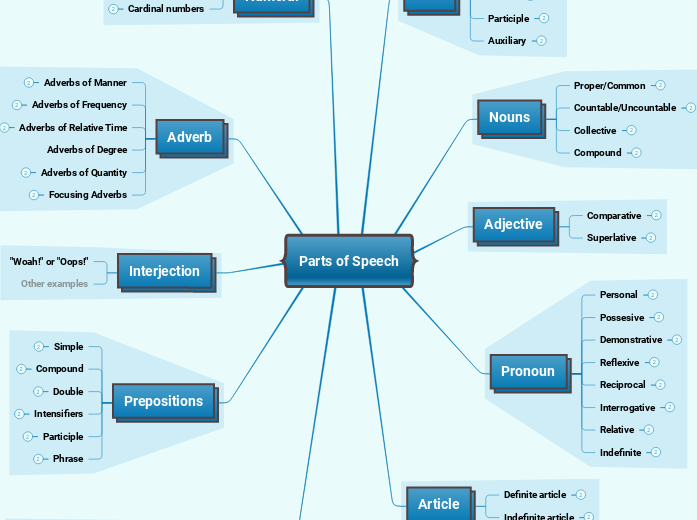
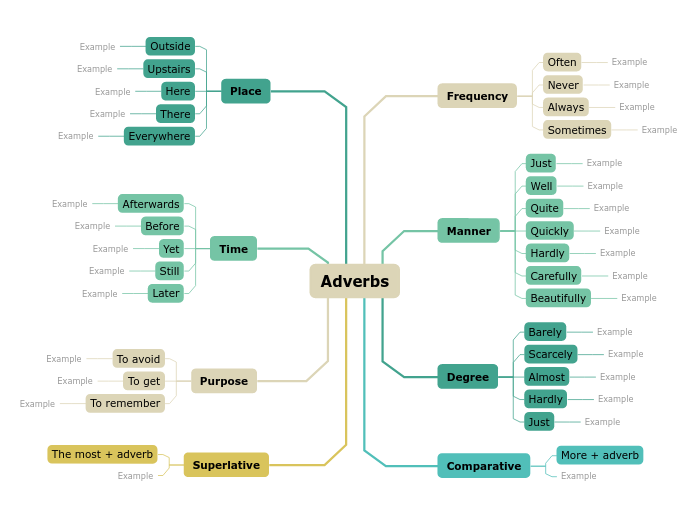
Use this mind map to improve your understanding of how adverbs are used and practice by creating different contexts. Adverbs are the parts of speech that describe verbs, adjectives, or other adverbs, phrases, clauses, or sentences. There are different types of adverbs: Adverbs of frequency present how frequently or how often verbs happen. Some examples of adverbs of frequency are: Adverbs of manner provide information about the way the verb is done. Some examples of adverbs of manner are: Adverbs of degree provide information about the level of intensity of verbs, adjectives, or other adverbs. Some examples of adverbs of degree are: Comparative adverbs are used to show change or make comparisons. Comparative adverbs are formed by adding the word ‘more’ to adverbs. Adverbs of purpose express the reason of verbs. Some examples of adverbs of purpose are: Adverbs of time offer information about the time when the verb takes place. Some examples of time adverbs are: Adverbs of place offer information about the place where the verb takes place. Some examples of adverbs of place are: Adverbs are words or expressions that modify a verb, adjective, another adverb, determiner, clause, preposition, or sentence. Adverbs typically express manner, place, time, frequency, degree, level of certainty, etc. Compares three or more things or people, usually is compounded of the words 'the most' plus adverb. Answers the question: Answers the question: Answers the question: Compares two things or people, usually is compounded of the word 'more' plus adverb. Answers the question: Answers the question: Answers the question: Write phrases as examples. Los mapas mentales ayudan a hacer lluvias de ideas, establecer relaciones entre conceptos y organizar y generar ideas. Las plantillas de mapas mentales ofrecen además una forma más fácil de empezar, ya que son estructuras que contienen información sobre un tema concreto junto con instrucciones orientativas. En esencia, las plantillas de mapas mentales aportan una estructura que reúne todos los elementos de un tema y sirven como punto de partida para tu propio mapa mental. Son un recurso práctico para crear un mapa mental sobre un tema concreto, ya sea en el ámbito empresarial o en el educativo. Mindomo te ofrece plantillas de mapas mentales inteligentes que te permiten trabajar y pensar sin esfuerzo. Puedes elegir entre una gran variedad de plantillas de mapas mentales de las cuentas empresariales o educativas de Mindomo, o crear tus propias plantillas desde cero. Cualquier mapa mental puede convertirse en una plantilla añadiendo notas orientativas a uno de sus temas.English Adverbs Examples
Acerca de esta plantilla
Adverbs
Adverbs
Superlative
The most + adverb
Purpose
To remember
To get
To avoid
Time
Later
Still
Yet
Before
Afterwards
Place
Everywhere
There
Here
Upstairs
Outside
Comparative
More + adverb
Degree
Almost
Scarcely
Barely
Manner
Beautifully
Carefully
Hardly
Quickly
Quite
Well
Just
Frequency
Sometimes
Always
Never
Often
Example
¿Por qué usar una plantilla de mapa mental de Mindomo?
Una plantilla tiene varias funciones:
-
Productos
-
Usos
- Usos generales
- Mapas mentales para la educación
- Mapas mentales para empresas
- Mapas mentales para el desarrollo personal
- Tecnología asistida
- Colaboración en equipo
- Briefs de campaña para profesionales de marketing
- Talleres de descubrimiento de clientes para consultores
- Recorridos de onboarding para RR. HH. y L&D
- Gestión del conocimiento
- Matriz de competencias del equipo
- Biblioteca de proyectos
- Roles
- Profesionales de marketing
- RR. HH. y L&D
- Consultores
- Gestión de proyectos
- Planificación de campañas de marketing
- Planes de formación para empleados
- Alcance del trabajo
- Organización de ideas
- Árboles de problemas
- Análisis de necesidades de formación
- Beneficios de los mapas mentales
-
Soluciones
- Guías
- Hacer presentaciones con mapas mentales
- Aprender con mapas mentales
- Planificar y organizar con mapas mentales
- Priorizar tareas con mapas mentales
- Tomar notas con mapas mentales
- Historias reales de clientes
- Escalar contenido educativo para 11.000 médicos
- Flujo de trabajo en equipo: de la prueba a herramienta imprescindible en dos meses
- 10 años sin diapositivas: repensar las clases de arquitectura
- Leer todas las historias
-
Recursos
- Aprende lo básico
- Los 29 mejores ejemplos de mapas mentales
- Programa de Gantt
- ¿Cómo hacer un mapa mental?
- Cómo hacer un diagrama de Gantt
- Guías y soporte
- Tutoriales en video
- Centro de ayuda
- Foro
- Ejemplos y plantillas
- ¿Qué es un mapa conceptual?
- Creador de mapas conceptuales
- Plantilla de mapa conceptual
- Plantillas de diagramas
- Páginas de funciones
- Educación
- Tareas para profesores
- Trabajo y uso personal
- Escritorio
- El blog de Mindomo
- Precios
- Iniciar sesión
- Registrarse
- Panel de control
Gestión del conocimiento
Beneficios de los mapas mentales
Por qué el pensamiento visual facilita recordar y planificar.
Aprende lo básico
Guías y soporte
Ejemplos y plantillas
Páginas de funciones
 Blog
El blog de Mindomo
Guías, ejemplos e investigación sobre el pensamiento visual.
Ver todos los artículos