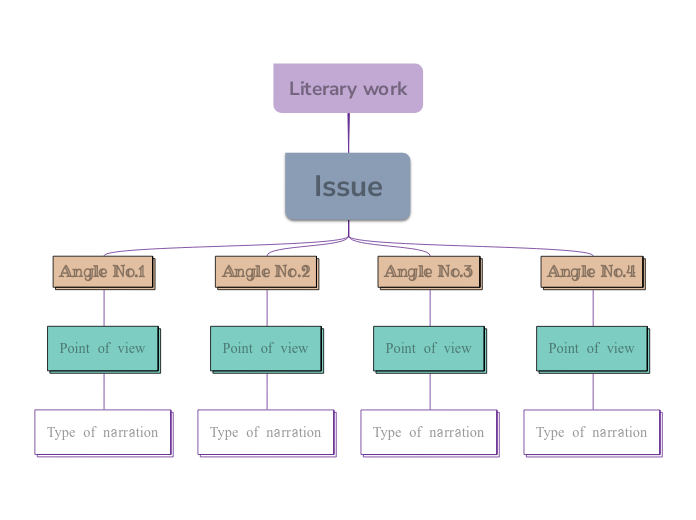
This mind map will help you discover the multiple perspectives from which you can analyze an issue from your literary work. Identifying multiple author’s perspectives can be difficult if you do not organize your ideas. Use this mind map template to look at an issue from four different angles. Type in the name of the multiple-perspectives text. Identify an important issue from the text that is being presented from different angles. Type it in. Decide on the fourth point of view Point of view How is the viewpoint introduced in the story? Whose character does the third point of view belong to? What does the character think, say or do that suggests their perspective on the issue? What kind of narration introduces the viewpoint? Decide on the second point of view Type in a quote that points out the character's position about the issue. How is the viewpoint introduced in the story? Decide on the first point of view you are going to present. Type in a relevant quote that highlights the character's point of view towards Type of narration What type of narration introduces the viewpoint? Los mapas mentales ayudan a hacer lluvias de ideas, establecer relaciones entre conceptos y organizar y generar ideas. Las plantillas de mapas mentales ofrecen además una forma más fácil de empezar, ya que son estructuras que contienen información sobre un tema concreto junto con instrucciones orientativas. En esencia, las plantillas de mapas mentales aportan una estructura que reúne todos los elementos de un tema y sirven como punto de partida para tu propio mapa mental. Son un recurso práctico para crear un mapa mental sobre un tema concreto, ya sea en el ámbito empresarial o en el educativo. Mindomo te ofrece plantillas de mapas mentales inteligentes que te permiten trabajar y pensar sin esfuerzo. Puedes elegir entre una gran variedad de plantillas de mapas mentales de las cuentas empresariales o educativas de Mindomo, o crear tus propias plantillas desde cero. Cualquier mapa mental puede convertirse en una plantilla añadiendo notas orientativas a uno de sus temas.Narrative Points of View
Acerca de esta plantilla
Identifying Multiple author’s perspectives
Literary work
Example: Bridge to Terabithia by Katherine PatersonIssue
Example: Jesse's drawing talent.Angle No.4
Type in the name of the last character whose perspective on the issue you are going to present.
Example: Leslie Burke, Jesse's new next-door neighbor, and best friend.
Type in a relevant quote that highlights the character's point of view. Try to follow a citation format: author's name, chapter, and page.
Example: I can't get the poetry of the trees,' he said. She nodded. Don't worry,' she said. You will someday. He believed her.' (Paterson, 4. 24)
Choose an answer:Angle No.3
Type in his/her name.
Example: Mr. Aarons, Jesse's father.
Type in a quote and try to maintain the citation format.
Example: 'He would like to show his drawings to his dad, but he didn't dare. (...) He'd thought his dad would be pleased. He wasn't. What are they teaching in that damn school? he had asked.' (Paterson, 2.8)
Choose an answer:Angle No.2
Name the character (it can either be the main character or one of the supporting characters) whose point of view you are presenting.
Example: Miss Edmunds, Jesse's music teacher.
Try to follow a citation format: author's name, chapter, and page.
Example: 'She said he was unusually talented, and she hoped he wouldn't let anything discourage him.' (Paterson, 2. 8)
Choose an answer:Angle No.1
Type in the name of the character (it can either be the main character or one of the supporting characters) whose point of view belongs to.
Example: Jesse Oliver Aarons, Jr., the main character of the novel, a fifth-grader living in a rural Southern area.Point of view
Issue.
Try following a citation format: author's name, chapter, and page.
Example: 'Jesse drew the way some people drank whiskey. (...) Lord, he loved to draw. (...) When he was in first grade, he told his father that he wanted to be an artist when he grew up.' (Paterson, 2. 7)
Choose an answer:¿Por qué usar una plantilla de mapa mental de Mindomo?
Una plantilla tiene varias funciones:
-
Productos
-
Usos
- Usos generales
- Mapas mentales para la educación
- Mapas mentales para empresas
- Mapas mentales para el desarrollo personal
- Tecnología asistida
- Colaboración en equipo
- Briefs de campaña para profesionales de marketing
- Talleres de descubrimiento de clientes para consultores
- Recorridos de onboarding para RR. HH. y L&D
- Gestión del conocimiento
- Matriz de competencias del equipo
- Biblioteca de proyectos
- Roles
- Profesionales de marketing
- RR. HH. y L&D
- Consultores
- Gestión de proyectos
- Planificación de campañas de marketing
- Planes de formación para empleados
- Alcance del trabajo
- Organización de ideas
- Árboles de problemas
- Análisis de necesidades de formación
- Beneficios de los mapas mentales
-
Soluciones
- Guías
- Hacer presentaciones con mapas mentales
- Aprender con mapas mentales
- Planificar y organizar con mapas mentales
- Priorizar tareas con mapas mentales
- Tomar notas con mapas mentales
- Historias reales de clientes
- Escalar contenido educativo para 11.000 médicos
- Flujo de trabajo en equipo: de la prueba a herramienta imprescindible en dos meses
- 10 años sin diapositivas: repensar las clases de arquitectura
- Leer todas las historias
-
Recursos
- Aprende lo básico
- Los 29 mejores ejemplos de mapas mentales
- Programa de Gantt
- ¿Cómo hacer un mapa mental?
- Cómo hacer un diagrama de Gantt
- Guías y soporte
- Tutoriales en video
- Centro de ayuda
- Foro
- Ejemplos y plantillas
- ¿Qué es un mapa conceptual?
- Creador de mapas conceptuales
- Plantilla de mapa conceptual
- Plantillas de diagramas
- Páginas de funciones
- Educación
- Tareas para profesores
- Trabajo y uso personal
- Escritorio
- El blog de Mindomo
- Precios
- Iniciar sesión
- Registrarse
- Panel de control
Gestión del conocimiento
Beneficios de los mapas mentales
Por qué el pensamiento visual facilita recordar y planificar.
Aprende lo básico
Guías y soporte
Ejemplos y plantillas
Páginas de funciones
 Blog
El blog de Mindomo
Guías, ejemplos e investigación sobre el pensamiento visual.
Ver todos los artículos
Blog
El blog de Mindomo
Guías, ejemplos e investigación sobre el pensamiento visual.
Ver todos los artículos