This mind map template helps you organize and balance the key elements of a business case, including advantages, costs, and risks, to justify your project or proposal. Start by outlining the project's objectives, followed by a detailed analysis of the potential benefits, associated costs, and any risks involved. Use the template to ensure all aspects are thoroughly considered, providing a solid foundation for decision-making. Ideal for project planning and proposals, this template helps you present a clear and persuasive business case. Where to next? Enter the business case title Add an advantage of taking the recommended action. Add an advantage of taking minimum action. Add the advantage of taking no action. How will the benefits of 'Advantage' be measured? Add a disadvantage of taking the recommended action. Add a disadvantage of taking the minimum action. Add a disadvantage of taking no action. KPI How will the disadvantages of 'Disadvantage' be measured? Add a operating cost needed to sustain the effectiveness of the proposed project or change. Capital costs Type in a risk of Project or Action Controls What steps are you taking to control 'Risk'? Add an action to be taken in order to follow the recommended route. Add an action to take or an item that will not change. Add an unchanged item What assumptions is the recommended action based upon? Add an organizational strategy to which this decision relates, either positively or negatively. Strategic alignment What methods were used? Add a stakeholder What was the need behind this project or proposal? What are the next steps you need to take, if approval is given? Return on investment Summarise the key benefits that will be obtained. Type in the proposed action in a few words Type in a summary of your recommendations: Decisions required Audience Los mapas mentales ayudan a realizar lluvias de ideas, establecer relaciones entre conceptos, organizar y generar ideas. Sin embargo, las modelos de mapas mentales ofrecen una forma más fácil de empezar, ya que son estructuras que contienen información sobre un tema específico con instrucciones orientativas. En esencia, las modelos de mapas mentales garantizan la estructura que combina todos los elementos de un tema específico y sirven como punto de partida para su mapa mental personal. Son un recurso que proporciona una solución práctica para crear un mapa mental sobre un tema concreto, ya sea para los negocios o para la educación. Mindomo le ofrece modelos de mapas mentales inteligentes que le permiten funcionar y pensar sin esfuerzo. Puede elegir entre una variedad de modelos de mapas mentales de las cuentas empresariales o educativas de Mindomo, o puede crear sus propios modelos de mapas mentales desde cero. Cualquier mapa mental puede transformarse en un mapa plantilla añadiendo notas orientativas a uno de sus temas.Business Case Template
A business case is built upon a balance between advantages, costs, and risks.
This mind map helps you plan and structure a Business Case, to justify a project or proposal.
Keywords: business case, communication, project, proposal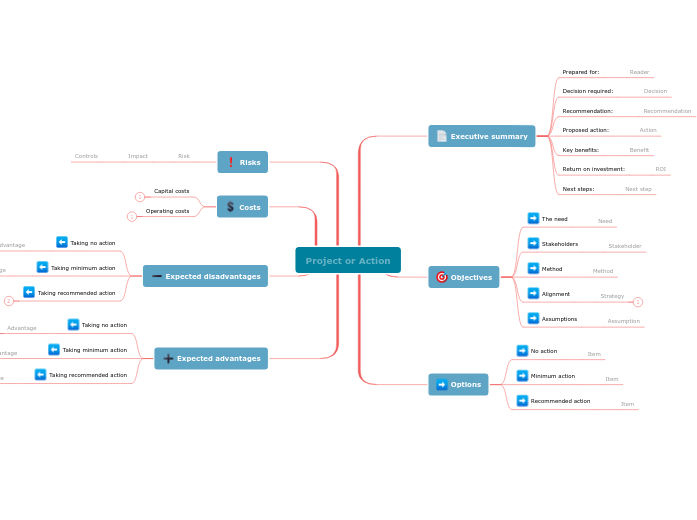
Structure a Business Case - Template
Where to next?
Since you have completed the outline of your business case, you can now Print or Download it or Share it with a colleague.Project or Action
Type in the project or proposed action.Expected advantages
For example:
For example:Advantage
For example:
Is this a tangible or intangible effect?
What KPI will be used?Expected disadvantages
Taking recommended action
For example:Taking minimum action
For example:Taking no action
Disadvantage
For example:
Is this a tangible or intangible effect? What KPI will be used?Costs
Operating costs
Include:Capital costs
Cost
Add a one-time capital expenditure needed for this project.
Include:Risks
Risk
Impact
How can you reduce the chances of it occurring? How can you reduce its impact if it does occur?Options
Recommended action
Identify which actions are essential and which are optional.Minimum action
Include:No action
Item
Identify something that will not change if no action is taken.
For example, 'Continue to use manual process' or 'Continue to tolerate losses in this segment'Objectives
Assumptions
Assumption
What do you expect to change or continue to change? What do you expect to stay the same?Alignment
Strategy
How does 'Project or Action' align with 'Strategy'?
Add notes about whether the proposed action supports this strategy or diverges from it.Method
Add some information about the methods used to determine the proposed action.
Include:Stakeholders
Stakeholder
Stakeholders are people who are involved in or affected by the decision to be made here.
Include:The need
Need
What problem does it solve, or what opportunity does it address?Executive summary
Next steps:
Next step
Return on investment:
ROI
Summarise how the investment will be repaid.Key benefits:
Benefit
Proposed action:
Action
Summarise the main points of the proposed action plan.
Mention:Recommendation:
Recommendation
Decision required:
Decision
What decision needs to be taken? Do you need the approval to proceed to the next stage?Prepared for:
Reader
Add a reader by role or name for this business case. This should be someone who can directly authorize the project or proposed action.¿Por qué utilizar una modelo de mapa mental Mindomo?
Una plantilla tiene varias funcionalidades: