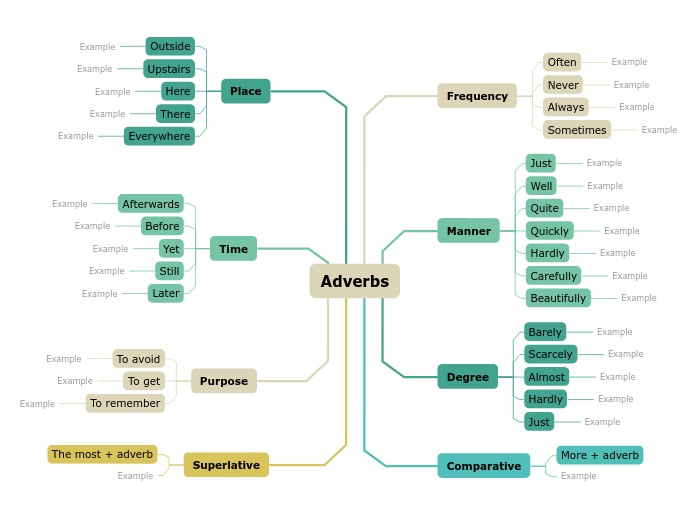
Adverbs are the parts of speech that describe verbs, adjectives, or other adverbs, phrases, clauses, or sentences. There are different types of adverbs: Adverbs of frequency Adverbs of manner Adverbs of degree Comparative adverbs Superlative adverbs Purpose adverbs Time adverbs Place adverbs Adverbs of frequency present how frequently or how often verbs happen. Some examples of adverbs of frequency are: Often Never Always Sometimes Adverbs of manner provide information about the way the verb is done. Some examples of adverbs of manner are: Just Well Quite Quickly Hardly Carefully Beautifully Adverbs of degree provide information about the level of intensity of verbs, adjectives, or other adverbs. Some examples of adverbs of degree are: Barely Scarcely Almost Hardly Just Comparative adverbs are used to show change or make comparisons. Comparative adverbs are formed by adding the word ‘more’ to adverbs. Adverbs of purpose express the reason of verbs. Some examples of adverbs of purpose are: To avoid To get To remember Adverbs of time offer information about the time when the verb takes place. Some examples of time adverbs are: Afterwards Before Yet Still Later Adverbs of place offer information about the place where the verb takes place. Some examples of adverbs of place are: Outside Upstairs Here There Everywhere Adverbs are words or expressions that modify a verb, adjective, another adverb, determiner, clause, preposition, or sentence. Adverbs typically express manner, place, time, frequency, degree, level of certainty, etc. Compares three or more things or people, usually is compounded of the words 'the most' plus adverb. Answers the question: Answers the question: Answers the question: Compares two things or people, usually is compounded of the word 'more' plus adverb. Answers the question: Answers the question: Answers the question: Write phrases as examples. Mapy myśli pomagają w burzy mózgów, w dostrzeganiu powiązań między pojęciami oraz w porządkowaniu i generowaniu pomysłów. Szablony map myśli ułatwiają jednak start, bo zawierają gotowy szkielet z informacjami na dany temat i wskazówkami, jak go uzupełnić. Zapewniają strukturę, która łączy wszystkie elementy tematu i służy jako punkt wyjścia dla twojej własnej mapy myśli. To praktyczne rozwiązanie, gdy chcesz szybko stworzyć mapę myśli na konkretny temat – zarówno w biznesie, jak i w edukacji. Mindomo oferuje inteligentne szablony map myśli, dzięki którym praca i myślenie przychodzą bez wysiłku. Możesz wybierać spośród szablonów map myśli dostępnych na kontach biznesowych i edukacyjnych Mindomo albo tworzyć własne szablony od podstaw. Każdą mapę myśli możesz zamienić w szablon, dodając do jej tematów notatki ze wskazówkami.O tym szablonie
Adverbs
Adverbs
Superlative
The most + adverb
Purpose
To remember
To get
To avoid
Time
Later
Still
Yet
Before
Afterwards
Place
Everywhere
There
Here
Upstairs
Outside
Comparative
More + adverb
Degree
Almost
Scarcely
Barely
Manner
Beautifully
Carefully
Hardly
Quickly
Quite
Well
Just
Frequency
Sometimes
Always
Never
Often
Example
Dlaczego warto używać szablonów map myśli Mindomo?
Szablony oferują różne funkcje:
-
Produkty
-
Zastosowania
- Zastosowania ogólne
- Mapy myśli dla edukacji
- Mapy myśli dla biznesu
- Mapy myśli dla rozwoju osobistego
- Technologia wspomagająca
- Współpraca zespołowa
- Briefy kampanii dla marketerów
- Warsztaty rozpoznania potrzeb klienta dla konsultantów
- Ścieżki onboardingu dla HR i L&D
- Zarządzanie wiedzą
- Matryca kompetencji zespołu
- Biblioteka projektów
- Role
- Marketerzy
- HR i L&D
- Konsultanci
- Zarządzanie projektami
- Planowanie kampanii marketingowych
- Wdrażanie szkoleń dla pracowników
- Zakres prac
- Organizacja pomysłów
- Drzewa problemów
- Analiza potrzeb szkoleniowych
- Korzyści z mapowania myśli
-
Rozwiązania
- Przewodniki
- Twórz prezentacje z mapami myśli
- Ucz się z mapami myśli
- Planuj i organizuj z mapami myśli
- Ustalaj priorytety zadań z mapami myśli
- Rób notatki z mapami myśli
- Prawdziwe historie klientów
- Skalowanie treści edukacyjnych dla 11 000 lekarzy
- Praca zespołu: od wersji próbnej do niezbędnego narzędzia w dwa miesiące
- 10 lat bez slajdów: nowe podejście do wykładów z architektury
- Przeczytaj wszystkie historie
-
Zasoby
- Podstawy
- Co to jest mapa myśli?
- Jak tworzyć mapy myśli?
- Poradniki i pomoc
- Samouczki wideo
- Centrum pomocy
- Forum
- Przykłady i szablony
- Top 29 przykładów map myśli
- Co to jest mapa pojęć?
- Strony funkcji
- Edukacja
- Zadania dla nauczycieli
- Praca i życie prywatne
- Wersja desktopowa
- Blog Mindomo
- Cennik
- Zaloguj się
- Zarejestruj się
- Panel główny
Zarządzanie wiedzą
Korzyści z mapowania myśli
Dlaczego myślenie wizualne ułatwia zapamiętywanie i planowanie.
Poradniki i pomoc
Przykłady i szablony
Strony funkcji
 Blog
Blog Mindomo
Poradniki, przykłady i badania dotyczące myślenia wizualnego.
Przeglądaj wszystkie artykuły