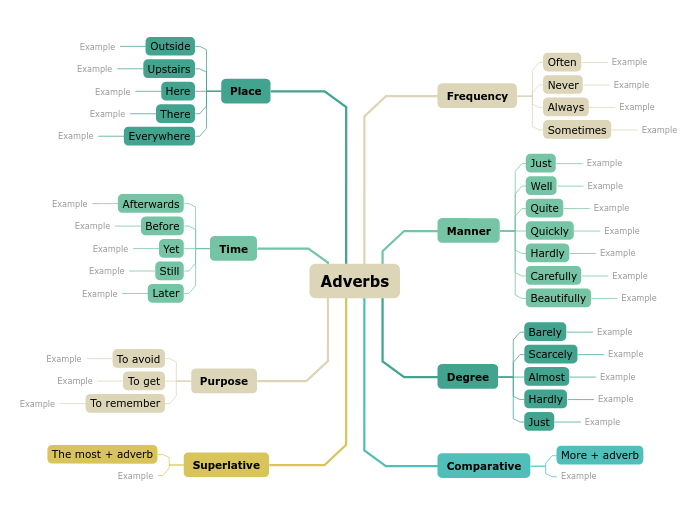
Adverbs are the parts of speech that describe verbs, adjectives, or other adverbs, phrases, clauses, or sentences. There are different types of adverbs: Adverbs of frequency present how frequently or how often verbs happen. Some examples of adverbs of frequency are: Adverbs of manner provide information about the way the verb is done. Some examples of adverbs of manner are: Adverbs of degree provide information about the level of intensity of verbs, adjectives, or other adverbs. Some examples of adverbs of degree are: Comparative adverbs are used to show change or make comparisons. Comparative adverbs are formed by adding the word ‘more’ to adverbs. Adverbs of purpose express the reason of verbs. Some examples of adverbs of purpose are: Adverbs of time offer information about the time when the verb takes place. Some examples of time adverbs are: Adverbs of place offer information about the place where the verb takes place. Some examples of adverbs of place are: Adverbs are words or expressions that modify a verb, adjective, another adverb, determiner, clause, preposition, or sentence. Adverbs typically express manner, place, time, frequency, degree, level of certainty, etc. Compares three or more things or people, usually is compounded of the words 'the most' plus adverb. Answers the question: Answers the question: Answers the question: Compares two things or people, usually is compounded of the word 'more' plus adverb. Answers the question: Answers the question: Answers the question: Write phrases as examples. Miellekarttojen avulla voit ideoida, hahmottaa käsitteiden välisiä suhteita sekä järjestää ja tuottaa ideoita. Miellekarttamallien avulla alkuun pääsee kuitenkin helpommin: ne ovat valmiita runkoja, jotka sisältävät tietoa tietystä aiheesta sekä ohjeita kartan täydentämiseen. Malli antaa rakenteen, joka kokoaa yhteen aiheen kaikki osa-alueet ja toimii lähtökohtana omalle miellekartallesi. Se on käytännöllinen tapa luoda miellekartta tietystä aiheesta niin työelämän kuin opiskelun tarpeisiin. Mindomon älykkäiden miellekarttamallien avulla ajattelet ja toimit vaivattomasti. Voit valita erilaisia miellekarttamalleja Mindomon yritys- ja koulutustileiltä tai luoda omia malleja tyhjästä. Minkä tahansa miellekartan voi muuttaa malliksi lisäämällä sen aiheisiin ohjaavia muistiinpanoja.Tietoja tästä mallista
Adverbs
Adverbs
Superlative
The most + adverb
Purpose
To remember
To get
To avoid
Time
Later
Still
Yet
Before
Afterwards
Place
Everywhere
There
Here
Upstairs
Outside
Comparative
More + adverb
Degree
Almost
Scarcely
Barely
Manner
Beautifully
Carefully
Hardly
Quickly
Quite
Well
Just
Frequency
Sometimes
Always
Never
Often
Example
Miksi käyttää Mindomon miellekarttamallia?
Malleissa on useita toimintoja:
-
Tuotteet
-
Käyttötarkoitukset
- Yleiset käyttötarkoitukset
- Miellekartat koulutukseen
- Miellekartat liiketoimintaan
- Miellekartat henkilökohtaiseen kehitykseen
- Apuvälineteknologia
- Tiimiyhteistyö
- Kampanjabriefit markkinoijille
- Asiakastarpeiden kartoitustyöpajat konsulteille
- Perehdytyspolut HR:lle ja L&D:lle
- Tietämyksenhallinta
- Tiimin osaamismatriisi
- Projektikirjasto
- Roolit
- Markkinoijat
- HR ja L&D
- Konsultit
- Projektinhallinta
- Markkinointikampanjan suunnittelu
- Henkilöstökoulutusten jalkautus
- Työn laajuuden määrittely
- Ideoiden organisointi
- Ongelmapuut
- Koulutustarveanalyysi
- Miellekarttojen hyödyt
-
Ratkaisut
- Oppaat
- Tee esityksiä miellekartoilla
- Opi miellekartoilla
- Suunnittele ja järjestä miellekartoilla
- Priorisoi tehtäviä miellekartoilla
- Tee muistiinpanoja miellekartoilla
- Aitoja asiakastarinoita
- Koulutussisällön skaalaaminen 11 000 lääkärille
- Tiimin työnkulku: kokeilusta korvaamattomaksi kahdessa kuukaudessa
- 10 vuotta ilman dioja: arkkitehtuuriluennot uusiksi
- Lue kaikki tarinat
-
Resurssit
- Perusteet
- Mikä on miellekartta?
- Miten miellekartta tehdään?
- Mikä on käsitekartta?
- Miellekarttaideoita opiskeluun
- Oppaat ja tuki
- Video-oppaat
- Ohjekeskus
- Foorumi
- Esimerkit ja mallit
- 100 miellekarttaideaa
- Miellekartat apuvälineteknologiana
- 29 parasta miellekarttaesimerkkiä
- Ominaisuussivut
- Koulutus
- Opettajan tehtävät
- Työ ja vapaa-aika
- Työpöytäsovellus
- Mindomo-blogi
- Hinnoittelu
- Kirjaudu sisään
- Rekisteröidy
- Hallintapaneeli
Yleiset käyttötarkoitukset
Miellekarttojen hyödyt
Miksi visuaalinen ajattelu helpottaa muistamista ja suunnittelua.
Perusteet
Oppaat ja tuki
Esimerkit ja mallit
Ominaisuussivut
 Blogi
Mindomo-blogi
Oppaita, esimerkkejä ja tutkimusta visuaalisesta ajattelusta.
Selaa kaikkia artikkeleita