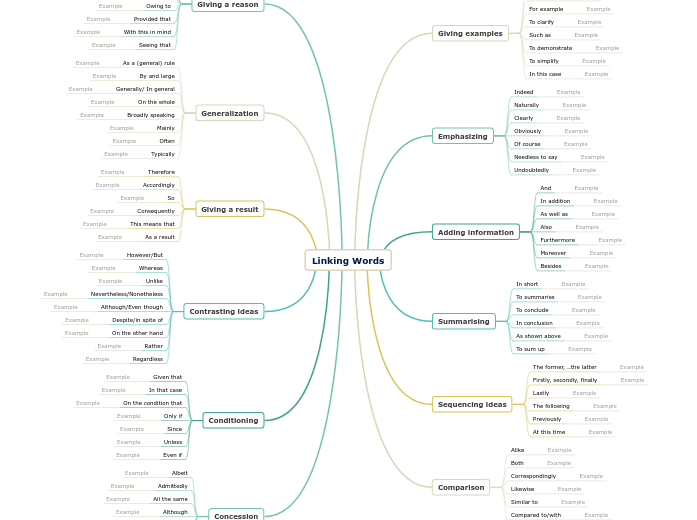
Learn the categories of linking words from this template and complete them with linking words examples to better understand them. Linking words help in connecting ideas and words in English. They are used to show contrast, connection, and condition between two things. Linking words used for giving examples: Linking words used for emphasizing: Linking words used for adding information: Linking words used for summarising: Linking words used for sequencing ideas: Linking words used for comparison: Linking words used for a concession: Linking words used for conditioning: Linking words used for contrasting ideas: Linking words used for giving a result: Linking words used for generalization: Linking words used for giving a reason: Linking words in any style of writing will help the reader to follow the flow of information. Use these words to accept a point or idea with reservation. These linking worss are used to provide a condition to what has been stated. However is the formal version of but. It is not normally used at the beginning of a sentence. Therefore, so, consequently and as a result are all used in a similar way. These words are used to make a general statement. Due to and owing to must be followed by a noun. Use these words to show how things are similar. These words are useful when you want to refer to one of two points, to list ideas. Use these words at the beginning of the sentence to give a summary of what has been said or written. Ideas are often linked by 'and'. In a list, you put a comma between each item, but not before and. These linking words are used to empashize a point. The most common way to give examples is by using for example or for instance. Write phrases to exercise! Miellekarttojen avulla voit ideoida, hahmottaa käsitteiden välisiä suhteita sekä järjestää ja tuottaa ideoita. Miellekarttamallien avulla alkuun pääsee kuitenkin helpommin: ne ovat valmiita runkoja, jotka sisältävät tietoa tietystä aiheesta sekä ohjeita kartan täydentämiseen. Malli antaa rakenteen, joka kokoaa yhteen aiheen kaikki osa-alueet ja toimii lähtökohtana omalle miellekartallesi. Se on käytännöllinen tapa luoda miellekartta tietystä aiheesta niin työelämän kuin opiskelun tarpeisiin. Mindomon älykkäiden miellekarttamallien avulla ajattelet ja toimit vaivattomasti. Voit valita erilaisia miellekarttamalleja Mindomon yritys- ja koulutustileiltä tai luoda omia malleja tyhjästä. Minkä tahansa miellekartan voi muuttaa malliksi lisäämällä sen aiheisiin ohjaavia muistiinpanoja.Tietoja tästä mallista
Linking words examples
Linking Words
These will show contrast, connection, condition between two things.Concession
Up to a point
Even so
And yet
Although
All the same
Admittedly
Albeit
Conditioning
Even if
Unless
Only if
On the condition that
In that case
Given that
Contrasting ideas
Although, despite and in spite of introduce an idea of contrast.Regardless
Rather
On the other hand
Despite/in spite of
Although/Even though
Nevertheless/Nonetheless
Unlike
Whereas
However/But
Giving a result
So is more informal.As a result
This means that
Consequently
So
Accordingly
Therefore
Generalization
Typically
Often
Mainly
Broadly speaking
On the whole
Generally/ In general
By and large
As a (general) rule
Giving a reason
Because of is followed by a noun and can be used at the beginning or in the middle of a sentence. Since and as also mean because.Seeing that
With this in mind
Provided that
Owing to
As
Since
Because of
Due to the fact that
Comparison
Compared to/with
Similar to
Likewise
Correspondingly
Both
Alike
Sequencing ideas
The following is a good way of starting a list.At this time
Previously
The following
Lastly
Firstly, secondly, finally
The former, ..the latter
Summarising
To sum up
As shown above
In conclusion
To conclude
To summarise
In short
Adding information
Recommended not to start a sentence with also. Use instead In addition, or In addition to this.Besides
Moreover
Furthermore
Also
As well as
In addition
And
Emphasizing
Undoubtedly
Needless to say
Of course
Obviously
Clearly
Naturally
Indeed
Giving examples
Namely refers to something by name.In this case
To simplify
To demonstrate
Such as
To clarify
For example
Namely
For instance
Example
Miksi käyttää Mindomon miellekarttamallia?
Malleissa on useita toimintoja:
-
Tuotteet
-
Käyttötarkoitukset
- Yleiset käyttötarkoitukset
- Miellekartat koulutukseen
- Miellekartat liiketoimintaan
- Miellekartat henkilökohtaiseen kehitykseen
- Apuvälineteknologia
- Tiimiyhteistyö
- Kampanjabriefit markkinoijille
- Asiakastarpeiden kartoitustyöpajat konsulteille
- Perehdytyspolut HR:lle ja L&D:lle
- Tietämyksenhallinta
- Tiimin osaamismatriisi
- Projektikirjasto
- Roolit
- Markkinoijat
- HR ja L&D
- Konsultit
- Projektinhallinta
- Markkinointikampanjan suunnittelu
- Henkilöstökoulutusten jalkautus
- Työn laajuuden määrittely
- Ideoiden organisointi
- Ongelmapuut
- Koulutustarveanalyysi
- Miellekarttojen hyödyt
-
Ratkaisut
- Oppaat
- Tee esityksiä miellekartoilla
- Opi miellekartoilla
- Suunnittele ja järjestä miellekartoilla
- Priorisoi tehtäviä miellekartoilla
- Tee muistiinpanoja miellekartoilla
- Aitoja asiakastarinoita
- Koulutussisällön skaalaaminen 11 000 lääkärille
- Tiimin työnkulku: kokeilusta korvaamattomaksi kahdessa kuukaudessa
- 10 vuotta ilman dioja: arkkitehtuuriluennot uusiksi
- Lue kaikki tarinat
-
Resurssit
- Perusteet
- Mikä on miellekartta?
- Miten miellekartta tehdään?
- Mikä on käsitekartta?
- Miellekarttaideoita opiskeluun
- Oppaat ja tuki
- Video-oppaat
- Ohjekeskus
- Foorumi
- Esimerkit ja mallit
- 100 miellekarttaideaa
- Miellekartat apuvälineteknologiana
- 29 parasta miellekarttaesimerkkiä
- Ominaisuussivut
- Koulutus
- Opettajan tehtävät
- Työ ja vapaa-aika
- Työpöytäsovellus
- Mindomo-blogi
- Hinnoittelu
- Kirjaudu sisään
- Rekisteröidy
- Hallintapaneeli
Yleiset käyttötarkoitukset
Miellekarttojen hyödyt
Miksi visuaalinen ajattelu helpottaa muistamista ja suunnittelua.
Perusteet
Oppaat ja tuki
Esimerkit ja mallit
Ominaisuussivut
 Blogi
Mindomo-blogi
Oppaita, esimerkkejä ja tutkimusta visuaalisesta ajattelusta.
Selaa kaikkia artikkeleita