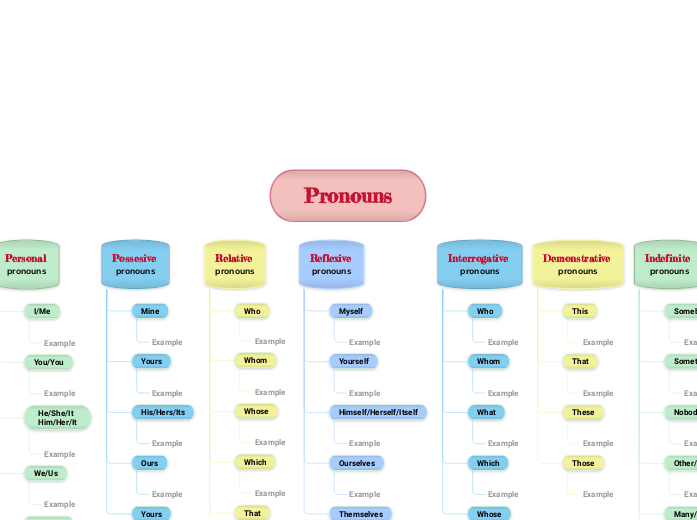
Use this template to learn the pronouns in English. Pronouns are the parts of speech used instead of nouns to avoid repetition. Depending on the situations in which they are used, they have different forms. The types of pronouns are: Personal pronouns Possessive pronouns Relative pronouns Reflexive pronouns Demonstrative pronouns Interrogative pronouns Indefinite pronouns Personal pronouns are the pronouns that refer to specific people or things. They can change depending on the person, number, gender, or case. Examples of personal pronouns, singular and plural form: I/Me You/You He/She/It Him/Her/It We/Us You/You They/Them Possessive pronouns show that something belongs to someone. Examples of possessive pronouns: Mine Yours His/Hers/Its Ours Yours Relative pronouns describe nouns in terms of how they relate to other words. Examples of relative pronouns: Who Whom Whose Which That What Reflexive pronouns are used when the subject of a sentence is also the object of the sentence. Examples of reflexive pronouns: Myself Yourself Himself/Herself/Itself Ourselves Themselves Demonstrative pronouns point to and identify a noun or a pronoun. They are used in place of particular things to show which one we’re discussing. Examples of demonstrative pronouns: Somebody/Someone Something/Anything Nobody/Nothing All Other/Another Both/Each Many/Most Some/Few None Such Interrogative pronouns are the pronouns used in questions. In sentences, when the pronoun is a subject, the verb will precede the pronoun. Examples of interrogative pronouns: Who Whom What Which Whose ’Who’ and ‘whom’ are used to refer to people and which is used for animals and things. Indefinite pronouns refer to a thing or person that is identifiable, but not specified. Examples of indefinite pronouns: This That These Those Complete the template by adding examples of phrases with these pronouns. In this way, you will retain information easier. Pronouns - a word that can function as a noun phrase used by itself and that refers either to the participants in the discourse. An indefinite pronoun is a pronoun that refers to a person or a thing without being specific. Demonstrative pronouns are pronouns that point to specific objects. They function as subjects or objects. An interrogative word or question word is a function word used to ask a question, Reflexive pronouns are words ending in -self or -selves that are used when the subject and the object of a sentence are the same. They refer back to an earlier noun or pronoun. A relative pronoun is a pronoun that marks a relative clause. They link one part of a sentence to another. Possessive pronouns show that something belongs to someone. Replaces noun in phrases. Personal pronouns are pronouns that are associated primarily with a particular grammatical person – They represents people places or things. Write phrases as examples. Mapy myśli pomagają w burzy mózgów, w dostrzeganiu powiązań między pojęciami oraz w porządkowaniu i generowaniu pomysłów. Szablony map myśli ułatwiają jednak start, bo zawierają gotowy szkielet z informacjami na dany temat i wskazówkami, jak go uzupełnić. Zapewniają strukturę, która łączy wszystkie elementy tematu i służy jako punkt wyjścia dla twojej własnej mapy myśli. To praktyczne rozwiązanie, gdy chcesz szybko stworzyć mapę myśli na konkretny temat – zarówno w biznesie, jak i w edukacji. Mindomo oferuje inteligentne szablony map myśli, dzięki którym praca i myślenie przychodzą bez wysiłku. Możesz wybierać spośród szablonów map myśli dostępnych na kontach biznesowych i edukacyjnych Mindomo albo tworzyć własne szablony od podstaw. Każdą mapę myśli możesz zamienić w szablon, dodając do jej tematów notatki ze wskazówkami.O tym szablonie
Pronouns in English
Personal pronouns in English
Possessive pronouns in English
Relative pronouns in English
Reflexive pronouns in English
Demonstrative pronouns in English
Interrogative pronouns in English
Indefinite pronouns in English
Pronouns
Indefinite pronouns
None/Some/Few
Many/Most/Such
Other/Another
Nobody/Nothing
Something/Anything
Somebody/Someone
Demonstrative pronouns
Those
These
This
Interrogative pronouns
Reflexive pronouns
Themselves
Ourselves
Himself/Herself/Itself
Yourself
Myself
Relative pronouns
What
That
Which
Whose
Whom
Who
Possesive pronouns
Ours
His/Hers/Its
Yours
Mine
Personal pronouns
They/Them
We/Us
He/She/It Him/Her/It
You/You
I/Me
Example
Dlaczego warto używać szablonów map myśli Mindomo?
Szablony oferują różne funkcje:
-
Produkty
-
Zastosowania
- Zastosowania ogólne
- Mapy myśli dla edukacji
- Mapy myśli dla biznesu
- Mapy myśli dla rozwoju osobistego
- Technologia wspomagająca
- Współpraca zespołowa
- Briefy kampanii dla marketerów
- Warsztaty rozpoznania potrzeb klienta dla konsultantów
- Ścieżki onboardingu dla HR i L&D
- Zarządzanie wiedzą
- Matryca kompetencji zespołu
- Biblioteka projektów
- Role
- Marketerzy
- HR i L&D
- Konsultanci
- Zarządzanie projektami
- Planowanie kampanii marketingowych
- Wdrażanie szkoleń dla pracowników
- Zakres prac
- Organizacja pomysłów
- Drzewa problemów
- Analiza potrzeb szkoleniowych
- Korzyści z mapowania myśli
-
Rozwiązania
- Przewodniki
- Twórz prezentacje z mapami myśli
- Ucz się z mapami myśli
- Planuj i organizuj z mapami myśli
- Ustalaj priorytety zadań z mapami myśli
- Rób notatki z mapami myśli
- Prawdziwe historie klientów
- Skalowanie treści edukacyjnych dla 11 000 lekarzy
- Praca zespołu: od wersji próbnej do niezbędnego narzędzia w dwa miesiące
- 10 lat bez slajdów: nowe podejście do wykładów z architektury
- Przeczytaj wszystkie historie
-
Zasoby
- Podstawy
- Co to jest mapa myśli?
- Jak tworzyć mapy myśli?
- Poradniki i pomoc
- Samouczki wideo
- Centrum pomocy
- Forum
- Przykłady i szablony
- Top 29 przykładów map myśli
- Co to jest mapa pojęć?
- Strony funkcji
- Edukacja
- Zadania dla nauczycieli
- Praca i życie prywatne
- Wersja desktopowa
- Blog Mindomo
- Cennik
- Zaloguj się
- Zarejestruj się
- Panel główny
Zarządzanie wiedzą
Korzyści z mapowania myśli
Dlaczego myślenie wizualne ułatwia zapamiętywanie i planowanie.
Poradniki i pomoc
Przykłady i szablony
Strony funkcji
 Blog
Blog Mindomo
Poradniki, przykłady i badania dotyczące myślenia wizualnego.
Przeglądaj wszystkie artykuły
Blog
Blog Mindomo
Poradniki, przykłady i badania dotyczące myślenia wizualnego.
Przeglądaj wszystkie artykuły