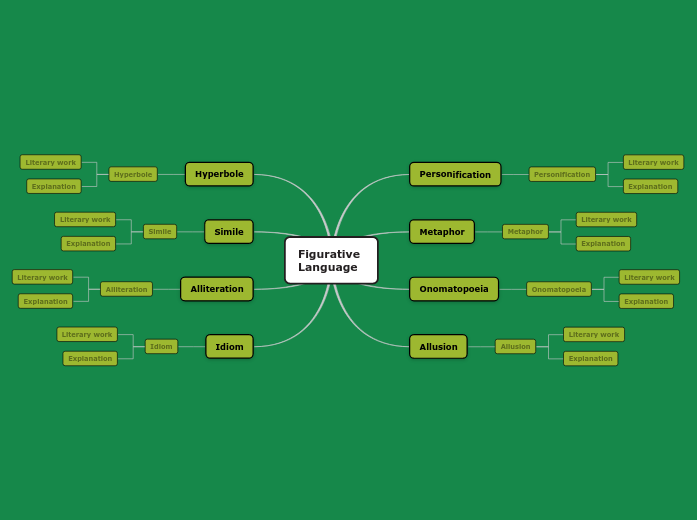
Find figures of speech in your favorite novels and poems. This template about figurative language will help you learn about each figure of speech: personification, simile, metaphor, onomatopoeia, allusion, idiom, alliteration, and hyperbole. You will have to think about a literary work where you find each of them, give an example and explain your choice. Use this template to learn the figurative language and think about examples for figures of speech so you can better understand each of them. Idiom is the figure of speech that uses a combination of words which challenges the conventional usage of those words. How do you explain your choice? Type in the explanation. What is the literary work in which you found the idiom? What genre is it? How do you explain your choice? What is the literary work Simile is a figure of speech that compares two objects through some connective word such as 'like', 'as', 'so', 'than', or a verb such as 'resembles'. How do you explain your choice? What is the literary work in which you found the simile? The hyperbole is a figure of speech that uses exaggerations to create emphasis or effect. How do you explain your choice? What is the literary work in which you found the hyperbole? Is it a novel, short story or poem? Allusion is the figure of speech that makes a reference to a well-known person, place, or thing in literature and history. How do you explain your choice? What is the literary work in which you found the allusion? What genre is it? Onomatopoeia is the figure of speech that uses words whose sounds suggest their meanings. Think of words related to water, air, collisions, sounds, voice, etc. How do you explain your choice? What is the literary work in which you found the onomatopoeia? Is it a novel, short story or poem? Metaphor is a figure of speech that compares two unlike things without using 'like' or 'as'. How do you explain your choice? What is the literary work in which you found the metaphor? Is it a novel, short story or poem? Personification is a figure of speech which gives human qualities to nonhuman things. How do you explain your choice? What is the literary work in which you found the personification? What is its genre? Le mappe mentali aiutano a fare brainstorming, a stabilire relazioni tra i concetti, a organizzare e generare idee. Tuttavia, i modelli di mappe concettuali e mentali vuote offrono un modo più semplice per iniziare, in quanto sono strutture che contengono informazioni su un argomento specifico con istruzioni guida. In sostanza, i modelli di mappe mentali garantiscono la struttura che combina tutti gli elementi di un argomento specifico e servono come punto di partenza per la vostra mappa mentale personale. Sono una risorsa che fornisce una soluzione pratica per creare una mappa mentale su un particolare argomento, sia per il lavoro che per l'istruzione. Mindomo offre modelli di mappe mentali intelligenti che consentono di lavorare e pensare senza sforzo. È possibile scegliere tra una varietà di modelli di mappe concettuali dagli account aziendali o educativi di Mindomo, oppure creare i propri modelli di mappe mentali da zero. Qualsiasi mappa mentale può essere trasformata in un modello di mappa concettuale aggiungendo ulteriori note guida a uno dei suoi argomenti.Types of Figurative Language
Informazioni su questo modello
Figurative language
Figurative Language
Find figures of speech in your favorite novels and poems.Idiom
What is the idiom that you found in the novel/poem?
Type it in.
Example: 'a stitch in time saves nine'.
Example:
- A timely effort saves you from much harder work later.
Example: Pie-IX: A Stitch in Time Saves Nine by Jaida Jones, K.J. Sturgeon - short story.Alliteration
Example:
- Almost all the words in the sentence begin with 'th'.
in which you found the alliteration? Type in the genre.
Example: Thank You for the Thistle by Dorie Thurston - short story.Simile
What simile did you find in the novel/poem? Type it in.
Example:
- 'Within the irregular arc of coral the lagoon was still as a mountain lake.'
Type in the explanation. Example:
- The lagoon is being compared with a mountain lake using the word 'as'.
Is it a novel, short story or poem?
Example: Lord of the flies by William Golding - novel.Hyperbole
What hyperbole did you find in the novel/poem? Type it in.
Example:
- 'All that we see or seem / Is but a dream within a dream.'
Type in the explanation.
Example:
- It is an exaggeration to claim that everything ('all we see or seem') is 'but a dream'.
Example: A dream within a dream by Edgar Allan Poe - poem.Allusion
What is the allusion that you found in the novel/poem? Type it in.
Example:
- 'Like a rich jewel in an Ethiop's ear'.
Example:
- Shakespeare makes an allusion of the Ethiopian slaves who wore expensive jewelry to express their masters' wealth.
Example: Romeo and Juliet by William Shakespeare - tragedyOnomatopoeia
What is the onomatopoeia that you found in the novel/poem? Type it in.
Example:
'The moan of doves in immemorial elms,
And murmuring of innumerable bees...'.
Example:
'Moan' and 'murmuring' refer to the way doves and bees sound like.
Example: Come Down, O Maid by Alfred Lord Tennyson - poemMetaphor
What is the metaphor that you found in the novel/poem? Type it in.
Example:
'The rain came down in long knitting needles.'
Example:
The rain is compared with 'long knitting needles', without the use of 'like' or 'as'.
Example:
National Velvet by Enid Bagnold - novel.Personification
Type in the personification you found in the novel/poem.
Example:
'- Not to-night, good Iago: I have very poor and unhappy brains for drinking.'Explanation
Type in the explanation.
Example:
The brain is given the attribute of being 'unhappy'.Literary work
Example:
Othello by William Shakespeare - tragedyPerché utilizzare un modello di mappa concettuale Mindomo?
Un modello ha diverse funzionalità:
-
Prodotti
-
Uso
- Usi generali
- Mappe concettuali per l'educazione
- Mappe concettuali per le Aziende
- Mappe concettuali per la Crescita Personale
- Tecnologia Assistiva
- Collaborazione di team
- Brief di campagna per marketer
- Workshop di scoperta del cliente per consulenti
- Percorsi di onboarding per HR e L&D
- Gestione della conoscenza
- Matrice delle competenze del team
- Libreria dei progetti
- Ruoli
- Marketer
- HR e L&D
- Consulenti
- Gestione dei progetti
- Pianificazione delle campagne marketing
- Rollout della formazione dei dipendenti
- Ambito di lavoro
- Organizzazione delle idee
- Alberi dei problemi
- Analisi dei bisogni formativi
- Vantaggi della Mappa Concettuale
-
Soluzioni
- Guide
- Creare presentazioni con le mappe concettuali
- Come imparare con le mappe concettuali
- Pianificare e organizzare con le mappe concettuali
- Come dare priorità ai compiti con le mappe concettuali
- Prendere appunti con le mappe concettuali
- Storie reali dei clienti
- Scalare contenuti formativi per 11.000 medici
- Flusso di lavoro di team: dalla prova a indispensabile in due mesi
- 10 anni senza slide: ripensare le lezioni di architettura
- Leggi tutte le storie
-
Risorse
- Le basi
- Cos'è una mappa mentale?
- Top 29 Esempi di Mappe Mentali
- Programmi per fare Mappe Concettuali
- Creatore di Diagrammi di Gantt
- Guide e Supporto
- Video tutorial
- Centro assistenza
- Forum
- Esempi e modelli
- Come fare una mappa concettuale?
- Modello di Mappa Mentale
- Esempi di Mappe Concettuali
- Programma per Diagrammi di Gantt
- Pagine funzionalità
- Istruzione
- Compiti per insegnanti
- Lavoro e Personale
- Desktop
- Il blog di Mindomo
- Prezzi
- Accedi
- Registrati
- Dashboard
Vantaggi della Mappa Concettuale
Perché il pensiero visivo rende più facile ricordare e pianificare.
Le basi
Guide e Supporto
Esempi e modelli
Pagine funzionalità
 Blog
Il blog di Mindomo
Guide, esempi e ricerche sul pensiero visivo.
Sfoglia tutti gli articoli
Blog
Il blog di Mindomo
Guide, esempi e ricerche sul pensiero visivo.
Sfoglia tutti gli articoli