
Learn how to plan a course by using this template. Here you can add your course goals, course materials, structure, and teaching methods and tools. Plan courses in advance and revise them. Type in the title of your course. Select methods and tools according to Decide whether you will use technology in your teaching or not. Look for a tool that will help you reach specific goals. Don't forget to take into consideration if these methods can help you achieve the course goal too. How do you plan to apply your style to suit the course goals, the size of the class, and the students? The evaluation must go hand-in-hand with course goals in order to achieve them and also help students to improve their skills. These can be partial - short evaluations after each segment of the course - or final - a final exam which will assess all the knowledge aquired during the school year at once. Decide if you want the assignments completed during the year to represent 1/3 of the final grade. Arrange the topics in a logical order. Select the major topics and determine the order in which you will teach them. Select the main topics to be covered. To obtain an initial list of course topics, search in current textbooks or in the current literature. Determine the goals of the course. 心智圖能幫助您集思廣益、建立概念之間的關聯,並整理與激發想法。 而心智圖範本讓入門更容易,因為範本是已含特定主題資訊與引導說明的架構。換句話說,範本先替您搭好能涵蓋該主題所有要素的結構,可作為您個人心智圖的起點。無論用於商業或教育,心智圖範本都能為特定主題的心智圖提供實用的解決方案。 Mindomo 提供智慧心智圖範本,讓您輕鬆工作、順暢思考。 您可以從 Mindomo 商業版或教育版帳號中挑選各式心智圖範本,也可以從頭建立自己的範本。只要在主題上加入進一步的引導說明,任何心智圖都能變成心智圖範本。關於此範本
How to plan a course
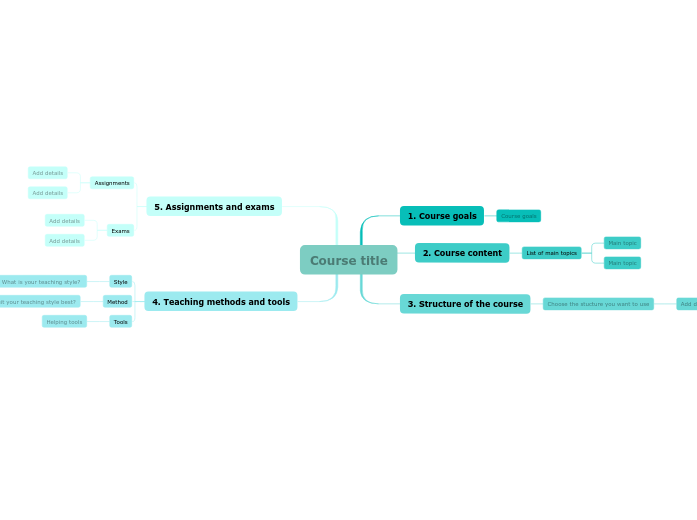
Course title
4. Teaching methods and tools
Tools
Helping tools
Also, consider your students' possibilities of accessing that tool.Method
Which methods will suit your teaching style best?
Style
What is your teaching style?
5. Assignments and exams
Also, assignments and homework need to reflect and help achieve course goals.Exams
Assignments
3. Structure of the course
Discuss how and why you have organized the material in a particular way.
This will help students to see the connections between topics.Choose the stucture you want to use
Add details
2. Course content
List of main topics
Main topic
1. Course goals
Having these course goals in mind will then help you make decisions about which content to include and what kind of assignments and exams are appropriate.
Consider the following questions:Course goals
為什麼要使用 Mindomo 心智圖範本?
範本提供多種功能: