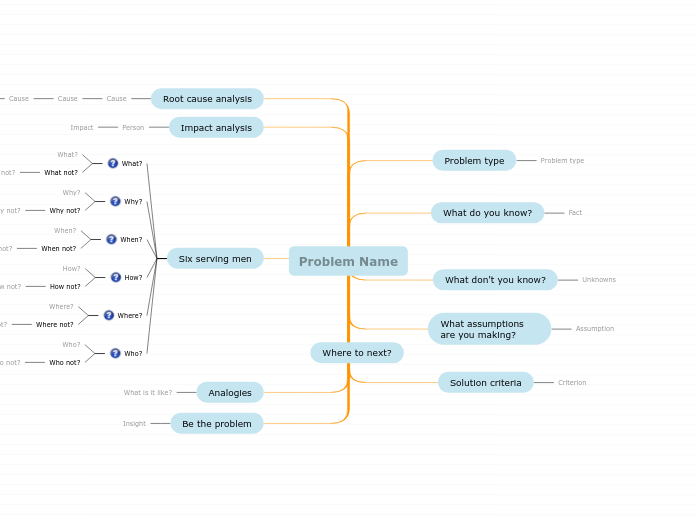
Researching and describing a problem is the foundation for solving it. This mind map takes you through a range of techniques for constructively and comprehensively describing a problem, before searching for solutions. Enter your problem's name and categorize it, whether you want to sort something out, create or just change something. Identify all the information you know as well as the one you don't know about it: include measurements, statistics, surveys or any known data together with uncertain or missing information, anything that will help you frame the entire difficulty. Specify the suppositions you make and think of results in case your presumptions are not valid. Give at least as much importance to the final outcome of a problem, as to the problem state itself. Try out the impersonation technique and be the problem as if it were a person. Once you do this, observe if anything changes, how things are perceived from this perspective, what are the opportunities and obstacles from this approach? Apply the problem analysis method 'Six serving men' and answer openly to each of the six essential questions, both positive and negative to better track the triggers and the situations when the problem manifests itself. The problem description toolbox goes hand in hand with the 5 Whys approach, so include it in the problem's final assessment and go to the root cause of the original issue. Where to next? Name the problem Add a statement describing the problem as if it were a person. What is 'Problem Name' like? Who does not cause 'Problem Name'? Who causes 'Problem Name'? Where does 'Problem Name' not happen? Where does 'Problem Name' happen? How does 'Problem Name' not happen? How does 'Problem Name' happen? When does 'Problem Name' not happen? When does 'Problem Name' happen? Why is 'Problem Name' not a problem? Why is 'Problem Name' a problem? What does not cause 'Problem Name'? What causes 'Problem Name'? Who is affected? How is Person affected by 'Problem Name'? Root Cause analysis Why does 'Problem Name' happen? Why does 'Cause' happen? Why does 'Cause' happen? Why does 'Cause' happen? Why does 'Cause' happen? Add solution criteria Add an assumption Add an unknown factor Add a piece of data Describe the problem type Os mapas mentais ajudam você a fazer brainstorming, estabelecer relações entre conceitos, organizar e gerar ideias. No entanto, os modelos de mapas mentais oferecem uma maneira mais fácil de começar, pois são estruturas que contêm informações sobre um assunto específico com instruções de orientação. Em essência, os modelos de mapas mentais garantem a estrutura que combina todos os elementos de um assunto específico e servem como ponto de partida para o seu mapa mental pessoal. Eles são um recurso para fornecer uma solução prática para criar um mapa mental sobre um determinado tema, seja para negócios ou educação. Mindomo traz modelos de mapas mentais inteligentes que permitem que você funcione e pense sem esforço. Você pode escolher entre uma variedade de modelos de mapas mentais das contas comerciais ou educacionais da Mindomo, ou pode criar seus próprios modelos de mapas mentais do zero. Qualquer mapa mental pode ser transformado em um modelo de mapa mental adicionando mais notas de orientação a um de seus tópicos.Problem Analysis Template
Sobre este modelo
Problem analysis template
Where to next?
When you have a comprehensive description of the problem, you can move towards finding solutions.
Consider brainstorming as a next step or Share the mind map with your colleagues.Problem Name
Identify the problem or issue in a few words and press Enter. This will become the title of your map.Be the problem
Insight
Analogies
What is it like?
For example, how would the problem behave at a wedding, at a concert, in a supermarket, or underwater?Six serving men
Who?
Who not?
Where?
Where not?
How?
How not?
When?
When not?
Why?
Why not?
What?
What not?
Impact analysis
Person
Type in a name or role of someone who is affected by 'Problem Name'Impact
Rate the impact by clicking an icon:Root cause analysis
For analytical problems, root cause analysis can help to unravel indirect causes of problems, leading to more effective solutions. One way to do this is to keep asking 'Why?' down to five levels, to understand the reasons behind the reasons.Cause
Enter a reason that 'Problem Name' happens.
Enter a reason that 'Cause' happens.
(Level 2 of 5)
Enter a reason that 'Cause' happens.
(Level 3 of 5)
Enter a reason that 'Cause' happens.
(Level 4 of 5)
Enter a reason that 'Cause' happens.
(Level 5 of 5)Solution criteria
Criterion
Make sure you consider:What assumptions are you making?
Assumption
Identify an assumption you are making in both the description of the problem and the logical solution.What don't you know?
Unknowns
Identify information or data that is not known or not reliable, and what you can do to find it. Think about:What do you know?
Fact
Add data or a reference to the problem. Think about:Problem type
Select the problem type or enter your own description.Por que usar um modelo de mapa mental Mindomo?
Um modelo possui várias funcionalidades:
-
Produtos
-
Usos
- Usos gerais
- Mapas Mentais para Educação
- Mapas Mentais para Empresas
- Mapas Mentais para Desenvolvimento Pessoal
- Tecnologia Assistiva
- Colaboração em equipe
- Briefs de campanha para profissionais de marketing
- Workshops de descoberta do cliente para consultores
- Jornadas de onboarding para RH e L&D
- Gestão do conhecimento
- Matriz de competências da equipe
- Biblioteca de projetos
- Funções
- Profissionais de marketing
- RH e L&D
- Consultores
- Gestão de projetos
- Planeamento de campanhas de marketing
- Implementação de treinamentos para funcionários
- Âmbito do trabalho
- Organização de ideias
- Árvores de problemas
- Análise de necessidades de formação
- Benefícios do Mapeamento Mental
-
Soluções
- Guias
- Criar apresentações com mapas mentais
- Como aprender com mapas mentais
- Planejar e organizar com mapas mentais
- Como priorizar tarefas com mapas mentais
- Como fazer anotações com mapas mentais
- Histórias reais de clientes
- Escalar conteúdo educacional para 11.000 médicos
- Fluxo de trabalho em equipe: do teste ao indispensável em dois meses
- 10 anos sem slides: repensar as aulas de arquitetura
- Ler todas as histórias
-
Recursos
- Aprenda o básico
- O que é um Mapa Mental?
- Como Fazer um Mapa Mental?
- O que é um Mapa Conceptual?
- Guias e Suporte
- Tutoriais em vídeo
- Centro de ajuda
- Fórum
- Exemplos e modelos
- Ideias de Mapas Mentais Criativos
- 29 Exemplos Principais de Mapas Mentais
- Páginas de funcionalidades
- Educação
- Tarefas para professores
- Trabalho & Pessoal
- Desktop
- O blogue Mindomo
- Preços
- Entrar
- Inscreva-se
- Painel de controle
Gestão do conhecimento
Benefícios do Mapeamento Mental
Porque o pensamento visual facilita recordar e planear.
Aprenda o básico
Guias e Suporte
Exemplos e modelos
Páginas de funcionalidades
 Blogue
O blogue Mindomo
Guias, exemplos e investigação sobre pensamento visual.
Ver todos os artigos
Blogue
O blogue Mindomo
Guias, exemplos e investigação sobre pensamento visual.
Ver todos os artigos