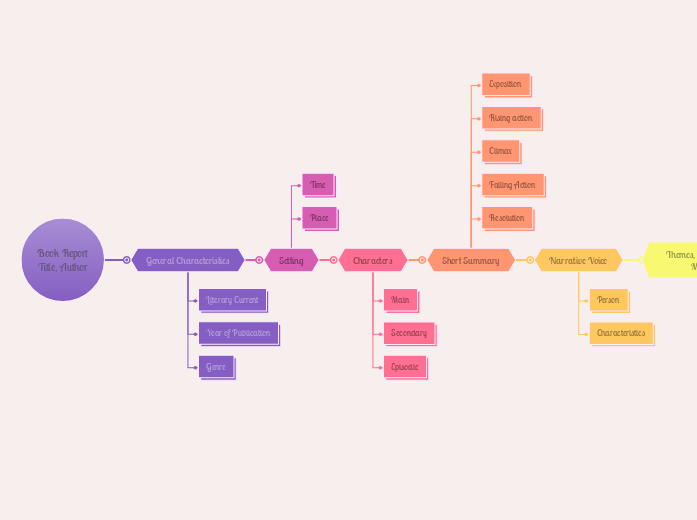
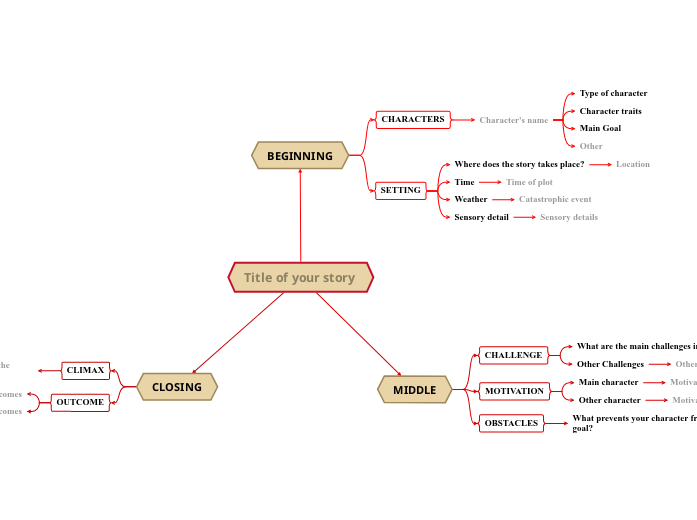
A story map is a strategy that uses a graphic organizer to help you learn the elements of a book or story. By identifying story characters, plot, setting, problem, and the solution you will learn the details. Use this story map template to learn the elements of a book or story. It is a graphic organizer, where you can identify story characters, plot, setting, challenges, and motivation of the main character, obstacles he/she encounters, and how he surpasses them. To name your story, you have to think about the overall message and what you want your audience to understand from the story. Also, make it relevant and easy to remember. The ending of a story is essential. We all know that if the ending is weak, what happened before loses its importance. So make it unpredictable, but fair. A resolved ending answers all the questions and ties up any loose threads from the plot. This is the closure section of the story. Try answering these questions to come up with a closure: This is the moment when the main character surpasses the last obstacle and finally faces their greatest challenge. The middle of the story is where you add layers of complications that will lead to the end. Reveal more about the character's journey. Did their personality go through changes? How did they overcome the challenges? And as you build up the story’s central conflict, make it more personal to that character. Also, from the middle act, you have to lead into the final act. There wouldn't be any tension and excitement in your story if there weren't any obstacles in your character's way. A story is nothing more than a character overcoming a series of difficulties to reach the desired goal. Obstacles usually create suspense and conflict. In overcoming obstacles, there is growth: weak becomes strong; hatred turns into love; sadness into happiness; wrong into right; lies into truth; or evil becomes good. Obstacles Your character(s) need(s) motivation in order to solve the challenge(s). Secondary characters might also have motives that lead them to cross paths with the main character or which might trigger them to help the main character. Why does your character need to confront this challenge? What does he/she expect to accomplish by solving it? Motivation Each story has a main character and that character usually needs to solve a problem or challenge. The character's challenge is the one that creates tension throughout the story. Type in any other challenges which other characters in the story need to face. Other challenges In most stories, there are 3 challenges. The number 3 is a mystical number symbolizing completeness. Try to come up with interesting challenges with which your character needs to struggle. Challenges In the beginning of the story (or the exposition), you will need to introduce the setting and characters. You might also want to introduce the main conflict. This part of the story is important because it gives the reader necessary background information and maybe even a first insight into a character’s personality. The setting (time & place) of a story can change throughout the plot. Sensory details include sight, sound, touch, smell, and taste. These details are important because they create depth in your setting. Sensory details The weather is an important element in your story because it can highly influence the ambiance and the mood of the characters. Catastrophic event Does your story include catastrophic weather? See a few suggestions below or add your own: The time of the story can also change. It can describe the event of a single day or can include an entire year's plot. Anyway, don't forget to mention it. Time of plot Your story can take place wherever your imagination will take you to. Location Characters are essential to a good story. Usually, the protagonist(s) is/are the most affected by the plot. Introduce a character by focusing on their actions, interests, and occupation, as the physical appearance doesn't make a difference in most cases. Type in the name of your character. Other Add other qualities/attributes of the character. Main Goal What is your character's main goal? Character traits Which traits best describe the character's personality? Choose more if necessary: Type of character Choose the type of your chacter: Mindmaps hjælper dig med at brainstorme, skabe sammenhænge mellem begreber og organisere og generere ideer. Mindmap-skabeloner gør det dog nemmere at komme i gang, fordi de er rammer med information om et bestemt emne og vejledende instruktioner. Mindmap-skabeloner giver dig grundlæggende den struktur, der samler alle elementerne i et bestemt emne, og fungerer som udgangspunkt for dit eget mindmap. De er en praktisk ressource, når du skal lave et mindmap om et bestemt emne, uanset om det er til arbejde eller uddannelse. Mindomo giver dig smarte mindmap-skabeloner, så du kan arbejde og tænke ubesværet. Du kan vælge mellem en række mindmap-skabeloner fra Mindomos erhvervs- og uddannelseskonti, eller du kan lave dine egne mindmap-skabeloner fra bunden. Ethvert mindmap kan gøres til en mindmap-skabelon ved at tilføje vejledende noter til et af emnerne.Story Map Template
Om denne skabelon
Story map template
Title of your story
CLOSING
OUTCOME
See examples of possible outcomes below:Outcomes
- Have all the problems been solved?
- Is there a clear picture of what happens with each character in the story?
- Has the challenge transformed your main character?
- How do the characters feel in the end?CLIMAX
The climax usually follows one of these patterns:
Type in your answer.How does your main character finally solve the problem?
MIDDLE
OBSTACLES
What prevents your character from accomplishing their goal?
See a few examples below:MOTIVATION
Other character
Main character
See a few examples:CHALLENGE
Other Challenges
What are the main challenges in your story?
See a few examples below:BEGINNING
SETTING
Sensory detail
See a few examples below:Weather
- hurricane, earthquake, storm, etcTime
Where does the story takes place?
For example: in an elevator, in an enchanted forest, etc. Don't forget to give details of the environment each time the setting changes, otherwise, the story can be confusing. Also, mention the seasons as each of them has unique weather and events.CHARACTERS
Character's name
Hvorfor bruge en mindmap-skabelon fra Mindomo?
En skabelon har forskellige funktioner:
-
Produkter
-
Anvendelser
- Generelle anvendelser
- Mindmaps til uddannelse
- Mindmaps til erhvervslivet
- Mindmaps til personlig udvikling
- Hjælpemiddelteknologi
- Teamsamarbejde
- Kampagnebriefs til marketingfolk
- Workshops om kundeafdækning for konsulenter
- Onboardingforløb for HR og L&D
- Videnstyring
- Kompetencematrix for teamet
- Projektbibliotek
- Roller
- Marketingfolk
- HR og L&D
- Konsulenter
- Projektledelse
- Planlægning af marketingkampagner
- Udrulning af medarbejderuddannelse
- Arbejdsbeskrivelse
- Idéorganisering
- Problemtræer
- Uddannelsesbehovsanalyse
- Fordele ved mindmapping
-
Løsninger
- Guider
- Lav præsentationer med mindmaps
- Lær med mindmaps
- Planlæg og organiser med mindmaps
- Prioritér opgaver med mindmaps
- Tag noter med mindmaps
- Ægte kundehistorier
- Skalering af uddannelsesindhold til 11.000 læger
- Teamworkflow: fra afprøvning til uundværlig på to måneder
- 10 år uden slides: arkitekturforelæsninger gentænkt
- Læs alle historier
-
Ressourcer
- Lær det grundlæggende
- Hvad er et mindmap?
- Hvordan laver man et mindmap?
- Vejledninger og support
- Videovejledninger
- Hjælpecenter
- Forum
- Eksempler og skabeloner
- Top 29 eksempler på mindmaps
- Hvad er et konceptkort?
- Funktionssider
- Uddannelse
- Læreropgaver
- Arbejde og privat
- Desktop
- Mindomo-bloggen
- Priser
- Log ind
- Tilmeld dig
- Dashboard
Fordele ved mindmapping
Hvorfor visuel tænkning gør det lettere at huske og planlægge.
Lær det grundlæggende
Vejledninger og support
Eksempler og skabeloner
Funktionssider
 Blog
Mindomo-bloggen
Guides, eksempler og forskning om visuel tænkning.
Se alle artikler
Blog
Mindomo-bloggen
Guides, eksempler og forskning om visuel tænkning.
Se alle artikler