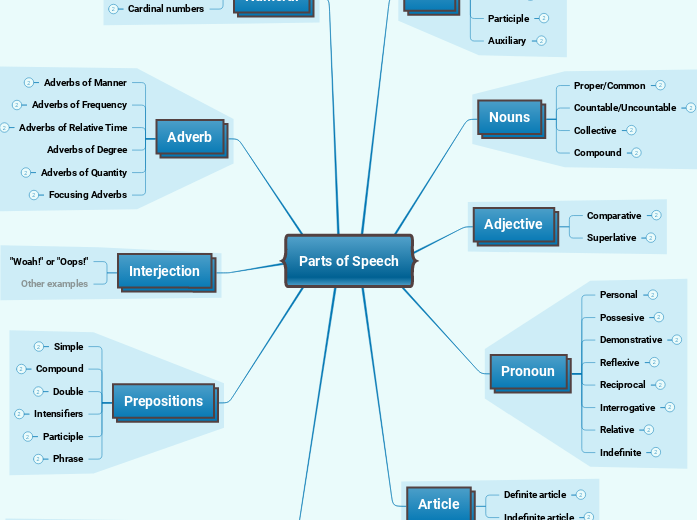
Learn parts of speech in an interactive way, by creating sentences with each of them and adding them to this template. The parts of speech are verbs, nouns, adjectives, pronouns, articles, conjunctions, prepositions, interjections, adverbs, and numerals. The part of speech is a category to which a word is assigned according to its syntactic functions. In English the main parts of speech are noun, pronoun, adjective, determiner, verb, adverb, preposition, conjunction, and interjection. A conjunction is a word like 'if' 'but' or 'and' which is used to connect sentences or clauses together. Subordinating conjunctions are conjunctions that are used at the beginning of subordinate clauses. Some examples of these conjunctions are: although, after, before, because, how, if, once, since, so that, until, unless, when etc. Coordinating conjunctions always connect phrases, words, and clauses. They are: for, and, nor, but, or, yet, so. A preposition is one of the most exciting parts of grammar. A preposition is used to describe the location of something in relation to something else. A group of words used with the force of a single preposition is called phrase preposition. Participle preposition consists of words that end in “ing”. When a preposition consists of more than one word, it is called double preposition. Compound preposition consists of two or more words. When a preposition consists of one word it is called single or simple preposition. An interjection is used to express emotion in a sentence. An adverb is used to describe a verb, but it can also describe an adjective or another adverb. The intensifiers strengthen adverbs adjectives and adverbs and down- toners make them weaker. A numeral is a word or phrase that describes a numerical quantity. An article is a word used to modify a noun, which is a person, place, object, or idea. Technically, an article is an adjective, which is any word that modifies a noun. Indefinite articles are the words 'a' and 'an.' Each of these articles is used to refer to a noun, but the noun being referred to is not a specific person, place, object, or idea. It can be any noun from a group of nouns. It refers directly to a specific noun or groups of nouns. A pronoun is a word that can be used in place of a noun, typically after the noun itself has already been stated. Unlike demonstrative pronouns, which point out specific items, indefinite pronouns are used for non-specific things. This is the largest group of pronouns. All, some, any, several, anyone, nobody, each, both, few, either, none, one, and no one are the most common. Relative pronouns are used to add more information to a sentence. Which, that, who (including whom and whose), and where are all relative pronouns. Interrogative pronouns are used in questions. Although they are classified as pronouns, it is not easy to see how they replace nouns. Who, which, what, where, and how are all interrogative pronouns. Reciprocal pronouns are used for actions or feelings that are reciprocated. The reciprocal pronouns are each other and one another. A reflexive pronoun ends with ...self or ...selves and refers to another noun or pronoun in the sentence (usually the subject of the sentence). The reflexive pronouns are myself, yourself, herself, himself, itself, ourselves, yourselves, and themselves. Demonstrative pronouns are used to demonstrate (or indicate). This, that, these, and those are all demonstrative pronouns. Possessive pronouns are used to show possession. The possessive pronouns are mine, yours, his, hers, ours, and theirs. The personal pronouns are I, you, he, she, it, we, they. More often than not (but certainly not always), they replace nouns representing people. An adjective is a word that's used to describe a specific noun and to provide more detail to the listener. Superlative adjectives demonstrate a higher level of comparison between entities. Expresses a comparison between two entities or groups of entities in quality or degree. A noun is defined as a person, place, thing or idea. Proper nouns always begin with a capital letter. Common nouns, which are general words, such as 'cars,' are not capitalized. Compound nouns are words where two nouns have been stuck together to make a new noun. Compound nouns should be written as one word, without a hyphen. A noun which refers to a group of things/people. Countable nouns are nouns that can be counted, even if the number might be extraordinarily high. Proper nouns are the names of specific people or places. They should always begin with a capital letter. A verb is an action word or 'doing' word that signifies movement in some way. An auxiliary verb helps the main (full) verb and is also called a 'helping verb.' With auxiliary verbs, you can write sentences in different tenses, moods, or voices. A participle is a verb form that can be used as an adjective or to create a verb tense. There are two types of participles: Present participle (ending -ing) and Past participle (usually ending -ed, -d, -t, -en, or -n). A modal is a type of auxiliary (helping) verb that is used to express: ability, possibility, permission or obligation. The main modal verbs in the English language are: can, could, may, might, must, shall, should, will, would. A linking verb connects the subject with a word that gives information about the subject, such as a condition or relationship. A verb with its own meaning: a verb that is not an auxiliary verb. A gondolattérképek segítenek az ötletelésben, a fogalmak közötti kapcsolatok kialakításában, a rendszerezésben és az ötletek generálásában. A gondolattérkép-sablonok azonban könnyebb utat kínálnak a kezdéshez, mivel ezek olyan keretek, amelyek egy adott témával kapcsolatos információkat tartalmaznak, irányadó utasításokkal. Lényegében a gondolattérkép-sablonok adják meg azt a struktúrát, amely egy téma összes elemét egybefogja, és kiindulópontként szolgál a saját gondolattérképedhez. Gyakorlati segítséget nyújtanak egy adott témájú gondolattérkép elkészítéséhez, akár üzleti, akár oktatási céllal. A Mindomo intelligens gondolattérkép-sablonokat kínál, amelyekkel könnyebben dolgozhatsz és gondolkodhatsz. Választhatsz a Mindomo üzleti és oktatási sablonjai közül, vagy a nulláról is létrehozhatod a saját gondolattérkép-sablonjaidat. Bármelyik gondolattérképből sablon lehet, ha a témáihoz irányadó jegyzeteket adsz.Erről a sablonról
Parts of speech
Parts of Speech
Conjunction
Subordinating conjunctions
Although it was raining, I went out.
Coordinating
This stew is savory and delicious.
Prepositions
Phrase
according to, by means of, owing to, with a view to, in place of, in front of, etc.
regarding, barring, concerning, considering, etc.
Intensifiers
Extremely, Very
Double
into, within, upto etc.
on behalf of, according to, in front of, from across, etc.
Simple
in, at, on, to for, of, from, up, after, over, under, with, etc.
Interjection
Think of other interjections!Other examples
"Woah!" or "Oops!"
Adverb
Adverbs normally help paint a fuller picture by describing how something happens.Focusing Adverbs
Especially, Specifically, Merely, Either
Adverbs of Quantity
A lot, Little, Much
Adverbs of Degree
Adverbs of Relative Time
Just, Afterward, Soon, Currently
Adverbs of Frequency
Always, usually, Never
Adverbs of Manner
Carefully, Slowly
Numeral
Some theories of grammar use the word 'numeral' to refer to cardinal numbers that act as a determiner to specify the quantity of a noun, for example the 'two' in 'two hats'.Cardinal numbers
One, two..
Ordinal numbers
First, second..
Article
Indefinite article
A car in the parking lot.
Definite article
The breakfast on my plate.
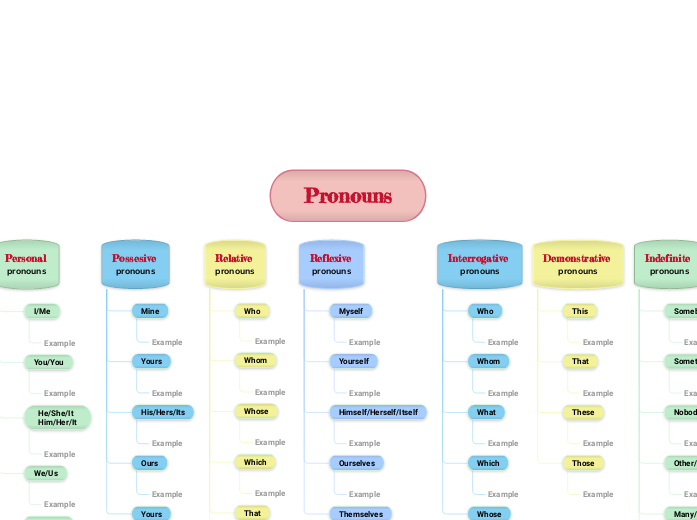
Pronoun
Indefinite
None, Several
Relative
Which, Where
Interrogative
Which, Who
Reciprocal
Each other, one another
Reflexive
Itself, Himself
Demonstrative
This, These
Possesive
His, Your
Personal
He, They
Adjective
Superlative
She is the prettiest princess.
Comparative
He is taller than she is.
Nouns
Compound
Candlestick
Collective
Family, Class
Countable/Uncountable
Uncountable nouns are nouns that come in a state or quantity which is impossible to count; liquids are uncountable, as are things which act
like liquids.Cats, Rain
Proper/Common
Mary, Paris
Verb
Auxiliary
You have been practicing hard.
Participle
The winning athlete gets a trophy.
Modal
I might go to the park if I get my homework done.
Linking verb
You look exhausted after studying all night.
Full verb
Create sentences
They have it.
Miért érdemes Mindomo gondolattérkép-sablont használni?
Egy sablon a következő funkciókat kínálja:
-
Termékek
-
Felhasználás
- Általános felhasználás
- Gondolattérképek az oktatásban
- Gondolattérképek az üzleti életben
- Gondolattérképek a személyes fejlődéshez
- Segítő technológia
- Csapatmunka
- Kampánybriefek marketingszakembereknek
- Ügyfélfeltáró workshopok tanácsadóknak
- Onboarding folyamatok HR- és L&D-csapatoknak
- Tudásmenedzsment
- Csapatkompetencia-mátrix
- Projektkönyvtár
- Szerepek
- Marketingszakemberek
- HR és L&D
- Tanácsadók
- Projektmenedzsment
- Marketingkampány-tervezés
- Munkavállalói képzések bevezetése
- Munkaterjedelem (SOW)
- Ötletszervezés
- Problémafák
- Képzési igényfelmérés
- A gondolattérkép-készítés előnyei
-
Megoldások
- Útmutatók
- Prezentációk készítése gondolattérképekkel
- Hogyan tanuljunk gondolattérképekkel
- Tervezés és rendszerezés gondolattérképekkel
- Hogyan priorizáljuk a feladatokat gondolattérképekkel
- Jegyzetelés gondolattérképekkel
- Valódi ügyféltörténetek
- Oktatási tartalmak skálázása 11 000 orvos számára
- Csapatmunka: két hónap alatt a próbaverziótól a nélkülözhetetlen eszközig
- 10 év diavetítés nélkül: az építészeti előadások újragondolása
- Összes történet elolvasása
-
Erőforrások
- Alapok
- Mi az a gondolattérkép?
- Hogyan készítsünk gondolattérképet?
- Útmutatók és támogatás
- Videós útmutatók
- Súgóközpont
- Fórum
- Példák és sablonok
- A 29 legjobb gondolattérkép-példa
- Mi az a fogalomtérkép?
- Funkcióoldalak
- Oktatás
- Tanári feladatok
- Munka és magánélet
- Asztali verzió
- A Mindomo blog
- Árazás
- Bejelentkezés
- Regisztráció
- Irányítópult
A gondolattérkép-készítés előnyei
Miért könnyíti meg a vizuális gondolkodás a felidézést és a tervezést?
Útmutatók és támogatás
Példák és sablonok
Funkcióoldalak
 Blog
A Mindomo blog
Útmutatók, példák és kutatások a vizuális gondolkodásról.
Összes cikk böngészése
Blog
A Mindomo blog
Útmutatók, példák és kutatások a vizuális gondolkodásról.
Összes cikk böngészése