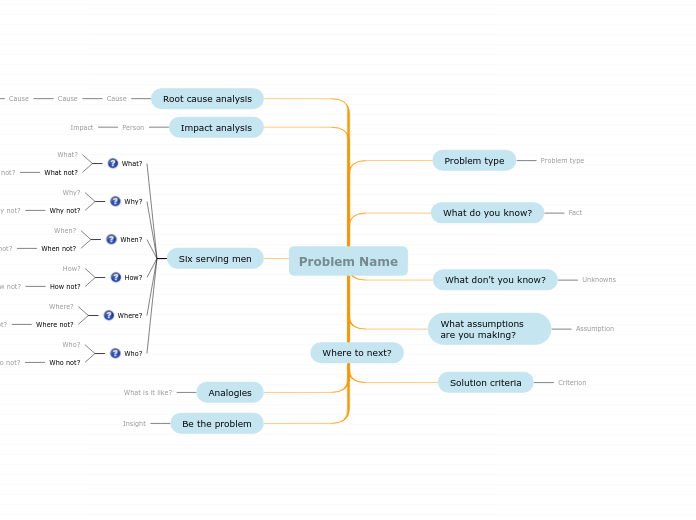
Researching and describing a problem is the foundation for solving it. This mind map takes you through a range of techniques for constructively and comprehensively describing a problem, before searching for solutions. Enter your problem's name and categorize it, whether you want to sort something out, create or just change something. Identify all the information you know as well as the one you don't know about it: include measurements, statistics, surveys or any known data together with uncertain or missing information, anything that will help you frame the entire difficulty. Specify the suppositions you make and think of results in case your presumptions are not valid. Give at least as much importance to the final outcome of a problem, as to the problem state itself. Try out the impersonation technique and be the problem as if it were a person. Once you do this, observe if anything changes, how things are perceived from this perspective, what are the opportunities and obstacles from this approach? Apply the problem analysis method 'Six serving men' and answer openly to each of the six essential questions, both positive and negative to better track the triggers and the situations when the problem manifests itself. The problem description toolbox goes hand in hand with the 5 Whys approach, so include it in the problem's final assessment and go to the root cause of the original issue. Where to next? Name the problem Add a statement describing the problem as if it were a person. What is 'Problem Name' like? Who does not cause 'Problem Name'? Who causes 'Problem Name'? Where does 'Problem Name' not happen? Where does 'Problem Name' happen? How does 'Problem Name' not happen? How does 'Problem Name' happen? When does 'Problem Name' not happen? When does 'Problem Name' happen? Why is 'Problem Name' not a problem? Why is 'Problem Name' a problem? What does not cause 'Problem Name'? What causes 'Problem Name'? Who is affected? How is Person affected by 'Problem Name'? Root Cause analysis Why does 'Problem Name' happen? Why does 'Cause' happen? Why does 'Cause' happen? Why does 'Cause' happen? Why does 'Cause' happen? Add solution criteria Add an assumption Add an unknown factor Add a piece of data Describe the problem type Mindmappen helpen je brainstormen, relaties leggen tussen concepten, organiseren en ideeën genereren. Lege mindmapsjablonen bieden echter een eenvoudigere manier om aan de slag te gaan, omdat het kaders zijn die informatie bevatten over een specifiek onderwerp met begeleidende instructies. In essentie zorgen mindmapsjablonen voor de structuur die alle elementen van een specifiek onderwerp combineert en als startpunt dient voor je persoonlijke mindmap. Ze zijn een hulpmiddel om een praktische oplossing te bieden voor het maken van een mindmap over een bepaald onderwerp, zowel voor het bedrijfsleven als voor het onderwijs. Mindomo brengt je slimme mindmap templates waarmee je moeiteloos kunt functioneren en denken. Je kunt kiezen uit verschillende mind map templates van Mindomo's zakelijke of educatieve accounts, of je kunt je eigen mind map templates maken. Elke mindmap kan getransformeerd worden in een mindmap template map door extra notities toe te voegen aan één van de onderwerpen.Problem Analysis Template
Over dit sjabloon
Problem analysis template
Where to next?
When you have a comprehensive description of the problem, you can move towards finding solutions.
Consider brainstorming as a next step or Share the mind map with your colleagues.Problem Name
Identify the problem or issue in a few words and press Enter. This will become the title of your map.Be the problem
Insight
Analogies
What is it like?
For example, how would the problem behave at a wedding, at a concert, in a supermarket, or underwater?Six serving men
Who?
Who not?
Where?
Where not?
How?
How not?
When?
When not?
Why?
Why not?
What?
What not?
Impact analysis
Person
Type in a name or role of someone who is affected by 'Problem Name'Impact
Rate the impact by clicking an icon:Root cause analysis
For analytical problems, root cause analysis can help to unravel indirect causes of problems, leading to more effective solutions. One way to do this is to keep asking 'Why?' down to five levels, to understand the reasons behind the reasons.Cause
Enter a reason that 'Problem Name' happens.
Enter a reason that 'Cause' happens.
(Level 2 of 5)
Enter a reason that 'Cause' happens.
(Level 3 of 5)
Enter a reason that 'Cause' happens.
(Level 4 of 5)
Enter a reason that 'Cause' happens.
(Level 5 of 5)Solution criteria
Criterion
Make sure you consider:What assumptions are you making?
Assumption
Identify an assumption you are making in both the description of the problem and the logical solution.What don't you know?
Unknowns
Identify information or data that is not known or not reliable, and what you can do to find it. Think about:What do you know?
Fact
Add data or a reference to the problem. Think about:Problem type
Select the problem type or enter your own description.Waarom een Mindomo mindmap template gebruiken?
Een sjabloon heeft verschillende functionaliteiten:
-
Producten
-
Toepassingen
- Algemene toepassingen
- Mindmaps voor Onderwijs
- Mindmaps voor Bedrijven
- Mindmaps voor Persoonlijke Ontwikkeling
- Ondersteunende Technologie
- Teamsamenwerking
- Campagnebriefs voor marketeers
- Workshops voor klantverkenning voor consultants
- Onboardingtrajecten voor HR en L&D
- Kennismanagement
- Teamvaardighedenmatrix
- Opdrachtenbibliotheek
- Rollen
- Marketeers
- HR en L&D
- Consultants
- Projectmanagement
- Marketingcampagneplanning
- Uitrol van medewerkerstrainingen
- Werkomvang
- Ideeënorganisatie
- Probleembomen
- Opleidingsbehoefteanalyse
- Voordelen van Mindmappen
-
Oplossingen
- Gidsen
- Maak presentaties met mindmaps
- Leer met mindmaps
- Plan en organiseer met mindmaps
- Hoe prioriteer je taken met mindmaps
- Hoe maak je notities met mindmaps
- Echte klantverhalen
- Educatieve content opschalen voor 11.000 artsen
- Teamworkflow: van proef naar onmisbaar in twee maanden
- 10 jaar zonder slides: architectuurcolleges heroverwogen
- Alle verhalen lezen
-
Hulpbronnen
- De basis
- Wat is een Mindmap?
- Hoe maak je een Mindmap?
- Wat is een Conceptmap?
- Mindmap ideeën voor studenten
- Handleidingen & Support
- Videohandleidingen
- Helpcentrum
- Forum
- Voorbeelden en sjablonen
- Mindmap ideeën
- Ondersteunende Technologie Tool
- Top 29 Mindmap Voorbeelden
- Functiepagina's
- Onderwijs
- Opdrachten voor docenten
- Werk & Persoonlijk
- Desktop
- De Mindomo-blog
- Prijzen
- Inloggen
- Aanmelden
- Dashboard
Voordelen van Mindmappen
Waarom visueel denken onthouden en plannen makkelijker maakt.
De basis
Handleidingen & Support
Voorbeelden en sjablonen
Functiepagina's
 Blog
De Mindomo-blog
Gidsen, voorbeelden en onderzoek over visueel denken.
Alle artikelen bekijken
Blog
De Mindomo-blog
Gidsen, voorbeelden en onderzoek over visueel denken.
Alle artikelen bekijken