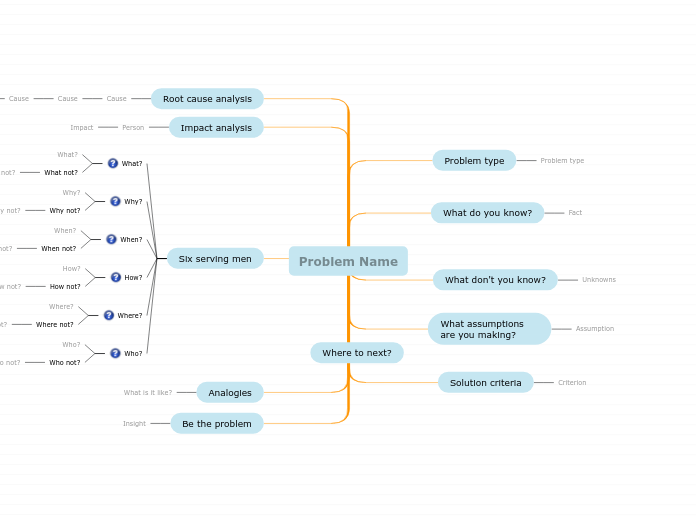
Researching and describing a problem is the foundation for solving it. This mind map takes you through a range of techniques for constructively and comprehensively describing a problem, before searching for solutions. Enter your problem's name and categorize it, whether you want to sort something out, create or just change something. Identify all the information you know as well as the one you don't know about it: include measurements, statistics, surveys or any known data together with uncertain or missing information, anything that will help you frame the entire difficulty. Specify the suppositions you make and think of results in case your presumptions are not valid. Give at least as much importance to the final outcome of a problem, as to the problem state itself. Try out the impersonation technique and be the problem as if it were a person. Once you do this, observe if anything changes, how things are perceived from this perspective, what are the opportunities and obstacles from this approach? Apply the problem analysis method 'Six serving men' and answer openly to each of the six essential questions, both positive and negative to better track the triggers and the situations when the problem manifests itself. The problem description toolbox goes hand in hand with the 5 Whys approach, so include it in the problem's final assessment and go to the root cause of the original issue. Where to next? Name the problem Add a statement describing the problem as if it were a person. What is 'Problem Name' like? Who does not cause 'Problem Name'? Who causes 'Problem Name'? Where does 'Problem Name' not happen? Where does 'Problem Name' happen? How does 'Problem Name' not happen? How does 'Problem Name' happen? When does 'Problem Name' not happen? When does 'Problem Name' happen? Why is 'Problem Name' not a problem? Why is 'Problem Name' a problem? What does not cause 'Problem Name'? What causes 'Problem Name'? Who is affected? How is Person affected by 'Problem Name'? Root Cause analysis Why does 'Problem Name' happen? Why does 'Cause' happen? Why does 'Cause' happen? Why does 'Cause' happen? Why does 'Cause' happen? Add solution criteria Add an assumption Add an unknown factor Add a piece of data Describe the problem type Карты ума помогают проводить мозговые штурмы, устанавливать взаимосвязи между понятиями, организовывать и генерировать идеи. Однако шаблоны mind map предлагают более простой способ начать работу, поскольку они представляют собой рамки, содержащие информацию о конкретном предмете с направляющими инструкциями. По сути, шаблоны mind map обеспечивают структуру, которая объединяет все элементы конкретной темы и служит отправной точкой для вашей личной mind map. Они представляют собой ресурс, обеспечивающий практическое решение для создания карты ума по определенной теме, будь то бизнес или образование. Mindomo предлагает вам умные шаблоны карт разума, которые позволят вам работать и думать без усилий. Вы можете выбрать один из множества шаблонов ментальных карт из бизнес- или образовательных аккаунтов Mindomo или создать свои собственные шаблоны ментальных карт с нуля. Любую карту мыслей можно превратить в карту-шаблон, добавив к одной из ее тем дополнительные направляющие заметки.Problem Analysis Template
Об этом шаблоне
Problem analysis template
Where to next?
When you have a comprehensive description of the problem, you can move towards finding solutions.
Consider brainstorming as a next step or Share the mind map with your colleagues.Problem Name
Identify the problem or issue in a few words and press Enter. This will become the title of your map.Be the problem
Insight
Analogies
What is it like?
For example, how would the problem behave at a wedding, at a concert, in a supermarket, or underwater?Six serving men
Who?
Who not?
Where?
Where not?
How?
How not?
When?
When not?
Why?
Why not?
What?
What not?
Impact analysis
Person
Type in a name or role of someone who is affected by 'Problem Name'Impact
Rate the impact by clicking an icon:Root cause analysis
For analytical problems, root cause analysis can help to unravel indirect causes of problems, leading to more effective solutions. One way to do this is to keep asking 'Why?' down to five levels, to understand the reasons behind the reasons.Cause
Enter a reason that 'Problem Name' happens.
Enter a reason that 'Cause' happens.
(Level 2 of 5)
Enter a reason that 'Cause' happens.
(Level 3 of 5)
Enter a reason that 'Cause' happens.
(Level 4 of 5)
Enter a reason that 'Cause' happens.
(Level 5 of 5)Solution criteria
Criterion
Make sure you consider:What assumptions are you making?
Assumption
Identify an assumption you are making in both the description of the problem and the logical solution.What don't you know?
Unknowns
Identify information or data that is not known or not reliable, and what you can do to find it. Think about:What do you know?
Fact
Add data or a reference to the problem. Think about:Problem type
Select the problem type or enter your own description.Зачем использовать шаблон карты ума Mindomo?
Шаблон обладает различными функциональными возможностями:
-
Продукты
-
Использование
- Общие применения
- Ментальные карты для образования
- Ментальные карты для бизнеса
- Ментальные карты для личного развития
- Технология вспомогательная
- Командное сотрудничество
- Брифы для маркетинговых кампаний
- Воркшопы по выявлению потребностей клиента для консультантов
- Маршруты онбординга для HR и L&D
- Управление знаниями
- Матрица навыков команды
- Библиотека проектов
- Роли
- Маркетологи
- HR и L&D
- Консультанты
- Управление проектами
- Планирование маркетинговых кампаний
- Развёртывание обучения сотрудников
- Объём работ
- Организация идей
- Деревья проблем
- Анализ потребностей в обучении
- Преимущества ментальных карт
-
Решения
- Руководства
- Создание презентаций с помощью ментальных карт
- Как учиться с помощью ментальных карт
- Планирование и организация с ментальными картами
- Как расставить приоритеты задач с помощью ментальных карт
- Как делать заметки с помощью ментальных карт
- Реальные истории клиентов
- Масштабирование образовательного контента для 11 000 врачей
- Командный workflow: от пробной версии до незаменимого инструмента за два месяца
- 10 лет без слайдов: новый взгляд на лекции по архитектуре
- Читать все истории
-
Ресурсы
- Основы
- Что такое ментальная карта?
- Топ 29 примеров ментальных карт
- Что такое концептуальная карта?
- Идеи для ментальных карт для студентов
- Руководства и Поддержка
- Видеоуроки
- Справочный центр
- Форум
- Примеры и шаблоны
- Идеи для ментальных карт
- Как создать ментальную карту?
- Страницы возможностей
- Образование
- Задания для учителей
- Рабочее и Личное
- Настольное
- Блог Mindomo
- Цены
- Войти
- Регистрация
- Панель управления
Управление знаниями
Преимущества ментальных карт
Почему визуальное мышление облегчает запоминание и планирование.
Основы
Руководства и Поддержка
Примеры и шаблоны
Страницы возможностей
 Блог
Блог Mindomo
Руководства, примеры и исследования о визуальном мышлении.
Все статьи
Блог
Блог Mindomo
Руководства, примеры и исследования о визуальном мышлении.
Все статьи