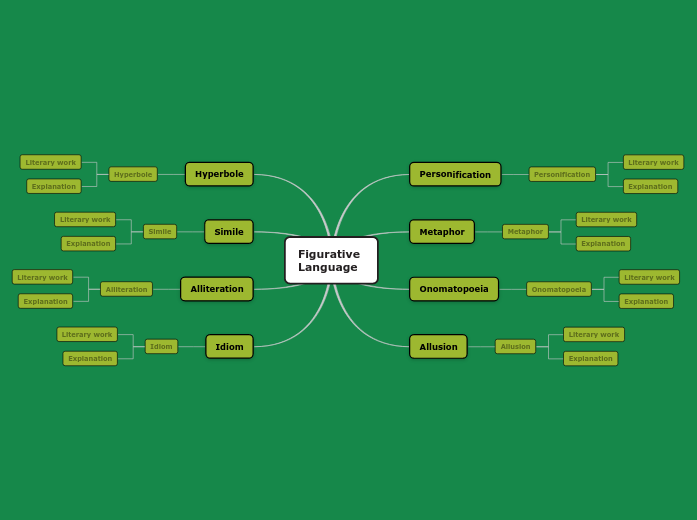
This template about figurative language will help you learn about each figure of speech: personification, simile, metaphor, onomatopoeia, allusion, idiom, alliteration, and hyperbole. You will have to think about a literary work where you find each of them, give an example and explain your choice. Use this template to learn the figurative language and think about examples for figures of speech so you can better understand each of them. Idiom is the figure of speech that uses a combination of words which challenges the conventional usage of those words. How do you explain your choice? Type in the explanation. What is the literary work in which you found the idiom? What genre is it? How do you explain your choice? What is the literary work Simile is a figure of speech that compares two objects through some connective word such as 'like', 'as', 'so', 'than', or a verb such as 'resembles'. How do you explain your choice? What is the literary work in which you found the simile? The hyperbole is a figure of speech that uses exaggerations to create emphasis or effect. How do you explain your choice? What is the literary work in which you found the hyperbole? Is it a novel, short story or poem? Allusion is the figure of speech that makes a reference to a well-known person, place, or thing in literature and history. How do you explain your choice? What is the literary work in which you found the allusion? What genre is it? Onomatopoeia is the figure of speech that uses words whose sounds suggest their meanings. Think of words related to water, air, collisions, sounds, voice, etc. How do you explain your choice? What is the literary work in which you found the onomatopoeia? Is it a novel, short story or poem? Metaphor is a figure of speech that compares two unlike things without using 'like' or 'as'. How do you explain your choice? What is the literary work in which you found the metaphor? Is it a novel, short story or poem? Personification is a figure of speech which gives human qualities to nonhuman things. How do you explain your choice? What is the literary work in which you found the personification? What is its genre? Every Mindomo template opens with its structure already in place: descriptive topics, guiding notes attached to the branches where people usually get stuck, and a default shape that new topics inherit. Edit it in the browser, switch it to a concept map, outline or Gantt chart without redrawing anything, and export it in more than twenty formats. See how mind map templates work, or browse the full gallery by category.About this template
Figurative language
Figurative Language
Find figures of speech in your favorite novels and poems.Idiom
What is the idiom that you found in the novel/poem?
Type it in.
Example: 'a stitch in time saves nine'.
Example:
- A timely effort saves you from much harder work later.
Example: Pie-IX: A Stitch in Time Saves Nine by Jaida Jones, K.J. Sturgeon - short story.Alliteration
Example:
- Almost all the words in the sentence begin with 'th'.
in which you found the alliteration? Type in the genre.
Example: Thank You for the Thistle by Dorie Thurston - short story.Simile
What simile did you find in the novel/poem? Type it in.
Example:
- 'Within the irregular arc of coral the lagoon was still as a mountain lake.'
Type in the explanation. Example:
- The lagoon is being compared with a mountain lake using the word 'as'.
Is it a novel, short story or poem?
Example: Lord of the flies by William Golding - novel.Hyperbole
What hyperbole did you find in the novel/poem? Type it in.
Example:
- 'All that we see or seem / Is but a dream within a dream.'
Type in the explanation.
Example:
- It is an exaggeration to claim that everything ('all we see or seem') is 'but a dream'.
Example: A dream within a dream by Edgar Allan Poe - poem.Allusion
What is the allusion that you found in the novel/poem? Type it in.
Example:
- 'Like a rich jewel in an Ethiop's ear'.
Example:
- Shakespeare makes an allusion of the Ethiopian slaves who wore expensive jewelry to express their masters' wealth.
Example: Romeo and Juliet by William Shakespeare - tragedyOnomatopoeia
What is the onomatopoeia that you found in the novel/poem? Type it in.
Example:
'The moan of doves in immemorial elms,
And murmuring of innumerable bees...'.
Example:
'Moan' and 'murmuring' refer to the way doves and bees sound like.
Example: Come Down, O Maid by Alfred Lord Tennyson - poemMetaphor
What is the metaphor that you found in the novel/poem? Type it in.
Example:
'The rain came down in long knitting needles.'
Example:
The rain is compared with 'long knitting needles', without the use of 'like' or 'as'.
Example:
National Velvet by Enid Bagnold - novel.Personification
Type in the personification you found in the novel/poem.
Example:
'- Not to-night, good Iago: I have very poor and unhappy brains for drinking.'Explanation
Type in the explanation.
Example:
The brain is given the attribute of being 'unhappy'.Literary work
Example:
Othello by William Shakespeare - tragedyWhy use a Mindomo mind map template?
-
Products
-
Uses
- General Uses
- Mind Maps for Education
- Mind Maps for Business
- Mind Maps for Personal Development
- Assistive Technology
- Team Collaboration
- Campaign briefs for marketers
- Client discovery workshops for consultants
- Onboarding journeys for HR & L&D
- Knowledge Management
- Team Skills Matrix
- Engagement Library
- Roles
- Marketers
- HR & L&D
- Consultants
- Project Management
- Marketing campaign planning
- Employee training rollouts
- Scope of Work
- Idea Organization
- Issue Trees
- Training Needs Analysis
- Mind Mapping Benefits
-
Solutions
- Guides
- Make Presentations with Mind Maps
- How to Learn with Mind Maps
- Plan and Organize with Mind Maps
- Prioritize Tasks with Mind Maps
- Take Notes with Mind Maps
- Real Customer Stories
- Scaling educational content for 11,000 doctors
- Team workflow: from trial to indispensable in two months
- 10 years without slides: rethinking architecture lectures
- Read all stories
-
Resources
- Learn the basics
- What is a Mind Map?
- How to Mind Map?
- What is a Concept Map?
- Benefits of Mind Mapping
- Guides & Support
- Video tutorials
- Help center
- Forum
- Examples & templates
- Top 29 Mind Map Examples
- Concept Map Templates
- Plan projects with a Gantt Chart Maker
- Mindomo's Efficiency in Education
- Feature pages
- Education
- Teacher Assignments
- Work & Personal
- Desktop
- The Mindomo blog
- Pricing
- Log In
- Sign Up
- Dashboard
Mind Mapping Benefits
Why visual thinking makes recall and planning easier.
Learn the basics
Guides & Support
Examples & templates
Feature pages
 Blog
The Mindomo blog
Guides, examples and research on visual thinking.
Browse all articles
Blog
The Mindomo blog
Guides, examples and research on visual thinking.
Browse all articles