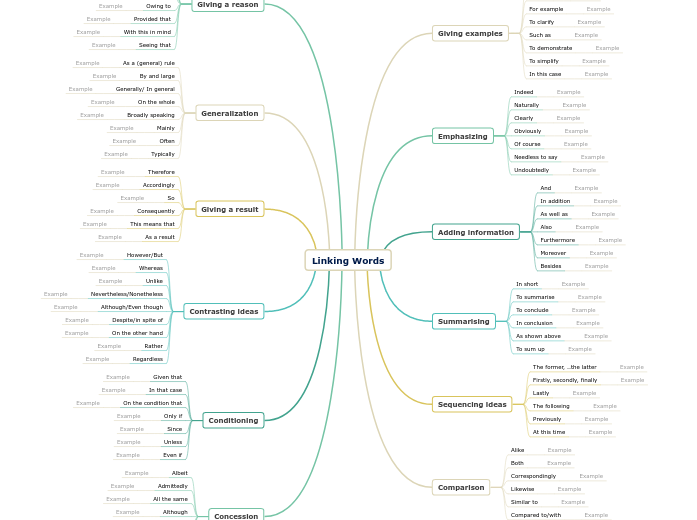
Use this mind map to have a view of the most usual situation when linking words are used and practice by creating various contexts. Learn the categories of linking words from this template and complete them with linking words examples to better understand them. Linking words help in connecting ideas and words in English. They are used to show contrast, connection, and condition between two things. Linking words used for giving examples: For instance Namely For example To clarify Such as To demonstrate To simplify In this case Linking words used for emphasizing: Indeed Naturally Clearly Obviously Of course Needless to say Undoubtedly Linking words used for adding information: And In addition As well as Also Furthermore Moreover Besides Linking words used for summarising: In short To summarise To conclude In conclusion As shown above To sum up Linking words used for sequencing ideas: The former, ..the latter Firstly, secondly, finally Lastly The following Previously At this time Linking words used for comparison: Alike Both Correspondingly Likewise Similar to Compared to/with Linking words used for a concession: Albeit Admittedly All the same Although And yet Even so Up to a point Linking words used for conditioning: Given that In that case On the condition that Only if Since Unless Even if Linking words used for contrasting ideas: However/But Whereas Unlike Nevertheless/Nonetheless Although/Even though Despite/in spite of On the other hand Rather Regardless Linking words used for giving a result: Therefore Accordingly So Consequently This means that As a result Linking words used for generalization: As a (general) rule By and large Generally/ In general On the whole Broadly speaking Mainly Often Typically Linking words used for giving a reason: Due to the fact that Because of Since As Owing to Provided that With this in mind Seeing that Linking words in any style of writing will help the reader to follow the flow of information. Use these words to accept a point or idea with reservation. These linking worss are used to provide a condition to what has been stated. However is the formal version of but. It is not normally used at the beginning of a sentence. Therefore, so, consequently and as a result are all used in a similar way. These words are used to make a general statement. Due to and owing to must be followed by a noun. Use these words to show how things are similar. These words are useful when you want to refer to one of two points, to list ideas. Use these words at the beginning of the sentence to give a summary of what has been said or written. Ideas are often linked by 'and'. In a list, you put a comma between each item, but not before and. These linking words are used to empashize a point. The most common way to give examples is by using for example or for instance. Write phrases to exercise! Mind maps hjælper dig med at brainstorme, etablere relationer mellem begreber, organisere og generere ideer. Mind map-skabeloner er dog en nemmere måde at komme i gang på, da de er rammer, der indeholder information om et specifikt emne med vejledende instruktioner. I bund og grund sikrer mind map-skabeloner den struktur, der kombinerer alle elementerne i et specifikt emne og fungerer som udgangspunkt for dit personlige mind map. De er en ressource, der giver en praktisk løsning til at lave et mind map om et bestemt emne, enten til erhverv eller uddannelse. Mindomo giver dig smarte mind map-skabeloner, der gør det muligt for dig at fungere og tænke ubesværet. Du kan vælge mellem en række mind map-skabeloner fra Mindomos erhvervs- eller uddannelseskonti, eller du kan lave dine egne mind map-skabeloner fra bunden. Ethvert mind map kan omdannes til et mind map-skabelon-map ved at tilføje yderligere vejledende noter til et af emnerne.Linking words examples
Om denne skabelon
Linking words examples
Linking Words
These will show contrast, connection, condition between two things.Concession
Up to a point
Even so
And yet
Although
All the same
Admittedly
Albeit
Conditioning
Even if
Unless
Only if
On the condition that
In that case
Given that
Contrasting ideas
Although, despite and in spite of introduce an idea of contrast.Regardless
Rather
On the other hand
Despite/in spite of
Although/Even though
Nevertheless/Nonetheless
Unlike
Whereas
However/But
Giving a result
So is more informal.As a result
This means that
Consequently
So
Accordingly
Therefore
Generalization
Typically
Often
Mainly
Broadly speaking
On the whole
Generally/ In general
By and large
As a (general) rule
Giving a reason
Because of is followed by a noun and can be used at the beginning or in the middle of a sentence. Since and as also mean because.Seeing that
With this in mind
Provided that
Owing to
As
Since
Because of
Due to the fact that
Comparison
Compared to/with
Similar to
Likewise
Correspondingly
Both
Alike
Sequencing ideas
The following is a good way of starting a list.At this time
Previously
The following
Lastly
Firstly, secondly, finally
The former, ..the latter
Summarising
To sum up
As shown above
In conclusion
To conclude
To summarise
In short
Adding information
Recommended not to start a sentence with also. Use instead In addition, or In addition to this.Besides
Moreover
Furthermore
Also
As well as
In addition
And
Emphasizing
Undoubtedly
Needless to say
Of course
Obviously
Clearly
Naturally
Indeed
Giving examples
Namely refers to something by name.In this case
To simplify
To demonstrate
Such as
To clarify
For example
Namely
For instance
Example
Hvorfor bruge en Mindomo mind map-skabelon?
En skabelon har forskellige funktioner:
-
Produkter
-
Anvendelser
- Generelle anvendelser
- Mind Maps til Uddannelse
- Mind Maps til Forretning
- Mind Maps til Personlig Udvikling
- Hjælpemiddelteknologi
- Teamsamarbejde
- Kampagnebriefs til marketingfolk
- Workshops om kundeafdækning for konsulenter
- Onboardingforløb for HR og L&D
- Videnstyring
- Team-kompetencematrix
- Projektbibliotek
- Roller
- Marketingfolk
- HR og L&D
- Konsulenter
- Projektledelse
- Planlægning af marketingkampagner
- Udrulning af medarbejderuddannelse
- Arbejdsomfang
- Idéorganisering
- Problemtræer
- Uddannelsesbehovsanalyse
- Fordele ved Mind Mapping
-
Løsninger
- Guider
- Lav præsentationer med mind maps
- Lær med mind maps
- Planlæg og organiser med mind maps
- Prioritér opgaver med mind maps
- Tag noter med mind maps
- Ægte kundehistorier
- Skalering af uddannelsesindhold til 11.000 læger
- Teamworkflow: fra prøve til uundværlig på to måneder
- 10 år uden slides: genoverveje arkitekturforelæsninger
- Læs alle historier
-
Ressourcer
- Lær det grundlæggende
- Hvad er et Mind Map?
- Hvordan laver man et Mind Map?
- Vejledninger & Support
- Videovejledninger
- Hjælpecenter
- Forum
- Eksempler og skabeloner
- Top 29 eksempler på Mind Maps
- Hvad er et Konceptkort?
- Funktionssider
- Uddannelse
- Læreropgaver
- Arbejde & Personligt
- Desktop
- Mindomo-bloggen
- Priser
- Log ind
- Tilmeld
- Dashboard
Fordele ved Mind Mapping
Hvorfor visuel tænkning gør det lettere at huske og planlægge.
Lær det grundlæggende
Vejledninger & Support
Eksempler og skabeloner
Funktionssider
 Blog
Mindomo-bloggen
Guides, eksempler og forskning om visuel tænkning.
Se alle artikler
Blog
Mindomo-bloggen
Guides, eksempler og forskning om visuel tænkning.
Se alle artikler