
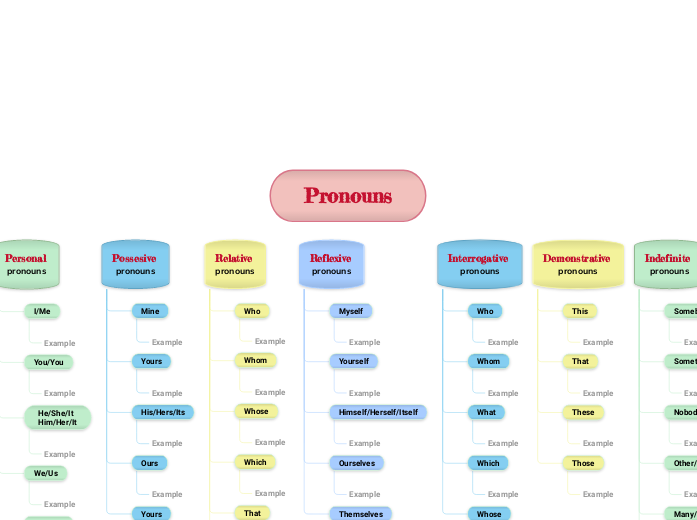
Use this mind map to understand how pronouns are used in different situations and practice by creating contexts. Use this template to learn the pronouns in English. Pronouns are the parts of speech used instead of nouns to avoid repetition. Depending on the situations in which they are used, they have different forms. The types of pronouns are: Personal pronouns Possessive pronouns Relative pronouns Reflexive pronouns Demonstrative pronouns Interrogative pronouns Indefinite pronouns Personal pronouns are the pronouns that refer to specific people or things. They can change depending on the person, number, gender, or case. Examples of personal pronouns, singular and plural form: I/Me You/You He/She/It Him/Her/It We/Us You/You They/Them Possessive pronouns show that something belongs to someone. Examples of possessive pronouns: Mine Yours His/Hers/Its Ours Yours Relative pronouns describe nouns in terms of how they relate to other words. Examples of relative pronouns: Who Whom Whose Which That What Reflexive pronouns are used when the subject of a sentence is also the object of the sentence. Examples of reflexive pronouns: Myself Yourself Himself/Herself/Itself Ourselves Themselves Demonstrative pronouns point to and identify a noun or a pronoun. They are used in place of particular things to show which one we’re discussing. Examples of demonstrative pronouns: Somebody/Someone Something/Anything Nobody/Nothing All Other/Another Both/Each Many/Most Some/Few None Such Interrogative pronouns are the pronouns used in questions. In sentences, when the pronoun is a subject, the verb will precede the pronoun. Examples of interrogative pronouns: Who Whom What Which Whose ’Who’ and ‘whom’ are used to refer to people and which is used for animals and things. Indefinite pronouns refer to a thing or person that is identifiable, but not specified. Examples of indefinite pronouns: This That These Those Complete the template by adding examples of phrases with these pronouns. In this way, you will retain information easier. Pronouns - a word that can function as a noun phrase used by itself and that refers either to the participants in the discourse. An indefinite pronoun is a pronoun that refers to a person or a thing without being specific. Demonstrative pronouns are pronouns that point to specific objects. They function as subjects or objects. An interrogative word or question word is a function word used to ask a question, Reflexive pronouns are words ending in -self or -selves that are used when the subject and the object of a sentence are the same. They refer back to an earlier noun or pronoun. A relative pronoun is a pronoun that marks a relative clause. They link one part of a sentence to another. Possessive pronouns show that something belongs to someone. Replaces noun in phrases. Personal pronouns are pronouns that are associated primarily with a particular grammatical person – They represents people places or things. Write phrases as examples. Mindmaps hjælper dig med at brainstorme, skabe sammenhænge mellem begreber og organisere og generere ideer. Mindmap-skabeloner gør det dog nemmere at komme i gang, fordi de er rammer med information om et bestemt emne og vejledende instruktioner. Mindmap-skabeloner giver dig grundlæggende den struktur, der samler alle elementerne i et bestemt emne, og fungerer som udgangspunkt for dit eget mindmap. De er en praktisk ressource, når du skal lave et mindmap om et bestemt emne, uanset om det er til arbejde eller uddannelse. Mindomo giver dig smarte mindmap-skabeloner, så du kan arbejde og tænke ubesværet. Du kan vælge mellem en række mindmap-skabeloner fra Mindomos erhvervs- og uddannelseskonti, eller du kan lave dine egne mindmap-skabeloner fra bunden. Ethvert mindmap kan gøres til en mindmap-skabelon ved at tilføje vejledende noter til et af emnerne.English Pronouns
Om denne skabelon
Pronouns in English
Personal pronouns in English
Possessive pronouns in English
Relative pronouns in English
Reflexive pronouns in English
Demonstrative pronouns in English
Interrogative pronouns in English
Indefinite pronouns in English
Pronouns
Indefinite pronouns
None/Some/Few
Many/Most/Such
Other/Another
Nobody/Nothing
Something/Anything
Somebody/Someone
Demonstrative pronouns
Those
These
This
Interrogative pronouns
Reflexive pronouns
Themselves
Ourselves
Himself/Herself/Itself
Yourself
Myself
Relative pronouns
What
That
Which
Whose
Whom
Who
Possesive pronouns
Ours
His/Hers/Its
Yours
Mine
Personal pronouns
They/Them
We/Us
He/She/It Him/Her/It
You/You
I/Me
Example
Hvorfor bruge en mindmap-skabelon fra Mindomo?
En skabelon har forskellige funktioner:
-
Produkter
-
Anvendelser
- Generelle anvendelser
- Mindmaps til uddannelse
- Mindmaps til erhvervslivet
- Mindmaps til personlig udvikling
- Hjælpemiddelteknologi
- Teamsamarbejde
- Kampagnebriefs til marketingfolk
- Workshops om kundeafdækning for konsulenter
- Onboardingforløb for HR og L&D
- Videnstyring
- Kompetencematrix for teamet
- Projektbibliotek
- Roller
- Marketingfolk
- HR og L&D
- Konsulenter
- Projektledelse
- Planlægning af marketingkampagner
- Udrulning af medarbejderuddannelse
- Arbejdsbeskrivelse
- Idéorganisering
- Problemtræer
- Uddannelsesbehovsanalyse
- Fordele ved mindmapping
-
Løsninger
- Guider
- Lav præsentationer med mindmaps
- Lær med mindmaps
- Planlæg og organiser med mindmaps
- Prioritér opgaver med mindmaps
- Tag noter med mindmaps
- Ægte kundehistorier
- Skalering af uddannelsesindhold til 11.000 læger
- Teamworkflow: fra afprøvning til uundværlig på to måneder
- 10 år uden slides: arkitekturforelæsninger gentænkt
- Læs alle historier
-
Ressourcer
- Lær det grundlæggende
- Hvad er et mindmap?
- Hvordan laver man et mindmap?
- Vejledninger og support
- Videovejledninger
- Hjælpecenter
- Forum
- Eksempler og skabeloner
- Top 29 eksempler på mindmaps
- Hvad er et konceptkort?
- Funktionssider
- Uddannelse
- Læreropgaver
- Arbejde og privat
- Desktop
- Mindomo-bloggen
- Priser
- Log ind
- Tilmeld dig
- Dashboard
Fordele ved mindmapping
Hvorfor visuel tænkning gør det lettere at huske og planlægge.
Lær det grundlæggende
Vejledninger og support
Eksempler og skabeloner
Funktionssider
 Blog
Mindomo-bloggen
Guides, eksempler og forskning om visuel tænkning.
Se alle artikler


