
by Mindomo Team 1 year ago 304780 Atoms are composed of neutrons, electrons, and protons. Electrons are negatively charged, while protons have a positive charge. Neutrons carry no charge. The arrangement of electrons around the nucleus in different shells determines the electronic configuration of an atom. ions are positively charged metals cations ions are negatively charged non-metals anions 4-8 non-metalic 1-2 metallic aliminium with 3 is an exception atoms of same elements phosphorus chlorine oxygen hydrogen nitrogen atoms of different elements hydrochloric acid carbon dioxide water ammonia methane boilling point melting point density same electronic configuration of both isotopesAtom structure
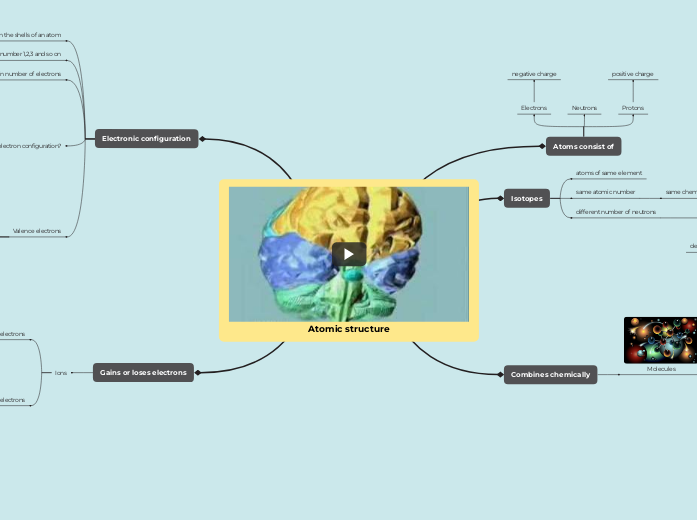
Atomic structure
Gains or loses electrons
Ions
Lose electrons
Gain electrons
Electronic configuration
Valence electrons
nature of elements determined by the number of valence electrons
outermost shell=shell furthest from the nucleus
find in outermost occupied shell of an atoms
How to find electron configuration?
electrons start occupying new shells when previous ones are occupied
arrange electrons in shells
find the derived number of electrons
find the proton number of the atom
each shell can occupy a certain number of electrons
shells number 1,2,3 and so on
electrons arranged around the nucleus in the shells of an atom
Combines chemically
Molecules
of elements
of compounds
Isotopes
different number of neutrons
different physical properties
same atomic number
same chemical properties
atoms of same element
Atoms consist of
Protons
positive charge
Neutrons
Electrons
negative charge
-
Products
-
Uses
- General Uses
- Mind Maps for Education
- Mind Maps for Business
- Mind Maps for Personal Development
- Assistive Technology
- Team Collaboration
- Campaign briefs for marketers
- Client discovery workshops for consultants
- Onboarding journeys for HR & L&D
- Knowledge Management
- Team Skills Matrix
- Engagement Library
- Roles
- Marketers
- HR & L&D
- Consultants
- Project Management
- Marketing campaign planning
- Employee training rollouts
- Scope of Work
- Idea Organization
- Issue Trees
- Training Needs Analysis
- Mind Mapping Benefits
-
Solutions
- Guides
- Make Presentations with Mind Maps
- How to Learn with Mind Maps
- Plan and Organize with Mind Maps
- Prioritize Tasks with Mind Maps
- Take Notes with Mind Maps
- Real Customer Stories
- Scaling educational content for 11,000 doctors
- Team workflow: from trial to indispensable in two months
- 10 years without slides: rethinking architecture lectures
- Read all stories
-
Resources
- Learn the basics
- What is a Mind Map?
- How to Mind Map?
- What is a Concept Map?
- Benefits of Mind Mapping
- Guides & Support
- Video tutorials
- Help center
- Forum
- Examples & templates
- Top 29 Mind Map Examples
- Concept Map Templates
- How to Make a Gantt Chart
- Mindomo's Efficiency in Education
- Feature pages
- Education
- Teacher Assignments
- Work & Personal
- Desktop
- The Mindomo blog
- Pricing
- Log In
- Sign Up
- Dashboard
Mind Mapping Benefits
Why visual thinking makes recall and planning easier.
Learn the basics
Guides & Support
Examples & templates
Feature pages
 Blog
The Mindomo blog
Guides, examples and research on visual thinking.
Browse all articles
Blog
The Mindomo blog
Guides, examples and research on visual thinking.
Browse all articles