Improve your chances by planning for emergency situations in advance. The process of identifying risks can reveal gaps in normal operations. Use this business continuity plan template to identify risks and improve your chances of success. There are different types of risks: staff risk, physical risk, IT risk, operations risk, legal/financial risk, PR risk, etc. Try to understand their impact and to find ways of detection, recovery, and prevention. Add your team member’s name in the template, ensuring that you have representation for many departments. Choose a critical staff member. He should be prepared with recovery strategies in case of a major incident. Add a core service or function and a critical supplier. Add a communication audience to whom you will communicate your plan in case they will need to take action. Think about ways to train your employees in order to be prepared in case an incident occurs. Add a milestone for your business continuity plan. Where to next? Type in your organization's name Add a critical supplier for your organization Add a core service or function Add a critical staff member Add a team member Add a milestone for your business continuity planning project, and set dates. Who needs to be trained in your emergency procedures? What action will you take to train 'Trainee'? Add a communication audience What action will you take to communicate with 'Audience'? What will they need to know? Add a location where you have people, assets, and operations that will be covered by your plan. Are there any other risks not covered above? What is the impact of "Other risks" on your business? What level of resources is appropriate for dealing with it and recovering from it? Incident detection and notification Add recovery procedures Add prevention measures Add a PR risk that may affect your business What is the impact of "PR risk" on your business? What level of resources is appropriate for dealing with it and recovering from it? Add prevention measures Add recovery procedures Incident detection and notification Add a legal or financial risk that may affect your business. Incident detection and notification Add prevention measures What is the impact of "Legal / financial risk" on your business? What level of resources is appropriate for dealing with it and recovering from it? Add recovery procedures Add a operations' risk that may affect your business. Add prevention measures What is the impact of "Operations risk" on your business? What level of resources is appropriate for dealing with it and recovering from it? Add recovery procedures Incident detection and notification Add a IT risk that may affect your business. What is the impact of "IT risk" on your business? What level of resources is appropriate for dealing with it and recovering from it? Incident detection and notification Add prevention measures Add recovery procedures Add a physical risk that may affect your business. Add recovery procedures What is the impact of "Physical risk" on your business? What level of resources is appropriate for dealing with it and recovering from it? Timeframe How quickly will "Impact" happen? Add prevention measures Incident detection and notification Add a business risk that may originate from your staff. Prevention Add prevention measures Recovery Procedure Add recovery procedures Detection Incident detection and notification Impact What is the impact of "Staff risk" on your business? What level of resources is appropriate for dealing with it and recovering from it? Mindmappen helpen je brainstormen, relaties leggen tussen concepten, organiseren en ideeën genereren. Lege mindmapsjablonen bieden echter een eenvoudigere manier om aan de slag te gaan, omdat het kaders zijn die informatie bevatten over een specifiek onderwerp met begeleidende instructies. In essentie zorgen mindmapsjablonen voor de structuur die alle elementen van een specifiek onderwerp combineert en als startpunt dient voor je persoonlijke mindmap. Ze zijn een hulpmiddel om een praktische oplossing te bieden voor het maken van een mindmap over een bepaald onderwerp, zowel voor het bedrijfsleven als voor het onderwijs. Mindomo brengt je slimme mindmap templates waarmee je moeiteloos kunt functioneren en denken. Je kunt kiezen uit verschillende mind map templates van Mindomo's zakelijke of educatieve accounts, of je kunt je eigen mind map templates maken. Elke mindmap kan getransformeerd worden in een mindmap template map door extra notities toe te voegen aan één van de onderwerpen.Business continuity plan template
Close them before anything happens to reduce your exposure to risk.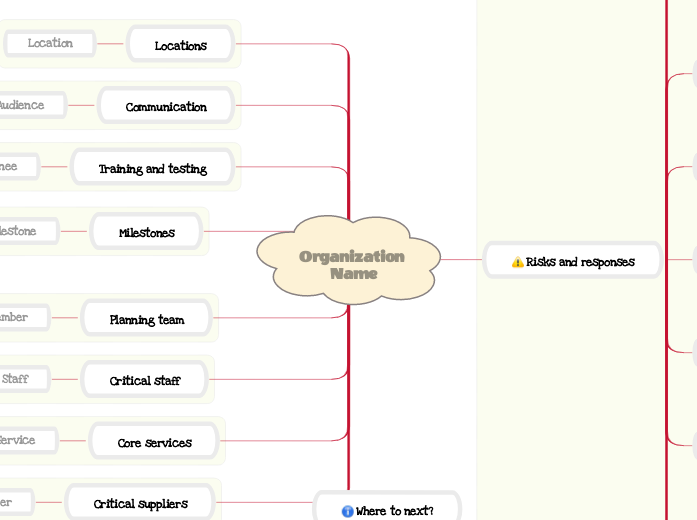
Over dit sjabloon
Business continuity plan template
Where to next?
Download this mind map to keep track of your business continuity planning project.Organization Name
Critical suppliers
Supplier
Where would failure in the supply chain cause significant problems?
These suppliers should be referenced in the risks section, and you should have a recovery strategy to cope with problems with your suppliers.Core services
Service
Core services are the ones that are critical to the survival of your organization - the ones without which you would not have customers or business.
These services or functions should be the first to be recovered in the event of a disaster.Critical staff
Critical staff members are the ones on whom you will depend when a major incident occurs.
You will need to ensure that your critical staff members are trained and can be easily contacted.
Make sure that a copy of the contact list is kept off-site.Planning team
Team member
Ensure that you have representation for:Milestones
Milestone
Think about:Training and testing
Trainee
Consider:
Consider:Communication
Audience
Who will you need to communicate parts of your plan to? Who needs to take action, stay informed or be reassured?
Consider:Action
Think about:Locations
Location
Risks and responses
Other risks
Rate the impact by clicking an icon:
If the impact from "Other risks" is not minor:Public relations
PR risk
Also think about things that your customers will notice, even if they are not widely publicized:
Rate the impact by clicking an icon:
If the impact from "PR risk" is not minor:Legal & financial
Legal / financial risk
Think about:
Rate the impact by clicking an icon:
If the impact from "Legal / financial risk" is not minor:Operations
Operations risk
Think about:
Rate the impact by clicking an icon:
If the impact from "Operations risk" is not minor:Information security
IT risk
Think about:
Rate the impact by clicking an icon:
If the impact from "IT risk" is not minor:Physical security
Physical risk
Think about:
If the impact from "Physical risk" is not minor:
Rate the impact by clicking an icon:
How quickly will this impact materialize? Faster responses are needed for fast-acting impacts.
Estimate a timeframe by clicking an icon below.Staff
Staff risk
Think about:
If the impact from "Staff risk" is not minor:
Rate the impact by clicking an icon:Waarom een Mindomo mindmap template gebruiken?
Een sjabloon heeft verschillende functionaliteiten:
-
Producten
-
Toepassingen
- Algemene toepassingen
- Mindmaps voor Onderwijs
- Mindmaps voor Bedrijven
- Mindmaps voor Persoonlijke Ontwikkeling
- Ondersteunende Technologie
- Teamsamenwerking
- Campagnebriefs voor marketeers
- Workshops voor klantverkenning voor consultants
- Onboardingtrajecten voor HR en L&D
- Kennismanagement
- Teamvaardighedenmatrix
- Opdrachtenbibliotheek
- Rollen
- Marketeers
- HR en L&D
- Consultants
- Projectmanagement
- Marketingcampagneplanning
- Uitrol van medewerkerstrainingen
- Werkomvang
- Ideeënorganisatie
- Probleembomen
- Opleidingsbehoefteanalyse
- Voordelen van Mindmappen
-
Oplossingen
- Gidsen
- Maak presentaties met mindmaps
- Leer met mindmaps
- Plan en organiseer met mindmaps
- Hoe prioriteer je taken met mindmaps
- Hoe maak je notities met mindmaps
- Echte klantverhalen
- Educatieve content opschalen voor 11.000 artsen
- Teamworkflow: van proef naar onmisbaar in twee maanden
- 10 jaar zonder slides: architectuurcolleges heroverwogen
- Alle verhalen lezen
-
Hulpbronnen
- De basis
- Wat is een Mindmap?
- Hoe maak je een Mindmap?
- Wat is een Conceptmap?
- Mindmap ideeën voor studenten
- Handleidingen & Support
- Videohandleidingen
- Helpcentrum
- Forum
- Voorbeelden en sjablonen
- Mindmap ideeën
- Ondersteunende Technologie Tool
- Top 29 Mindmap Voorbeelden
- Functiepagina's
- Onderwijs
- Opdrachten voor docenten
- Werk & Persoonlijk
- Desktop
- De Mindomo-blog
- Prijzen
- Inloggen
- Aanmelden
- Dashboard
Voordelen van Mindmappen
Waarom visueel denken onthouden en plannen makkelijker maakt.
De basis
Handleidingen & Support
Voorbeelden en sjablonen
Functiepagina's
 Blog
De Mindomo-blog
Gidsen, voorbeelden en onderzoek over visueel denken.
Alle artikelen bekijken
Blog
De Mindomo-blog
Gidsen, voorbeelden en onderzoek over visueel denken.
Alle artikelen bekijken