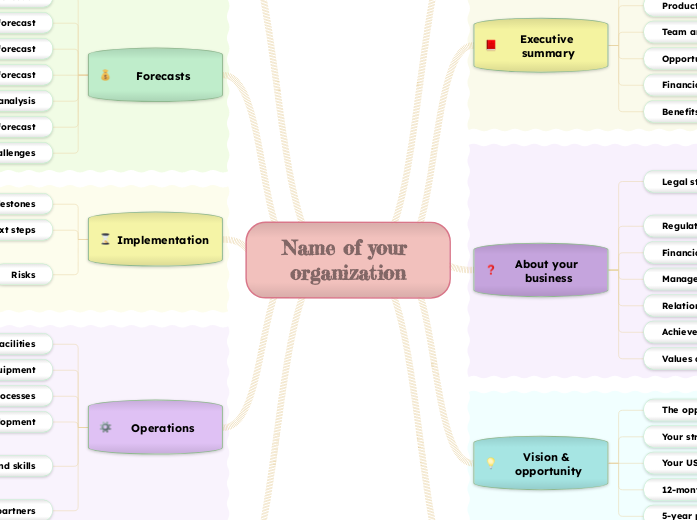
This mind map acts as a dashboard for developing a business plan. It helps you organize your research and data, and answer the questions that an investor will ask. For an efficient business plan, you need to consider several key elements. First of all, you need to protect your confidential and business-sensitive documents so begin yours with a non-disclosure agreement. Then brainstorm your executive summary and take into account the mission statement, products or services, and financial requirements. It is quite a complex document to put together so create a detailed overview of your business, vision, values, and opportunities and research your market to come up with a viable marketing and sales strategy. Forecasting and actual implementation of the project are the last steps and the most important ones, so make sure you devote some time to this process. Type in the name of your organization and press Enter. The question that investors will ask is How will you turn your forecasts into reality? Describe exactly what customers will buy, how they will buy it, how it will be provided or delivered, and how it will be supported after purchase. What campaigns are you planning to publicize your product or service? Examples include: List the ways that you can reach your market segments. Examples include: Add a description of your market research. How will the operations of your organization need to change, to support this plan? Add a supplier or partner. Add staff, knowledge or skills. What new processes will you need to establish? Do you need to change existing processes? Add a process. What new equipment and tools will you need? Will you replace old ones, or extend your capacity? How will your facilities need to change to implement your plan? If you win the investment or support that you need, where will you start? Add a risk. Add the next step. What are the key points in the implementation of your plan? How will you know that you are making real progress? Add a milestone. You will need credible forecasts of profitability and strategic benefits if you are proposing investment in your business. What is the impact on your strategy of this initiative? How will your strategy change to ensure that you can adapt to whatever this plan brings, whether it is good or not so good? Think about: Add a strategic point. Even if your plan will eventually be profitable, cashflow limitations could prevent you from getting there. Your cash flow forecast should show that you are in control of this. Add a key point from the cashflow forecast. Your breakeven analysis should show the minimum level of achievement that is still survivable. If operations go below breakeven, then you will need to take evasive action. Make forecasts for: Your profit and loss (or income) forecasts should detail where, when and how profitability will be achieved. How will your balance sheet change as a result of this initiative? Add a key point from the balance sheet forecast. How will your costs base change as a result of your initiatives? Think about: Add a key point from the costs forecast. How will sales increase as a result of your initiatives? Think about: Add a key point from the sales forecast. It must be clear to investors what you are asking for, when you need it and when & how it will be repaid - in short, what value they will get for their investment. Add highlights of the return or repayment plan for investors. Consider: Add a sum-up of how this investment will be spent. Include: Add a summary of how much is required and when. Investors will ask: how well do you know your customers and your market? Your business plan should show that you are targeting your market by well-defined segments and are focused on creating value for customers. Add an organization that can compete with you, either now or in the future. Think about all alternatives that the customer may have, including doing nothing or addressing their problem in a completely different way. Strategies Strategy How will you compete effectively? Weaknesses Weakness What do the competitors do that is less attractive than your product or service? Strengths Strength What do the competitors do that is more attractive than your product or service? Describe the competing product or service Who are your customers? Add a target customer segment. Groupings might include: Additional info Solutions What solutions are you offering for customers in this segment? What value do you create for them? Needs What are the needs and interests of the customers in this segment? What do they value? How do they select their purchases? Pain points What problems and pain points do the customers in this segment face? Profile What is the characteristic of the customers in this segment? Segment size Size What is the estimated size and value of this segment? Add some key points about the industry you are working in. Describe the vision and the opportunity that the plan is based on. Where do you want to be in 5 years? Where do you want to be in 12 months? Where would you like to be in terms of: Add a key point about your Unique Selling Point. Your USP is what will lead marketing, and help customers to choose you over alternatives. In comparison to the alternatives, why will your product or service... Add a key point about your strategy. Add a key point about the opportunity that you are pursuing. Provide your investors with a clear picture of your business: how it is structured, who owns it, who runs it, and how it is doing so far? Add some information about the values and principles of your company. Add some information about your successes and achievements. Think about: Add some information about important partnerships. Think about: Who are the key members of your management team, and what are their skills and experience? Add some information about the capital finance situation at your company. Add some information about the regulatory environment that affects your company. Apart from company law, what other regulations apply to your sector? Consider: Add some information about the governance of your organization. What is the legal status of your organization? Are you a sole trader, a limited company with shareholders, or a non-profit? Although the executive summary appears first in the document, it is easier to complete it last, when you can summarise and prioritize the key points in your plan. List the benefits that will come from pursuing this opportunity. Include: List the financial aid and other support that you are seeking, so that you can take advantage of this opportunity. Briefly summarise the opportunity that your plan describes, and why it is strategic for your company. Add the key points about the track record of your team and your capabilities. Add short descriptions of the key products and services which bring your mission to life and are making it happen. Summarise the value and the difference that your organization aims to create. Mission statements are more useful if they describe the difference that you want to make to your customer's lives, rather than what you want to achieve personally. Your mission statement should directly influence strategic decisions. Your business plan is a commercially sensitive document and you may wish to add a confidentiality statement (or non-disclosure agreement) at the front of the document. Every Mindomo template opens with its structure already in place: descriptive topics, guiding notes attached to the branches where people usually get stuck, and a default shape that new topics inherit. Edit it in the browser, switch it to a concept map, outline or Gantt chart without redrawing anything, and export it in more than twenty formats. See how mind map templates work, or browse the full gallery by category.Steps on how to make a business plan
About this template
All the necessary steps on how to make a business plan
Name of your organization
Marketing & sales
Having identified your product or service, and the demand for it in the market, how will you reach that market?What you will sell
Think about:Campaigns
Campaign
Routes to market
Route to market
Market research
What market research have you done to identify the best routes to market for your particular segment?Operations
Investors will need to know that you will also have the capabilities to deliver it, sustain it and scale it up.Suppliers and partners
Supplier or partner
Staff, knowledge and skills
Staff and skills
Development
Processes
Process
Processes include:Equipment
Add capital equipment.Facilities
Facility
Will you need new premises or changes to existing premises?
Add a facility.Implementation
Risks
Risk
Next steps
Next step
Milestones
Milestone
Think about:Forecasts
Strategic challenges
Strategic highlights
Cashflow forecast
Cashflow highlight
Consider:Breakeven analysis
Breakeven highlight
Profit and loss forecast
Profit and loss highlight
Add a highlight from your Profit and Loss forecast.
Consider making forecasts for year 1, year 2 and year 3 of your plan.Balance sheet forecast
Balance sheet highlight
Costs forecast
Cost highlight
Sales forecast
Sales highlight
Returns and repayments
Return or repayment
Purpose
Investment purpose
Schedule
Investment schedule
The market
Competitors
Competitor
Add an element of your competitive strategy. Think about:
Do they have:
Do they have:Customers
Customer segment
Add a solution.
Add a customer need.
Add a pain point.
How do you identify your potential customers?
Add a characteristic of the future customer.
What proportion of the segment is potential customer for you, taking into account competitors, market maturity and demand?Market position
The industry
About the industry
Vision & opportunity
The investor's question you answer here is Where are you headed, and why?5-year plan
Long term goal
Where would you like to be in terms of:12-month plan
Short term goal
Your USP
Describe your USP
Your strategy
Describe your strategy
How does this opportunity...The opportunity
Describe the opportunity
About your business
Values and principles
Value or principle
Achievements and track record
Achievement
Relationships and partnerships
Relationship
Management team
Key team member
Financial status
Financial structure
Regulatory environment
Regulatory condition
Legal status
Governance
Executive summary
Benefits
Financial requirements
Requirements
Opportunity
Team and track record
Track record
Products & Services
Product or service
Mission statement
Your mission
Statement of confidentiality
Type in or attach your statement of confidentialityConfidentiality document
Why use a Mindomo mind map template?
-
Products
-
Uses
- General Uses
- Mind Maps for Education
- Mind Maps for Business
- Mind Maps for Personal Development
- Assistive Technology
- Team Collaboration
- Campaign briefs for marketers
- Client discovery workshops for consultants
- Onboarding journeys for HR & L&D
- Knowledge Management
- Team Skills Matrix
- Engagement Library
- Roles
- Marketers
- HR & L&D
- Consultants
- Project Management
- Marketing campaign planning
- Employee training rollouts
- Scope of Work
- Idea Organization
- Issue Trees
- Training Needs Analysis
- Mind Mapping Benefits
-
Solutions
- Guides
- Make Presentations with Mind Maps
- How to Learn with Mind Maps
- Plan and Organize with Mind Maps
- Prioritize Tasks with Mind Maps
- Take Notes with Mind Maps
- Real Customer Stories
- Scaling educational content for 11,000 doctors
- Team workflow: from trial to indispensable in two months
- 10 years without slides: rethinking architecture lectures
- Read all stories
-
Resources
- Learn the basics
- What is a Mind Map?
- How to Mind Map?
- What is a Concept Map?
- Benefits of Mind Mapping
- Guides & Support
- Video tutorials
- Help center
- Forum
- Examples & templates
- Top 29 Mind Map Examples
- Concept Map Templates
- Plan projects with a Gantt Chart Maker
- Mindomo's Efficiency in Education
- Feature pages
- Education
- Teacher Assignments
- Work & Personal
- Desktop
- The Mindomo blog
- Pricing
- Log In
- Sign Up
- Dashboard
Mind Mapping Benefits
Why visual thinking makes recall and planning easier.
Learn the basics
Guides & Support
Examples & templates
Feature pages
 Blog
The Mindomo blog
Guides, examples and research on visual thinking.
Browse all articles
Blog
The Mindomo blog
Guides, examples and research on visual thinking.
Browse all articles