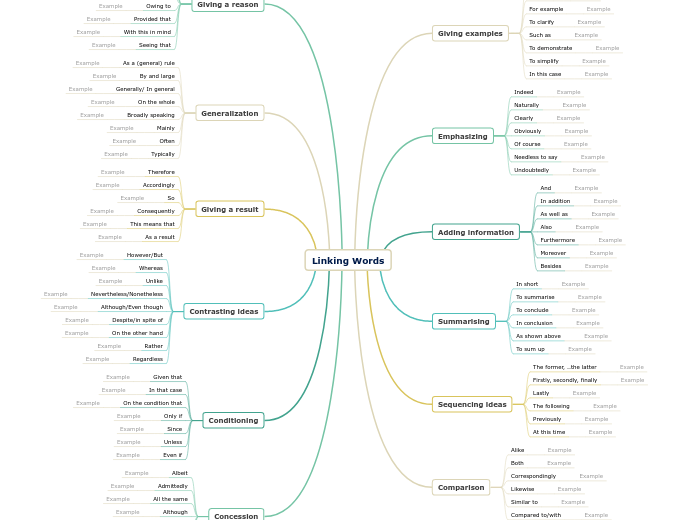
Learn the categories of linking words from this template and complete them with linking words examples to better understand them. Linking words help in connecting ideas and words in English. They are used to show contrast, connection, and condition between two things. Linking words used for giving examples: For instance Namely For example To clarify Such as To demonstrate To simplify In this case Linking words used for emphasizing: Indeed Naturally Clearly Obviously Of course Needless to say Undoubtedly Linking words used for adding information: And In addition As well as Also Furthermore Moreover Besides Linking words used for summarising: In short To summarise To conclude In conclusion As shown above To sum up Linking words used for sequencing ideas: The former, ..the latter Firstly, secondly, finally Lastly The following Previously At this time Linking words used for comparison: Alike Both Correspondingly Likewise Similar to Compared to/with Linking words used for a concession: Albeit Admittedly All the same Although And yet Even so Up to a point Linking words used for conditioning: Given that In that case On the condition that Only if Since Unless Even if Linking words used for contrasting ideas: However/But Whereas Unlike Nevertheless/Nonetheless Although/Even though Despite/in spite of On the other hand Rather Regardless Linking words used for giving a result: Therefore Accordingly So Consequently This means that As a result Linking words used for generalization: As a (general) rule By and large Generally/ In general On the whole Broadly speaking Mainly Often Typically Linking words used for giving a reason: Due to the fact that Because of Since As Owing to Provided that With this in mind Seeing that Linking words in any style of writing will help the reader to follow the flow of information. Use these words to accept a point or idea with reservation. These linking worss are used to provide a condition to what has been stated. However is the formal version of but. It is not normally used at the beginning of a sentence. Therefore, so, consequently and as a result are all used in a similar way. These words are used to make a general statement. Due to and owing to must be followed by a noun. Use these words to show how things are similar. These words are useful when you want to refer to one of two points, to list ideas. Use these words at the beginning of the sentence to give a summary of what has been said or written. Ideas are often linked by 'and'. In a list, you put a comma between each item, but not before and. These linking words are used to empashize a point. The most common way to give examples is by using for example or for instance. Write phrases to exercise! Mindmaps helfen beim Brainstorming, zeigen Beziehungen zwischen Konzepten, organisieren und generieren Ideen. Mindmap-Vorlagen bieten einen einfacheren Einstieg, da sie Rahmenbedingungen enthalten, die Informationen und Anleitung zu einem spezifischen Thema bieten. Sie liefern eine Struktur, die alle Elemente eines Themas verbindet und dienen als Ausgangspunkt für Ihre persönliche Mindmap, sowohl für geschäftliche als auch pädagogische Zwecke. Mindomo bietet intelligente Mindmap-Vorlagen, die Ihnen müheloses Arbeiten und Denken ermöglichen. Sie können aus einer Vielzahl von Mindmap-Vorlagen aus Mindomos geschäftlichen oder Bildungsangeboten wählen oder eigene Vorlagen erstellen. Jede Mindmap kann durch Hinzufügen von Anleitungshinweisen in eine Mindmap-Vorlage umgewandelt werden.Über diese Vorlage
Linking words examples
Linking Words
These will show contrast, connection, condition between two things.Concession
Up to a point
Even so
And yet
Although
All the same
Admittedly
Albeit
Conditioning
Even if
Unless
Only if
On the condition that
In that case
Given that
Contrasting ideas
Although, despite and in spite of introduce an idea of contrast.Regardless
Rather
On the other hand
Despite/in spite of
Although/Even though
Nevertheless/Nonetheless
Unlike
Whereas
However/But
Giving a result
So is more informal.As a result
This means that
Consequently
So
Accordingly
Therefore
Generalization
Typically
Often
Mainly
Broadly speaking
On the whole
Generally/ In general
By and large
As a (general) rule
Giving a reason
Because of is followed by a noun and can be used at the beginning or in the middle of a sentence. Since and as also mean because.Seeing that
With this in mind
Provided that
Owing to
As
Since
Because of
Due to the fact that
Comparison
Compared to/with
Similar to
Likewise
Correspondingly
Both
Alike
Sequencing ideas
The following is a good way of starting a list.At this time
Previously
The following
Lastly
Firstly, secondly, finally
The former, ..the latter
Summarising
To sum up
As shown above
In conclusion
To conclude
To summarise
In short
Adding information
Recommended not to start a sentence with also. Use instead In addition, or In addition to this.Besides
Moreover
Furthermore
Also
As well as
In addition
And
Emphasizing
Undoubtedly
Needless to say
Of course
Obviously
Clearly
Naturally
Indeed
Giving examples
Namely refers to something by name.In this case
To simplify
To demonstrate
Such as
To clarify
For example
Namely
For instance
Example
Warum eine Mindomo-Mindmap-Vorlage verwenden?
Eine Vorlage bietet verschiedene Funktionen:
-
Produkte
-
Anwendungen
- Allgemeine Anwendungen
- Mindmaps für Bildung
- Mindmaps für Unternehmen
- Mindmaps für die persönliche Entwicklung
- Assistive Technologie
- Teamzusammenarbeit
- Kampagnenbriefings für Marketingfachleute
- Workshops zur Kundenermittlung für Berater
- Onboarding-Prozesse für HR und L&D
- Wissensmanagement
- Team-Kompetenzmatrix
- Projektbibliothek
- Rollen
- Marketingfachleute
- HR und L&D
- Berater
- Projektmanagement
- Marketing-Kampagnenplanung
- Rollout von Mitarbeiterschulungen
- Leistungsumfang
- Ideenorganisation
- Problembäume
- Trainingsbedarfsanalyse
- Mindmapping Vorteile
-
Lösungen
- Anleitungen
- Präsentationen mit Mindmaps erstellen
- Wie man mit Mindmaps lernt
- Planen und Organisieren mit Mindmaps
- Aufgaben mit Mindmaps priorisieren
- Wie kann man mit Mindmaps Notizen machen?
- Echte Kundengeschichten
- Bildungsinhalte für 11.000 Ärzte skalieren
- Team-Workflow: vom Test zur unverzichtbaren Lösung in zwei Monaten
- 10 Jahre ohne Folien: Architekturvorlesungen neu gedacht
- Alle Erfolgsgeschichten lesen
-
Resourcen
- Grundlagen
- Was ist eine Mindmap?
- Wie macht man eine Mindmap?
- Mindmapping als assistive Technologie
- Was ist eine Concept Map?
- Anleitungen & Support
- Videoanleitungen
- Hilfezentrum
- Forum
- Beispiele & Vorlagen
- Die 29 besten Mindmap-Beispiele
- Mindomo für Microsoft Teams
- Plane Projekte mit einem Gantt-Diagramm-Maker
- Funktionsseiten
- Bildung
- Aufgaben für Lehrer
- Arbeit & Persönlich
- Desktop
- Der Mindomo-Blog
- Preise
- Anmelden
- Registrieren
- Dashboard
Mindmapping Vorteile
Warum visuelles Denken Erinnern und Planen erleichtert.
Grundlagen
Anleitungen & Support
Beispiele & Vorlagen
Funktionsseiten
 Blog
Der Mindomo-Blog
Anleitungen, Beispiele und Forschung zum visuellen Denken.
Alle Artikel ansehen
Blog
Der Mindomo-Blog
Anleitungen, Beispiele und Forschung zum visuellen Denken.
Alle Artikel ansehen