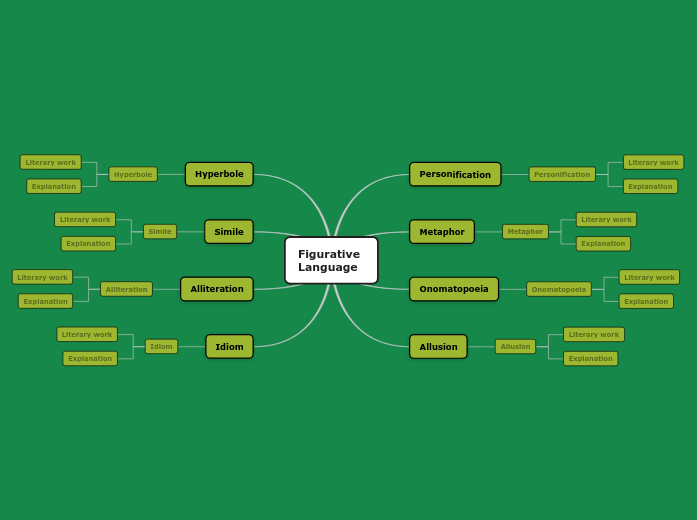
This template about figurative language will help you learn about each figure of speech: personification, simile, metaphor, onomatopoeia, allusion, idiom, alliteration, and hyperbole. You will have to think about a literary work where you find each of them, give an example and explain your choice. Use this template to learn the figurative language and think about examples for figures of speech so you can better understand each of them. Idiom is the figure of speech that uses a combination of words which challenges the conventional usage of those words. How do you explain your choice? Type in the explanation. What is the literary work in which you found the idiom? What genre is it? How do you explain your choice? What is the literary work Simile is a figure of speech that compares two objects through some connective word such as 'like', 'as', 'so', 'than', or a verb such as 'resembles'. How do you explain your choice? What is the literary work in which you found the simile? The hyperbole is a figure of speech that uses exaggerations to create emphasis or effect. How do you explain your choice? What is the literary work in which you found the hyperbole? Is it a novel, short story or poem? Allusion is the figure of speech that makes a reference to a well-known person, place, or thing in literature and history. How do you explain your choice? What is the literary work in which you found the allusion? What genre is it? Onomatopoeia is the figure of speech that uses words whose sounds suggest their meanings. Think of words related to water, air, collisions, sounds, voice, etc. How do you explain your choice? What is the literary work in which you found the onomatopoeia? Is it a novel, short story or poem? Metaphor is a figure of speech that compares two unlike things without using 'like' or 'as'. How do you explain your choice? What is the literary work in which you found the metaphor? Is it a novel, short story or poem? Personification is a figure of speech which gives human qualities to nonhuman things. How do you explain your choice? What is the literary work in which you found the personification? What is its genre? Mindmaps helfen beim Brainstorming, zeigen Beziehungen zwischen Konzepten, organisieren und generieren Ideen. Mindmap-Vorlagen bieten einen einfacheren Einstieg, da sie Rahmenbedingungen enthalten, die Informationen und Anleitung zu einem spezifischen Thema bieten. Sie liefern eine Struktur, die alle Elemente eines Themas verbindet und dienen als Ausgangspunkt für Ihre persönliche Mindmap, sowohl für geschäftliche als auch pädagogische Zwecke. Mindomo bietet intelligente Mindmap-Vorlagen, die Ihnen müheloses Arbeiten und Denken ermöglichen. Sie können aus einer Vielzahl von Mindmap-Vorlagen aus Mindomos geschäftlichen oder Bildungsangeboten wählen oder eigene Vorlagen erstellen. Jede Mindmap kann durch Hinzufügen von Anleitungshinweisen in eine Mindmap-Vorlage umgewandelt werden.Über diese Vorlage
Figurative language
Figurative Language
Find figures of speech in your favorite novels and poems.Idiom
What is the idiom that you found in the novel/poem?
Type it in.
Example: 'a stitch in time saves nine'.
Example:
- A timely effort saves you from much harder work later.
Example: Pie-IX: A Stitch in Time Saves Nine by Jaida Jones, K.J. Sturgeon - short story.Alliteration
Example:
- Almost all the words in the sentence begin with 'th'.
in which you found the alliteration? Type in the genre.
Example: Thank You for the Thistle by Dorie Thurston - short story.Simile
What simile did you find in the novel/poem? Type it in.
Example:
- 'Within the irregular arc of coral the lagoon was still as a mountain lake.'
Type in the explanation. Example:
- The lagoon is being compared with a mountain lake using the word 'as'.
Is it a novel, short story or poem?
Example: Lord of the flies by William Golding - novel.Hyperbole
What hyperbole did you find in the novel/poem? Type it in.
Example:
- 'All that we see or seem / Is but a dream within a dream.'
Type in the explanation.
Example:
- It is an exaggeration to claim that everything ('all we see or seem') is 'but a dream'.
Example: A dream within a dream by Edgar Allan Poe - poem.Allusion
What is the allusion that you found in the novel/poem? Type it in.
Example:
- 'Like a rich jewel in an Ethiop's ear'.
Example:
- Shakespeare makes an allusion of the Ethiopian slaves who wore expensive jewelry to express their masters' wealth.
Example: Romeo and Juliet by William Shakespeare - tragedyOnomatopoeia
What is the onomatopoeia that you found in the novel/poem? Type it in.
Example:
'The moan of doves in immemorial elms,
And murmuring of innumerable bees...'.
Example:
'Moan' and 'murmuring' refer to the way doves and bees sound like.
Example: Come Down, O Maid by Alfred Lord Tennyson - poemMetaphor
What is the metaphor that you found in the novel/poem? Type it in.
Example:
'The rain came down in long knitting needles.'
Example:
The rain is compared with 'long knitting needles', without the use of 'like' or 'as'.
Example:
National Velvet by Enid Bagnold - novel.Personification
Type in the personification you found in the novel/poem.
Example:
'- Not to-night, good Iago: I have very poor and unhappy brains for drinking.'Explanation
Type in the explanation.
Example:
The brain is given the attribute of being 'unhappy'.Literary work
Example:
Othello by William Shakespeare - tragedyWarum eine Mindomo-Mindmap-Vorlage verwenden?
Eine Vorlage bietet verschiedene Funktionen:
-
Produkte
-
Anwendungen
- Allgemeine Anwendungen
- Mindmaps für Bildung
- Mindmaps für Unternehmen
- Mindmaps für die persönliche Entwicklung
- Assistive Technologie
- Teamzusammenarbeit
- Kampagnenbriefings für Marketingfachleute
- Workshops zur Kundenermittlung für Berater
- Onboarding-Prozesse für HR und L&D
- Wissensmanagement
- Team-Kompetenzmatrix
- Projektbibliothek
- Rollen
- Marketingfachleute
- HR und L&D
- Berater
- Projektmanagement
- Marketing-Kampagnenplanung
- Rollout von Mitarbeiterschulungen
- Leistungsumfang
- Ideenorganisation
- Problembäume
- Trainingsbedarfsanalyse
- Mindmapping Vorteile
-
Lösungen
- Anleitungen
- Präsentationen mit Mindmaps erstellen
- Wie man mit Mindmaps lernt
- Planen und Organisieren mit Mindmaps
- Aufgaben mit Mindmaps priorisieren
- Wie kann man mit Mindmaps Notizen machen?
- Echte Kundengeschichten
- Bildungsinhalte für 11.000 Ärzte skalieren
- Team-Workflow: vom Test zur unverzichtbaren Lösung in zwei Monaten
- 10 Jahre ohne Folien: Architekturvorlesungen neu gedacht
- Alle Erfolgsgeschichten lesen
-
Ressourcen
- Grundlagen
- Was ist eine Mindmap?
- Wie macht man eine Mindmap?
- Mindmapping als assistive Technologie
- Was ist eine Concept Map?
- Anleitungen & Support
- Videoanleitungen
- Hilfezentrum
- Forum
- Beispiele & Vorlagen
- Die 29 besten Mindmap-Beispiele
- Mindomo für Microsoft Teams
- Plane Projekte mit einem Gantt-Diagramm-Maker
- Die Effizienz von Mindomo im Bildungsbereich
- Funktionsseiten
- Bildung
- Aufgaben für Lehrer
- Arbeit & Persönlich
- Desktop
- Der Mindomo-Blog
- Preise
- Anmelden
- Registrieren
- Dashboard
Mindmapping Vorteile
Warum visuelles Denken Erinnern und Planen erleichtert.
Grundlagen
Anleitungen & Support
Beispiele & Vorlagen
Funktionsseiten
 Blog
Der Mindomo-Blog
Anleitungen, Beispiele und Forschung zum visuellen Denken.
Alle Artikel ansehen
Blog
Der Mindomo-Blog
Anleitungen, Beispiele und Forschung zum visuellen Denken.
Alle Artikel ansehen