Use this template to learn the different types of verb and give examples for each of them to understand in which situations you can use them. A verb is a word that expresses an action, that tells you what’s happening in a sentence. They are the main part of speech in a sentence, along with nouns, and show actions made by nouns. You should always link the subject of a sentence to a verb. Examples of verbs: run, sing, write, dance, work, walk, stay. Depending on the form of the verb and its use, there are several types of verbs. Some of them are transitive verbs, intransitive verbs, participle verbs, conditional verbs, infinitive verbs, auxiliary verbs, modal verbs. To determine if a verb is transitive or intransitive, you should take into account the following things: A verb is transitive if there is a noun receiving the action A verb is intransitive if there is no direct object to receive the action and if it does not make sense without a direct object. Participle verbs can be used as an adjective and are combined with the verb to construct different verbs at past or present tenses. As you can see in the template, there are four types of conditionals: Simple, Continuous, Perfect, and Perfect Continuous. Auxiliary verbs like can/could, will/would, may/might help at the formation of conditional tenses. Infinitive verbs are the base forms of the verbs, usually used with the particle ‘to’. Auxiliary verbs add meaning to the clause in which they occur, to express tense, aspect, modality, voice, emphasis, etc. Auxiliary verbs usually accompany an infinitive verb or a participle. Some examples of auxiliary verbs are: have, be, must, do, can, will, shall. Some examples of modal verbs are: can, could, must, should, had better, had to and sometimes need or dare. The voice describes whether a verb is active or passive. In other words, when the subject of the verb is doing the action of the verb or the verb is said to be in the active voice. Verb moods indicate the attitude of the speaker. There are three types of moods: declarative, interrogative and imperative. After going through this template and practical learning by thinking about examples, it will be easier for you to differentiate between different types of verbs. As the main word in a sentence, the verb will generally describe an occurrence or an action. Conditional verbs are used to create conditional sentences, which express hypothetical or unlikely situations. Conditional verbs can be used in the past, present, or future tense, and auxiliary verbs like can/could, will/would, and may/might are important in forming conditionals An infinitive verb is essentially the base form of a verb with the word 'to' in front of it. When you use an infinitive verb, the 'to' is a part of the verb. It is not acting as a preposition in this case. The negative verb forms are made by putting not after an auxiliary verb. Auxiliary verbs are verbs such as have, be, may, do, shall, will, can, or must that are used with another verb to show the verb's tense, to form a question, etc. A modal verb is a type of verb that is used to indicate modality. Commonly used modal verbs are can, could, must, should, had better, have to and sometimes need or dare. Grammatical mood refers to the quality or form of a verb in a sentence. More specifically, mood denotes the tone of a verb in a sentence, so the intention of the writer or speaker is clear. In grammar, the voice of a verb describes the relationship between the action that the verb expresses and the participants identified by its arguments. A participle is a form of a verb that can be used as an adjective or combined with the verb to be to construct different verb tenses. A transitive verb will only makes sense if it applies its action on an object. An intransitive verb has two characteristics: Create sentences with examples! Hărțile mentale vă ajută să faceți brainstorming, să stabiliți relații între concepte și să organizați și generați idei. Cu toate acestea, șabloanele de hărți mentale oferă o modalitate mai simplă de a începe, deoarece sunt modele care includ informații despre un subiect și instrucțiuni de ghidare. În esență, ele asigură structura care combină toate elementele unui subiect și servesc drept punct de plecare pentru harta mentală personală. Sunt o resursă practică pentru a crea hărți mentale pe diverse subiecte, fie în domeniul afacerilor, fie în educație. Mindomo vă oferă șabloane inteligente de hărți mentale, care vă ajută să acționați și să gândiți fără efort. Puteți alege dintr-o varietate de șabloane de hărți mentale disponibile în conturile pentru afaceri sau educaționale ale Mindomo sau puteți crea propriile șabloane de la zero. Orice hartă mentală poate fi transformată într-un șablon prin adăugarea de instrucțiuni de ghidare suplimentare la unul dintre subiectele sale.Despre acest șablon
What is a verb?
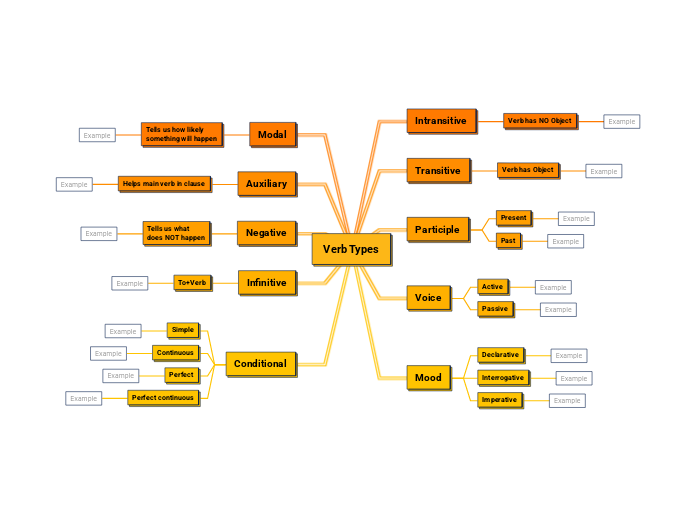
Different types of verb
Transitive and intransitive verbs
Participle verbs
Conditional verbs
Infinitive verbs
Auxiliary verbs
Modal verbs
The voice of a verb
The mood of a verb
Verb Types
Conditional
Perfect continuous
Perfect
Continuous
Simple
Infinitive
To+Verb
Negative
Tells us what does NOT happen
Auxiliary
Helps main verb in clause
Modal
Tells us how likely something will happen
Mood
Imperative
Interrogative
Declarative
Voice
Passive
Active
Participle
Past
Present
Transitive
Verb has Object
Intransitive
1.it is an action verb, expressing a doable activity
2.it will not have a direct object receiving the actionVerb has NO Object
Example
De ce să folosiți un șablon Mindomo de tip hartă mentală?
Un șablon are diverse funcționalități:
-
Produse
-
Utilizări
- Utilizări generale
- Hărți mentale pentru Educație
- Hărți mentale pentru Afaceri
- Hărți mentale pentru Dezvoltarea Personală
- Tehnologie Asistivă
- Colaborare în echipă
- Briefuri de campanie pentru specialiști în marketing
- Workshopuri de descoperire a clientului pentru consultanți
- Parcursuri de onboarding pentru HR și L&D
- Managementul cunoștințelor
- Matricea de competențe a echipei
- Biblioteca de proiecte
- Roluri
- Specialiști în marketing
- HR și L&D
- Consultanți
- Managementul proiectelor
- Planificarea campaniilor de marketing
- Coordonarea instruirii angajaților
- Domeniul lucrărilor
- Organizarea ideilor
- Arbori de probleme
- Analiza nevoilor de instruire
- Beneficiile Cartografierii Mentale
-
Soluții
- Ghiduri
- Creare prezentări cu hărți mentale
- Cum să înveți cu hărți mentale
- Planificare și organizare cu hărți mentale
- Cum să prioritizezi sarcinile cu hărți mentale
- Cum să creezi notițe cu hărți mentale
- Povești reale ale clienților
- Scalarea conținutului educațional pentru 11.000 de medici
- Flux de lucru în echipă: de la test la indispensabil în două luni
- 10 ani fără slide-uri: regândirea cursurilor de arhitectură
- Citește toate poveștile
-
Resurse
- Noțiuni de bază
- Ce este o hartă mentală?
- Cum se creează o hartă mentală?
- Ce este o hartă conceptuală?
- Beneficiile utilizării hărților mentale
- Ghiduri și suport
- Tutoriale video
- Centru de ajutor
- Forum
- Exemple și șabloane
- Top 29 exemple de hărți mentale
- Șabloane pentru hărți conceptuale
- Crearea de diagrame Gantt
- Pagini de funcționalități
- Educație
- Teme pentru profesori
- Profesional și Personal
- Desktop
- Blogul Mindomo
- Prețuri
- Autentificați-vă
- Înregistrați-vă
- Tablou de bord
Managementul cunoștințelor
Beneficiile Cartografierii Mentale
De ce gândirea vizuală ușurează memorarea și planificarea.
Noțiuni de bază
Ghiduri și suport
Exemple și șabloane
Pagini de funcționalități
 Blog
Blogul Mindomo
Ghiduri, exemple și cercetări despre gândirea vizuală.
Vezi toate articolele
Blog
Blogul Mindomo
Ghiduri, exemple și cercetări despre gândirea vizuală.
Vezi toate articolele