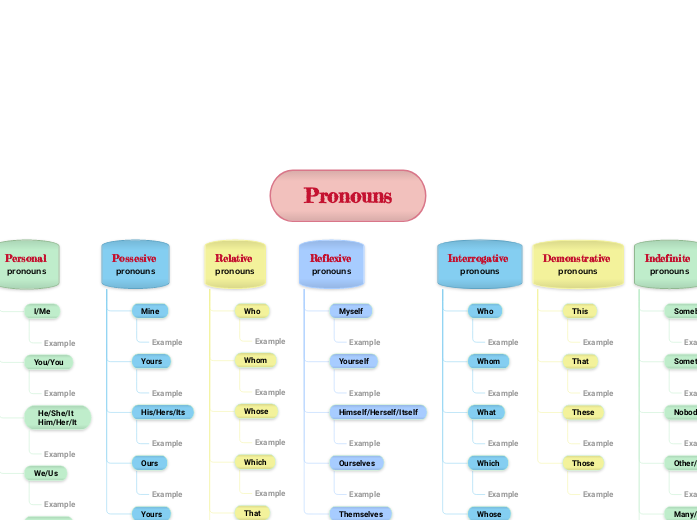
Use this template to learn the pronouns in English. Pronouns are the parts of speech used instead of nouns to avoid repetition. Depending on the situations in which they are used, they have different forms. The types of pronouns are: Personal pronouns are the pronouns that refer to specific people or things. They can change depending on the person, number, gender, or case. Examples of personal pronouns, singular and plural form: Possessive pronouns show that something belongs to someone. Examples of possessive pronouns: Relative pronouns describe nouns in terms of how they relate to other words. Examples of relative pronouns: Reflexive pronouns are used when the subject of a sentence is also the object of the sentence. Examples of reflexive pronouns: Demonstrative pronouns point to and identify a noun or a pronoun. They are used in place of particular things to show which one we’re discussing. Examples of demonstrative pronouns: Interrogative pronouns are the pronouns used in questions. In sentences, when the pronoun is a subject, the verb will precede the pronoun. Examples of interrogative pronouns: ’Who’ and ‘whom’ are used to refer to people and which is used for animals and things. Indefinite pronouns refer to a thing or person that is identifiable, but not specified. Examples of indefinite pronouns: Complete the template by adding examples of phrases with these pronouns. In this way, you will retain information easier. Pronouns - a word that can function as a noun phrase used by itself and that refers either to the participants in the discourse. An indefinite pronoun is a pronoun that refers to a person or a thing without being specific. Demonstrative pronouns are pronouns that point to specific objects. They function as subjects or objects. An interrogative word or question word is a function word used to ask a question, Reflexive pronouns are words ending in -self or -selves that are used when the subject and the object of a sentence are the same. They refer back to an earlier noun or pronoun. A relative pronoun is a pronoun that marks a relative clause. They link one part of a sentence to another. Possessive pronouns show that something belongs to someone. Replaces noun in phrases. Personal pronouns are pronouns that are associated primarily with a particular grammatical person – They represents people places or things. Write phrases as examples. Hărțile mentale vă ajută să faceți brainstorming, să stabiliți relații între concepte și să organizați și generați idei. Cu toate acestea, șabloanele de hărți mentale oferă o modalitate mai simplă de a începe, deoarece sunt modele care includ informații despre un subiect și instrucțiuni de ghidare. În esență, ele asigură structura care combină toate elementele unui subiect și servesc drept punct de plecare pentru harta mentală personală. Sunt o resursă practică pentru a crea hărți mentale pe diverse subiecte, fie în domeniul afacerilor, fie în educație. Mindomo vă oferă șabloane inteligente de hărți mentale, care vă ajută să acționați și să gândiți fără efort. Puteți alege dintr-o varietate de șabloane de hărți mentale disponibile în conturile pentru afaceri sau educaționale ale Mindomo sau puteți crea propriile șabloane de la zero. Orice hartă mentală poate fi transformată într-un șablon prin adăugarea de instrucțiuni de ghidare suplimentare la unul dintre subiectele sale.Despre acest șablon
Pronouns in English
Personal pronouns in English
Possessive pronouns in English
Relative pronouns in English
Reflexive pronouns in English
Demonstrative pronouns in English
Interrogative pronouns in English
Indefinite pronouns in English
Pronouns
Indefinite pronouns
None/Some/Few
Many/Most/Such
Other/Another
Nobody/Nothing
Something/Anything
Somebody/Someone
Demonstrative pronouns
Those
These
This
Interrogative pronouns
Reflexive pronouns
Themselves
Ourselves
Himself/Herself/Itself
Yourself
Myself
Relative pronouns
What
That
Which
Whose
Whom
Who
Possesive pronouns
Ours
His/Hers/Its
Yours
Mine
Personal pronouns
They/Them
We/Us
He/She/It Him/Her/It
You/You
I/Me
Example
De ce să folosiți un șablon Mindomo de tip hartă mentală?
Un șablon are diverse funcționalități:
-
Produse
-
Utilizări
- Utilizări generale
- Hărți mentale pentru Educație
- Hărți mentale pentru Afaceri
- Hărți mentale pentru Dezvoltarea Personală
- Tehnologie Asistivă
- Colaborare în echipă
- Briefuri de campanie pentru specialiști în marketing
- Workshopuri de descoperire a clientului pentru consultanți
- Parcursuri de onboarding pentru HR și L&D
- Managementul cunoștințelor
- Matricea de competențe a echipei
- Biblioteca de proiecte
- Roluri
- Specialiști în marketing
- HR și L&D
- Consultanți
- Managementul proiectelor
- Planificarea campaniilor de marketing
- Coordonarea instruirii angajaților
- Domeniul lucrărilor
- Organizarea ideilor
- Arbori de probleme
- Analiza nevoilor de instruire
- Beneficiile Cartografierii Mentale
-
Soluții
- Ghiduri
- Creare prezentări cu hărți mentale
- Cum să înveți cu hărți mentale
- Planificare și organizare cu hărți mentale
- Cum să prioritizezi sarcinile cu hărți mentale
- Cum să creezi notițe cu hărți mentale
- Povești reale ale clienților
- Scalarea conținutului educațional pentru 11.000 de medici
- Flux de lucru în echipă: de la test la indispensabil în două luni
- 10 ani fără slide-uri: regândirea cursurilor de arhitectură
- Citește toate poveștile
-
Resurse
- Noțiuni de bază
- Ce este o hartă mentală?
- Cum se creează o hartă mentală?
- Ce este o hartă conceptuală?
- Beneficiile utilizării hărților mentale
- Ghiduri și suport
- Tutoriale video
- Centru de ajutor
- Forum
- Exemple și șabloane
- Top 29 exemple de hărți mentale
- Șabloane pentru hărți conceptuale
- Cum faci o diagramă Gantt
- Pagini de funcționalități
- Educație
- Teme pentru profesori
- Profesional și Personal
- Desktop
- Blogul Mindomo
- Prețuri
- Autentificați-vă
- Înregistrați-vă
- Tablou de bord
Managementul cunoștințelor
Beneficiile Cartografierii Mentale
De ce gândirea vizuală ușurează memorarea și planificarea.
Noțiuni de bază
Ghiduri și suport
Exemple și șabloane
Pagini de funcționalități
 Blog
Blogul Mindomo
Ghiduri, exemple și cercetări despre gândirea vizuală.
Vezi toate articolele