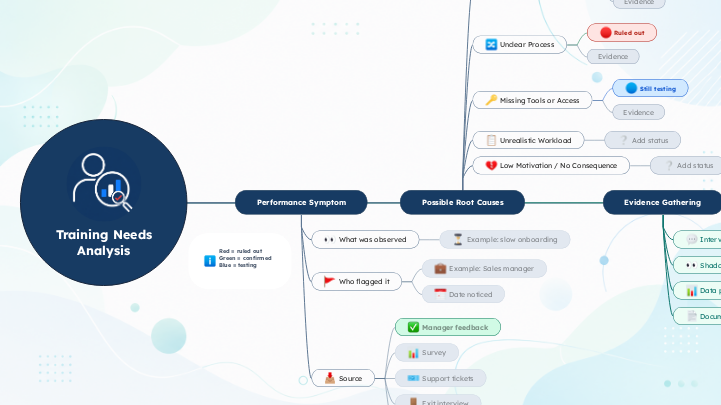
The Training Needs Analysis template helps teams identify performance gaps, evaluate possible root causes, gather supporting evidence, confirm training needs, plan next steps, and track their impact in one clear visual workflow. This training needs analysis template helps HR professionals, learning and development teams, managers, and business leaders identify performance gaps and determine whether training is the right solution. It covers key areas such as performance symptoms, possible root causes, evidence gathering, confirmed gaps, follow-up checks, next steps, and business impact. Use this template to document performance issues, evaluate skills and knowledge gaps, rule out non-training causes, collect supporting evidence, define recommended actions, and measure results. It provides a clear visual workflow for making evidence-based training decisions and aligning employee development initiatives with organizational goals. Start at Performance Symptom and work right. Each branch tests one possible cause before any training gets recommended. What does it cost to leave this unresolved? Use this to justify urgency, not to pad the case — pick what's actually true. Route to whoever actually owns the fix — this is very often not L&D. Set the re-check date now, while the original numbers are fresh. If Status comes back Recurred, reopen Possible Root Causes — don't start a new training request from scratch. Resolved / Recurred / Inconclusive Only fill this in once a root cause is Confirmed. If more than one cause is confirmed, mark each as Primary or Contributing — real cases are rarely one clean cause. Confidence: List every plausible explanation, not just the one that got mentioned loudest. Most performance problems have three to five candidate causes — training is usually the right answer for only one or two. Confirm if the person can do it, knows how, but has no reason to — usually a management or incentive fix, not training. Confirm if volume or headcount, not skill, is driving the symptom — usually an ops or staffing fix, not L&D's. Confirm if the person has the skill but not the system/permission/resource to use it. Confirm if the steps themselves are missing, contradictory, or undocumented — not a training issue, route to the process owner. Confirm only if evidence shows the person genuinely doesn't know how, not that they know how but aren't doing it. This is the level of analysis: Attach the actual file or link here— the survey export, ticket log, or exit interview notes. The evidence should be one click away, not a separate document someone has to go find. Le mappe mentali aiutano a fare brainstorming, a stabilire relazioni tra i concetti, a organizzare e generare idee. Tuttavia, i modelli di mappe concettuali e mentali vuote offrono un modo più semplice per iniziare, in quanto sono strutture che contengono informazioni su un argomento specifico con istruzioni guida. In sostanza, i modelli di mappe mentali garantiscono la struttura che combina tutti gli elementi di un argomento specifico e servono come punto di partenza per la vostra mappa mentale personale. Sono una risorsa che fornisce una soluzione pratica per creare una mappa mentale su un particolare argomento, sia per il lavoro che per l'istruzione. Mindomo offre modelli di mappe mentali intelligenti che consentono di lavorare e pensare senza sforzo. È possibile scegliere tra una varietà di modelli di mappe concettuali dagli account aziendali o educativi di Mindomo, oppure creare i propri modelli di mappe mentali da zero. Qualsiasi mappa mentale può essere trasformata in un modello di mappa concettuale aggiungendo ulteriori note guida a uno dei suoi argomenti.Training Needs Analysis Template
Informazioni su questo modello
Training needs analysis template
Red = ruled out Green = confirmed Blue = testing
Training Needs Analysis
Business Impact
Cost of inaction
Risk or compliance
Customer impact
Quality impact
Productivity impact
Next Steps
Share this with diagram them as a guest editor so they can review the evidence and fill in Approval themselves.Hand off: process owner
Hand off: training rollout
Hand off: skills matrix
Approval
Date:
Approved by:
Follow-up Check
Status
Actual result
Expected result if fix worked
Original metric, re-measured
Re-check date
Confirmed Gap
Evidence summary
High urgency
Scope: who / how many
Contributing factor
Gap description
Evidence Gathering
Note how the evidence was gathered and how many people or instances it covers — 'one manager mentioned it' and 'shadowed 6 of 9 reps' shouldn't carry the same weight.Documentation review
Data pulled
Shadowed observation
Interviews
Possible Root Causes
Low Motivation / No Consequence
Unrealistic Workload
Add status
Missing Tools or Access
Still testing
Unclear Process
Ruled out
Skill or Knowledge Gap
Evidence
Confirmed
Performance Symptom
Same symptom, different scale — name which one this is before you branch into causes.Source
Compliance deadline
Exit interview
Support tickets
Survey
Manager feedback
Who flagged it
Date noticed
Example: Sales manager
What was observed
Example: slow onboarding
Perché utilizzare un modello di mappa concettuale Mindomo?
Un modello ha diverse funzionalità:
-
Prodotti
-
Uso
- Usi generali
- Mappe concettuali per l'educazione
- Mappe concettuali per le Aziende
- Mappe concettuali per la Crescita Personale
- Tecnologia Assistiva
- Collaborazione di team
- Brief di campagna per marketer
- Workshop di scoperta del cliente per consulenti
- Percorsi di onboarding per HR e L&D
- Gestione della conoscenza
- Matrice delle competenze del team
- Libreria dei progetti
- Ruoli
- Marketer
- HR e L&D
- Consulenti
- Gestione dei progetti
- Pianificazione delle campagne marketing
- Rollout della formazione dei dipendenti
- Ambito di lavoro
- Organizzazione delle idee
- Alberi dei problemi
- Analisi dei bisogni formativi
- Vantaggi della Mappa Concettuale
-
Soluzioni
- Guide
- Creare presentazioni con le mappe concettuali
- Come imparare con le mappe concettuali
- Pianificare e organizzare con le mappe concettuali
- Come dare priorità ai compiti con le mappe concettuali
- Prendere appunti con le mappe concettuali
- Storie reali dei clienti
- Scalare contenuti formativi per 11.000 medici
- Flusso di lavoro di team: dalla prova a indispensabile in due mesi
- 10 anni senza slide: ripensare le lezioni di architettura
- Leggi tutte le storie
-
Risorse
- Le basi
- Cos'è una mappa mentale?
- Top 29 Esempi di Mappe Mentali
- Programmi per fare Mappe Concettuali
- Creatore di Diagrammi di Gantt
- Guide e Supporto
- Video tutorial
- Centro assistenza
- Forum
- Esempi e modelli
- Come fare una mappa concettuale?
- Modello di Mappa Mentale
- Esempi di Mappe Concettuali
- Programma per Diagrammi di Gantt
- Pagine funzionalità
- Istruzione
- Compiti per insegnanti
- Lavoro e Personale
- Desktop
- Il blog di Mindomo
- Prezzi
- Accedi
- Registrati
- Dashboard
Vantaggi della Mappa Concettuale
Perché il pensiero visivo rende più facile ricordare e pianificare.
Le basi
Guide e Supporto
Esempi e modelli
Pagine funzionalità
 Blog
Il blog di Mindomo
Guide, esempi e ricerche sul pensiero visivo.
Sfoglia tutti gli articoli
Blog
Il blog di Mindomo
Guide, esempi e ricerche sul pensiero visivo.
Sfoglia tutti gli articoli