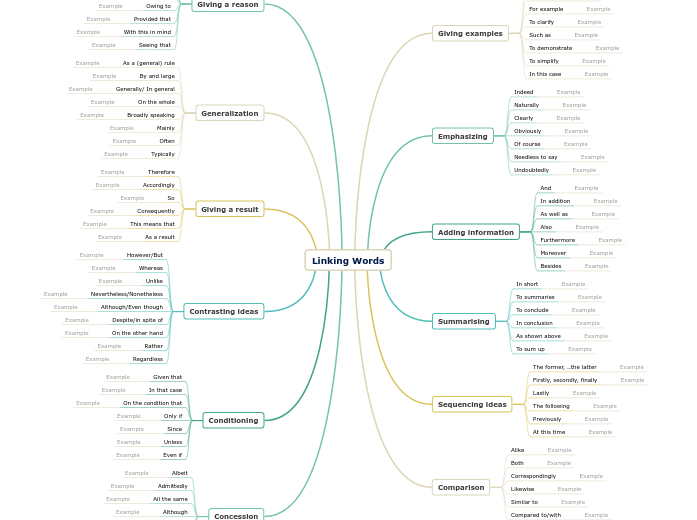
Use this mind map to have a view of the most usual situation when linking words are used and practice by creating various contexts. Learn the categories of linking words from this template and complete them with linking words examples to better understand them. Linking words help in connecting ideas and words in English. They are used to show contrast, connection, and condition between two things. Linking words used for giving examples: Linking words used for emphasizing: Linking words used for adding information: Linking words used for summarising: Linking words used for sequencing ideas: Linking words used for comparison: Linking words used for a concession: Linking words used for conditioning: Linking words used for contrasting ideas: Linking words used for giving a result: Linking words used for generalization: Linking words used for giving a reason: Linking words in any style of writing will help the reader to follow the flow of information. Use these words to accept a point or idea with reservation. These linking worss are used to provide a condition to what has been stated. However is the formal version of but. It is not normally used at the beginning of a sentence. Therefore, so, consequently and as a result are all used in a similar way. These words are used to make a general statement. Due to and owing to must be followed by a noun. Use these words to show how things are similar. These words are useful when you want to refer to one of two points, to list ideas. Use these words at the beginning of the sentence to give a summary of what has been said or written. Ideas are often linked by 'and'. In a list, you put a comma between each item, but not before and. These linking words are used to empashize a point. The most common way to give examples is by using for example or for instance. Write phrases to exercise! Los mapas mentales ayudan a hacer lluvias de ideas, establecer relaciones entre conceptos y organizar y generar ideas. Las plantillas de mapas mentales ofrecen además una forma más fácil de empezar, ya que son estructuras que contienen información sobre un tema concreto junto con instrucciones orientativas. En esencia, las plantillas de mapas mentales aportan una estructura que reúne todos los elementos de un tema y sirven como punto de partida para tu propio mapa mental. Son un recurso práctico para crear un mapa mental sobre un tema concreto, ya sea en el ámbito empresarial o en el educativo. Mindomo te ofrece plantillas de mapas mentales inteligentes que te permiten trabajar y pensar sin esfuerzo. Puedes elegir entre una gran variedad de plantillas de mapas mentales de las cuentas empresariales o educativas de Mindomo, o crear tus propias plantillas desde cero. Cualquier mapa mental puede convertirse en una plantilla añadiendo notas orientativas a uno de sus temas.Linking words examples
Acerca de esta plantilla
Linking words examples
Linking Words
These will show contrast, connection, condition between two things.Concession
Up to a point
Even so
And yet
Although
All the same
Admittedly
Albeit
Conditioning
Even if
Unless
Only if
On the condition that
In that case
Given that
Contrasting ideas
Although, despite and in spite of introduce an idea of contrast.Regardless
Rather
On the other hand
Despite/in spite of
Although/Even though
Nevertheless/Nonetheless
Unlike
Whereas
However/But
Giving a result
So is more informal.As a result
This means that
Consequently
So
Accordingly
Therefore
Generalization
Typically
Often
Mainly
Broadly speaking
On the whole
Generally/ In general
By and large
As a (general) rule
Giving a reason
Because of is followed by a noun and can be used at the beginning or in the middle of a sentence. Since and as also mean because.Seeing that
With this in mind
Provided that
Owing to
As
Since
Because of
Due to the fact that
Comparison
Compared to/with
Similar to
Likewise
Correspondingly
Both
Alike
Sequencing ideas
The following is a good way of starting a list.At this time
Previously
The following
Lastly
Firstly, secondly, finally
The former, ..the latter
Summarising
To sum up
As shown above
In conclusion
To conclude
To summarise
In short
Adding information
Recommended not to start a sentence with also. Use instead In addition, or In addition to this.Besides
Moreover
Furthermore
Also
As well as
In addition
And
Emphasizing
Undoubtedly
Needless to say
Of course
Obviously
Clearly
Naturally
Indeed
Giving examples
Namely refers to something by name.In this case
To simplify
To demonstrate
Such as
To clarify
For example
Namely
For instance
Example
¿Por qué usar una plantilla de mapa mental de Mindomo?
Una plantilla tiene varias funciones:
-
Productos
-
Usos
- Usos generales
- Mapas mentales para la educación
- Mapas mentales para empresas
- Mapas mentales para el desarrollo personal
- Tecnología asistida
- Colaboración en equipo
- Briefs de campaña para profesionales de marketing
- Talleres de descubrimiento de clientes para consultores
- Recorridos de onboarding para RR. HH. y L&D
- Gestión del conocimiento
- Matriz de competencias del equipo
- Biblioteca de proyectos
- Roles
- Profesionales de marketing
- RR. HH. y L&D
- Consultores
- Gestión de proyectos
- Planificación de campañas de marketing
- Planes de formación para empleados
- Alcance del trabajo
- Organización de ideas
- Árboles de problemas
- Análisis de necesidades de formación
- Beneficios de los mapas mentales
-
Soluciones
- Guías
- Hacer presentaciones con mapas mentales
- Aprender con mapas mentales
- Planificar y organizar con mapas mentales
- Priorizar tareas con mapas mentales
- Tomar notas con mapas mentales
- Historias reales de clientes
- Escalar contenido educativo para 11.000 médicos
- Flujo de trabajo en equipo: de la prueba a herramienta imprescindible en dos meses
- 10 años sin diapositivas: repensar las clases de arquitectura
- Leer todas las historias
-
Recursos
- Aprende lo básico
- Los 29 mejores ejemplos de mapas mentales
- Programa de Gantt
- ¿Cómo hacer un mapa mental?
- Cómo hacer un diagrama de Gantt
- Guías y soporte
- Tutoriales en video
- Centro de ayuda
- Foro
- Ejemplos y plantillas
- ¿Qué es un mapa conceptual?
- Creador de mapas conceptuales
- Plantilla de mapa conceptual
- Plantillas de diagramas
- Páginas de funciones
- Educación
- Tareas para profesores
- Trabajo y uso personal
- Escritorio
- El blog de Mindomo
- Precios
- Iniciar sesión
- Registrarse
- Panel de control
Gestión del conocimiento
Beneficios de los mapas mentales
Por qué el pensamiento visual facilita recordar y planificar.
Aprende lo básico
Guías y soporte
Ejemplos y plantillas
Páginas de funciones
 Blog
El blog de Mindomo
Guías, ejemplos e investigación sobre el pensamiento visual.
Ver todos los artículos