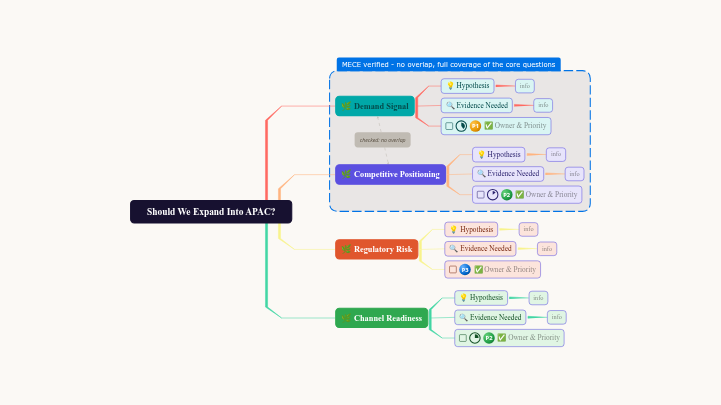
Example issue tree for a market-entry engagement. Every branch carries its own hypothesis, evidence need, and owner/priority - the structure the partner review actually checks. This issue trees template helps consultants, strategy teams, analysts, and project leads break complex business problems into clear, manageable components. It organizes key questions, hypotheses, evidence needs, owners, and priorities in one structured visual workspace. Use this template to frame problems, test assumptions, identify the analyses required, assign responsibility, and prepare for partner or stakeholder reviews. It supports market-entry studies, growth strategy, profitability analysis, operational improvement, and other consulting engagements by making the problem-solving logic transparent and easy to follow. Core question. Every branch below must be a genuine, non-overlapping child of this question — the MECE check that gets run once and re-run every time a branch moves. Can existing partners actually carry this offering to market on our timeline? Medium impact, low effort - quick to validate. Partner capacity interviews; onboarding timeline from the most recent comparable launch. Existing distribution partners can onboard the new offering within one quarter. Add the task owner and priority level Legal review of foreign-ownership rules; precedent from comparable entrants. Current licensing rules allow market entry within two quarters without a local JV. Is there room for a fast mover, or is the field already locked up? Is there room for a fast mover, or is the field already locked up? Competitor share data; win/loss interviews with regional buyers. No incumbent holds more than 15% share, leaving room for a fast mover. Is there real, durable demand for this offering in the APAC region? High impact, low effort - chase that task first. Third-party market-sizing report; win-rate data from comparable adjacent markets. Details about the evidence APAC demand for this offering is growing at 3x the rate of our home market. Detail your hypothesis Os mapas mentais ajudam você a fazer brainstorming, estabelecer relações entre conceitos, organizar e gerar ideias. No entanto, os modelos de mapas mentais oferecem uma maneira mais fácil de começar, pois são estruturas que contêm informações sobre um assunto específico com instruções de orientação. Em essência, os modelos de mapas mentais garantem a estrutura que combina todos os elementos de um assunto específico e servem como ponto de partida para o seu mapa mental pessoal. Eles são um recurso para fornecer uma solução prática para criar um mapa mental sobre um determinado tema, seja para negócios ou educação. Mindomo traz modelos de mapas mentais inteligentes que permitem que você funcione e pense sem esforço. Você pode escolher entre uma variedade de modelos de mapas mentais das contas comerciais ou educacionais da Mindomo, ou pode criar seus próprios modelos de mapas mentais do zero. Qualquer mapa mental pode ser transformado em um modelo de mapa mental adicionando mais notas de orientação a um de seus tópicos.Issue Trees template
Sobre este modelo
Issue trees template
Should We Expand Into APAC?
🌿 Channel Readiness
Add the task owner and the priority level.🌿 Regulatory Risk
🌿 Competitive Positioning
Add the owner and priority level.🌿 Demand Signal
✅ Owner & Priority
Add an owner and priority level.🔍 Evidence Needed
💡 Hypothesis
info
Por que usar um modelo de mapa mental Mindomo?
Um modelo possui várias funcionalidades:
-
Produtos
-
Usos
- Usos gerais
- Mapas Mentais para Educação
- Mapas Mentais para Empresas
- Mapas Mentais para Desenvolvimento Pessoal
- Tecnologia Assistiva
- Colaboração em equipe
- Briefs de campanha para profissionais de marketing
- Workshops de descoberta do cliente para consultores
- Jornadas de onboarding para RH e L&D
- Gestão do conhecimento
- Matriz de competências da equipe
- Biblioteca de projetos
- Funções
- Profissionais de marketing
- RH e L&D
- Consultores
- Gestão de projetos
- Planeamento de campanhas de marketing
- Implementação de treinamentos para funcionários
- Âmbito do trabalho
- Organização de ideias
- Árvores de problemas
- Análise de necessidades de formação
- Benefícios do Mapeamento Mental
-
Soluções
- Guias
- Criar apresentações com mapas mentais
- Como aprender com mapas mentais
- Planejar e organizar com mapas mentais
- Como priorizar tarefas com mapas mentais
- Como fazer anotações com mapas mentais
- Histórias reais de clientes
- Escalar conteúdo educacional para 11.000 médicos
- Fluxo de trabalho em equipe: do teste ao indispensável em dois meses
- 10 anos sem slides: repensar as aulas de arquitetura
- Ler todas as histórias
-
Recursos
- Aprenda o básico
- O que é um Mapa Mental?
- Como Fazer um Mapa Mental?
- O que é um Mapa Conceptual?
- Guias e Suporte
- Tutoriais em vídeo
- Centro de ajuda
- Fórum
- Exemplos e modelos
- Ideias de Mapas Mentais Criativos
- 29 Exemplos Principais de Mapas Mentais
- Páginas de funcionalidades
- Educação
- Tarefas para professores
- Trabalho & Pessoal
- Desktop
- O blogue Mindomo
- Preços
- Entrar
- Inscreva-se
- Painel de controle
Gestão do conhecimento
Benefícios do Mapeamento Mental
Porque o pensamento visual facilita recordar e planear.
Aprenda o básico
Guias e Suporte
Exemplos e modelos
Páginas de funcionalidades
 Blogue
O blogue Mindomo
Guias, exemplos e investigação sobre pensamento visual.
Ver todos os artigos
Blogue
O blogue Mindomo
Guias, exemplos e investigação sobre pensamento visual.
Ver todos os artigos