Use this template to learn the pronouns in English. Pronouns are the parts of speech used instead of nouns to avoid repetition. Depending on the situations in which they are used, they have different forms. The types of pronouns are: Personal pronouns Possessive pronouns Relative pronouns Reflexive pronouns Demonstrative pronouns Interrogative pronouns Indefinite pronouns Personal pronouns are the pronouns that refer to specific people or things. They can change depending on the person, number, gender, or case. Examples of personal pronouns, singular and plural form: I/Me You/You He/She/It Him/Her/It We/Us You/You They/Them Possessive pronouns show that something belongs to someone. Examples of possessive pronouns: Mine Yours His/Hers/Its Ours Yours Relative pronouns describe nouns in terms of how they relate to other words. Examples of relative pronouns: Who Whom Whose Which That What Reflexive pronouns are used when the subject of a sentence is also the object of the sentence. Examples of reflexive pronouns: Myself Yourself Himself/Herself/Itself Ourselves Themselves Demonstrative pronouns point to and identify a noun or a pronoun. They are used in place of particular things to show which one we’re discussing. Examples of demonstrative pronouns: Somebody/Someone Something/Anything Nobody/Nothing All Other/Another Both/Each Many/Most Some/Few None Such Interrogative pronouns are the pronouns used in questions. In sentences, when the pronoun is a subject, the verb will precede the pronoun. Examples of interrogative pronouns: Who Whom What Which Whose ’Who’ and ‘whom’ are used to refer to people and which is used for animals and things. Indefinite pronouns refer to a thing or person that is identifiable, but not specified. Examples of indefinite pronouns: This That These Those Complete the template by adding examples of phrases with these pronouns. In this way, you will retain information easier. Pronouns - a word that can function as a noun phrase used by itself and that refers either to the participants in the discourse. An indefinite pronoun is a pronoun that refers to a person or a thing without being specific. Demonstrative pronouns are pronouns that point to specific objects. They function as subjects or objects. An interrogative word or question word is a function word used to ask a question, Reflexive pronouns are words ending in -self or -selves that are used when the subject and the object of a sentence are the same. They refer back to an earlier noun or pronoun. A relative pronoun is a pronoun that marks a relative clause. They link one part of a sentence to another. Possessive pronouns show that something belongs to someone. Replaces noun in phrases. Personal pronouns are pronouns that are associated primarily with a particular grammatical person – They represents people places or things. Write phrases as examples. Карты ума помогают проводить мозговые штурмы, устанавливать взаимосвязи между понятиями, организовывать и генерировать идеи. Однако шаблоны mind map предлагают более простой способ начать работу, поскольку они представляют собой рамки, содержащие информацию о конкретном предмете с направляющими инструкциями. По сути, шаблоны mind map обеспечивают структуру, которая объединяет все элементы конкретной темы и служит отправной точкой для вашей личной mind map. Они представляют собой ресурс, обеспечивающий практическое решение для создания карты ума по определенной теме, будь то бизнес или образование. Mindomo предлагает вам умные шаблоны карт разума, которые позволят вам работать и думать без усилий. Вы можете выбрать один из множества шаблонов ментальных карт из бизнес- или образовательных аккаунтов Mindomo или создать свои собственные шаблоны ментальных карт с нуля. Любую карту мыслей можно превратить в карту-шаблон, добавив к одной из ее тем дополнительные направляющие заметки.English Pronouns
Use this mind map to understand how pronouns are used in different situations and practice by creating contexts.
Keywords: grammar, language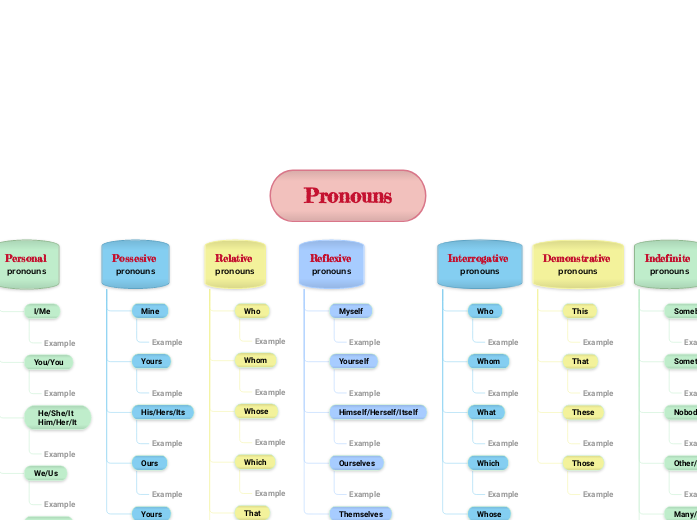
Pronouns in English
Personal pronouns in English
Possessive pronouns in English
Relative pronouns in English
Reflexive pronouns in English
Demonstrative pronouns in English
Interrogative pronouns in English
Indefinite pronouns in English
Pronouns
Indefinite pronouns
None/Some/Few
Many/Most/Such
Other/Another
Nobody/Nothing
Something/Anything
Somebody/Someone
Demonstrative pronouns
Those
These
This
Interrogative pronouns
Reflexive pronouns
Themselves
Ourselves
Himself/Herself/Itself
Yourself
Myself
Relative pronouns
What
That
Which
Whose
Whom
Who
Possesive pronouns
Ours
His/Hers/Its
Yours
Mine
Personal pronouns
They/Them
We/Us
He/She/It Him/Her/It
You/You
I/Me
Example
Зачем использовать шаблон карты ума Mindomo?
Шаблон обладает различными функциональными возможностями: