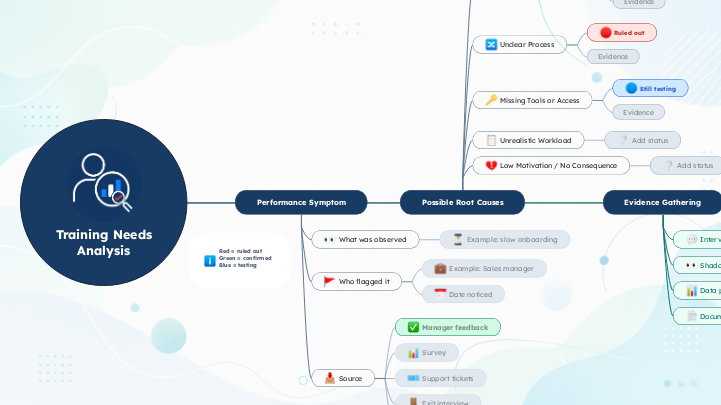
The Training Needs Analysis template helps teams identify performance gaps, evaluate possible root causes, gather supporting evidence, confirm training needs, plan next steps, and track their impact in one clear visual workflow. This training needs analysis template helps HR professionals, learning and development teams, managers, and business leaders identify performance gaps and determine whether training is the right solution. It covers key areas such as performance symptoms, possible root causes, evidence gathering, confirmed gaps, follow-up checks, next steps, and business impact. Use this template to document performance issues, evaluate skills and knowledge gaps, rule out non-training causes, collect supporting evidence, define recommended actions, and measure results. It provides a clear visual workflow for making evidence-based training decisions and aligning employee development initiatives with organizational goals. Start at Performance Symptom and work right. Each branch tests one possible cause before any training gets recommended. What does it cost to leave this unresolved? Use this to justify urgency, not to pad the case — pick what's actually true. Route to whoever actually owns the fix — this is very often not L&D. Set the re-check date now, while the original numbers are fresh. If Status comes back Recurred, reopen Possible Root Causes — don't start a new training request from scratch. Resolved / Recurred / Inconclusive Only fill this in once a root cause is Confirmed. If more than one cause is confirmed, mark each as Primary or Contributing — real cases are rarely one clean cause. Confidence: List every plausible explanation, not just the one that got mentioned loudest. Most performance problems have three to five candidate causes — training is usually the right answer for only one or two. Confirm if the person can do it, knows how, but has no reason to — usually a management or incentive fix, not training. Confirm if volume or headcount, not skill, is driving the symptom — usually an ops or staffing fix, not L&D's. Confirm if the person has the skill but not the system/permission/resource to use it. Confirm if the steps themselves are missing, contradictory, or undocumented — not a training issue, route to the process owner. Confirm only if evidence shows the person genuinely doesn't know how, not that they know how but aren't doing it. This is the level of analysis: Attach the actual file or link here— the survey export, ticket log, or exit interview notes. The evidence should be one click away, not a separate document someone has to go find. Os mapas mentais ajudam você a fazer brainstorming, estabelecer relações entre conceitos, organizar e gerar ideias. No entanto, os modelos de mapas mentais oferecem uma maneira mais fácil de começar, pois são estruturas que contêm informações sobre um assunto específico com instruções de orientação. Em essência, os modelos de mapas mentais garantem a estrutura que combina todos os elementos de um assunto específico e servem como ponto de partida para o seu mapa mental pessoal. Eles são um recurso para fornecer uma solução prática para criar um mapa mental sobre um determinado tema, seja para negócios ou educação. Mindomo traz modelos de mapas mentais inteligentes que permitem que você funcione e pense sem esforço. Você pode escolher entre uma variedade de modelos de mapas mentais das contas comerciais ou educacionais da Mindomo, ou pode criar seus próprios modelos de mapas mentais do zero. Qualquer mapa mental pode ser transformado em um modelo de mapa mental adicionando mais notas de orientação a um de seus tópicos.Training Needs Analysis Template
Sobre este modelo
Training needs analysis template
Red = ruled out Green = confirmed Blue = testing
Training Needs Analysis
Business Impact
Cost of inaction
Risk or compliance
Customer impact
Quality impact
Productivity impact
Next Steps
Share this with diagram them as a guest editor so they can review the evidence and fill in Approval themselves.Hand off: process owner
Hand off: training rollout
Hand off: skills matrix
Approval
Date:
Approved by:
Follow-up Check
Status
Actual result
Expected result if fix worked
Original metric, re-measured
Re-check date
Confirmed Gap
Evidence summary
High urgency
Scope: who / how many
Contributing factor
Gap description
Evidence Gathering
Note how the evidence was gathered and how many people or instances it covers — 'one manager mentioned it' and 'shadowed 6 of 9 reps' shouldn't carry the same weight.Documentation review
Data pulled
Shadowed observation
Interviews
Possible Root Causes
Low Motivation / No Consequence
Unrealistic Workload
Add status
Missing Tools or Access
Still testing
Unclear Process
Ruled out
Skill or Knowledge Gap
Evidence
Confirmed
Performance Symptom
Same symptom, different scale — name which one this is before you branch into causes.Source
Compliance deadline
Exit interview
Support tickets
Survey
Manager feedback
Who flagged it
Date noticed
Example: Sales manager
What was observed
Example: slow onboarding
Por que usar um modelo de mapa mental Mindomo?
Um modelo possui várias funcionalidades:
-
Produtos
-
Usos
- Usos gerais
- Mapas Mentais para Educação
- Mapas Mentais para Empresas
- Mapas Mentais para Desenvolvimento Pessoal
- Tecnologia Assistiva
- Colaboração em equipe
- Briefs de campanha para profissionais de marketing
- Workshops de descoberta do cliente para consultores
- Jornadas de onboarding para RH e L&D
- Gestão do conhecimento
- Matriz de competências da equipe
- Biblioteca de projetos
- Funções
- Profissionais de marketing
- RH e L&D
- Consultores
- Gestão de projetos
- Planeamento de campanhas de marketing
- Implementação de treinamentos para funcionários
- Âmbito do trabalho
- Organização de ideias
- Árvores de problemas
- Análise de necessidades de formação
- Benefícios do Mapeamento Mental
-
Soluções
- Guias
- Criar apresentações com mapas mentais
- Como aprender com mapas mentais
- Planejar e organizar com mapas mentais
- Como priorizar tarefas com mapas mentais
- Como fazer anotações com mapas mentais
- Histórias reais de clientes
- Escalar conteúdo educacional para 11.000 médicos
- Fluxo de trabalho em equipe: do teste ao indispensável em dois meses
- 10 anos sem slides: repensar as aulas de arquitetura
- Ler todas as histórias
-
Recursos
- Aprenda o básico
- O que é um Mapa Mental?
- Como Fazer um Mapa Mental?
- O que é um Mapa Conceptual?
- Guias e Suporte
- Tutoriais em vídeo
- Centro de ajuda
- Fórum
- Exemplos e modelos
- Ideias de Mapas Mentais Criativos
- 29 Exemplos Principais de Mapas Mentais
- Páginas de funcionalidades
- Educação
- Tarefas para professores
- Trabalho & Pessoal
- Desktop
- O blogue Mindomo
- Preços
- Entrar
- Inscreva-se
- Painel de controle
Gestão do conhecimento
Benefícios do Mapeamento Mental
Porque o pensamento visual facilita recordar e planear.
Aprenda o básico
Guias e Suporte
Exemplos e modelos
Páginas de funcionalidades
 Blogue
O blogue Mindomo
Guias, exemplos e investigação sobre pensamento visual.
Ver todos os artigos
Blogue
O blogue Mindomo
Guias, exemplos e investigação sobre pensamento visual.
Ver todos os artigos