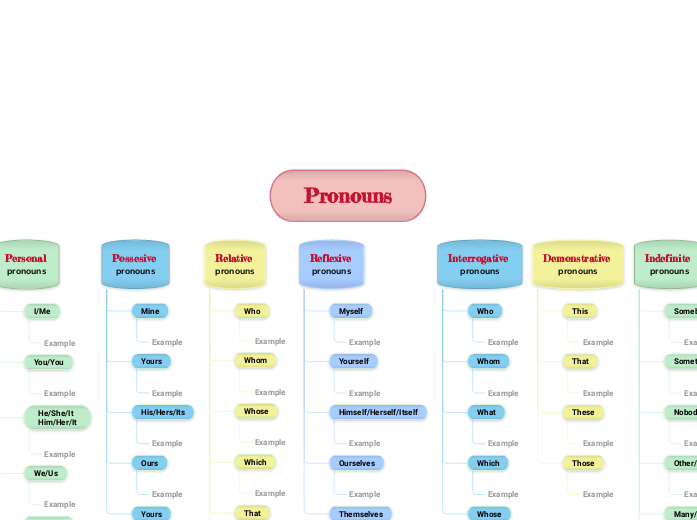
Use this template to learn the pronouns in English. Pronouns are the parts of speech used instead of nouns to avoid repetition. Depending on the situations in which they are used, they have different forms. The types of pronouns are: Personal pronouns Possessive pronouns Relative pronouns Reflexive pronouns Demonstrative pronouns Interrogative pronouns Indefinite pronouns Personal pronouns are the pronouns that refer to specific people or things. They can change depending on the person, number, gender, or case. Examples of personal pronouns, singular and plural form: I/Me You/You He/She/It Him/Her/It We/Us You/You They/Them Possessive pronouns show that something belongs to someone. Examples of possessive pronouns: Mine Yours His/Hers/Its Ours Yours Relative pronouns describe nouns in terms of how they relate to other words. Examples of relative pronouns: Who Whom Whose Which That What Reflexive pronouns are used when the subject of a sentence is also the object of the sentence. Examples of reflexive pronouns: Myself Yourself Himself/Herself/Itself Ourselves Themselves Demonstrative pronouns point to and identify a noun or a pronoun. They are used in place of particular things to show which one we’re discussing. Examples of demonstrative pronouns: Somebody/Someone Something/Anything Nobody/Nothing All Other/Another Both/Each Many/Most Some/Few None Such Interrogative pronouns are the pronouns used in questions. In sentences, when the pronoun is a subject, the verb will precede the pronoun. Examples of interrogative pronouns: Who Whom What Which Whose ’Who’ and ‘whom’ are used to refer to people and which is used for animals and things. Indefinite pronouns refer to a thing or person that is identifiable, but not specified. Examples of indefinite pronouns: This That These Those Complete the template by adding examples of phrases with these pronouns. In this way, you will retain information easier. Pronouns - a word that can function as a noun phrase used by itself and that refers either to the participants in the discourse. An indefinite pronoun is a pronoun that refers to a person or a thing without being specific. Demonstrative pronouns are pronouns that point to specific objects. They function as subjects or objects. An interrogative word or question word is a function word used to ask a question, Reflexive pronouns are words ending in -self or -selves that are used when the subject and the object of a sentence are the same. They refer back to an earlier noun or pronoun. A relative pronoun is a pronoun that marks a relative clause. They link one part of a sentence to another. Possessive pronouns show that something belongs to someone. Replaces noun in phrases. Personal pronouns are pronouns that are associated primarily with a particular grammatical person – They represents people places or things. Write phrases as examples. Tankekartor hjälper dig att brainstorma, skapa relationer mellan begrepp, organisera och generera idéer. Mallar för mind maps är dock ett enklare sätt att komma igång, eftersom de är ramverk som innehåller information om ett specifikt ämne med vägledande instruktioner. I grund och botten är mind map-mallar en struktur som kombinerar alla element i ett specifikt ämne och fungerar som en utgångspunkt för din personliga mind map. De är en resurs som ger en praktisk lösning för att skapa en mind map om ett visst ämne, antingen för företag eller utbildning. Mindomo ger dig smarta mind map-mallar som gör att du kan fungera och tänka utan ansträngning. Du kan välja mellan en mängd olika mind map-mallar från Mindomos konton för företag eller utbildning, eller så kan du skapa dina egna mind map-mallar från grunden. Varje mind map kan omvandlas till en mind map-mall genom att lägga till ytterligare vägledande kommentarer till ett av dess ämnen.Om den här mallen
Pronouns in English
Personal pronouns in English
Possessive pronouns in English
Relative pronouns in English
Reflexive pronouns in English
Demonstrative pronouns in English
Interrogative pronouns in English
Indefinite pronouns in English
Pronouns
Indefinite pronouns
None/Some/Few
Many/Most/Such
Other/Another
Nobody/Nothing
Something/Anything
Somebody/Someone
Demonstrative pronouns
Those
These
This
Interrogative pronouns
Reflexive pronouns
Themselves
Ourselves
Himself/Herself/Itself
Yourself
Myself
Relative pronouns
What
That
Which
Whose
Whom
Who
Possesive pronouns
Ours
His/Hers/Its
Yours
Mine
Personal pronouns
They/Them
We/Us
He/She/It Him/Her/It
You/You
I/Me
Example
Varför använda en Mindomo mind map-mall?
En mall har olika funktioner:
-
Produkter
-
Användningsområden
- Allmänna användningsområden
- Tankekartor för utbildning
- Tankekartor för företag
- Tankekartor för personlig utveckling
- Hjälpmedelsteknik
- Teamsamarbete
- Kampanjbriefar för marknadsförare
- Workshops för kundinsikt för konsulter
- Onboardingresor för HR och L&D
- Kunskapshantering
- Kompetensmatris för team
- Uppdragsbibliotek
- Roller
- Marknadsförare
- HR och L&D
- Konsulter
- Projektledning
- Planering av marknadsföringskampanjer
- Utrullning av medarbetarutbildning
- Arbetsomfattning
- Idéorganisering
- Problemträd
- Utbildningsbehovsanalys
- Fördelar med tankekartor
-
Lösningar
- Guider
- Skapa presentationer med tankekartor
- Lär dig med tankekartor
- Planera och organisera med tankekartor
- Hur prioriterar man uppgifter med tankekartor
- Hur man tar anteckningar med tankekartor
- Verkliga kundberättelser
- Skala utbildningsinnehåll för 11 000 läkare
- Teamarbetsflöde: från test till oumbärligt på två månader
- 10 år utan bilder: ompröva arkitekturföreläsningar
- Läs alla berättelser
-
Resurser
- Lär dig grunderna
- Vad är en tankekarta?
- Hur gör man en tankekarta?
- Vad är en konceptkarta?
- Idéer för tankekartor för studenter
- Guider & Support
- Videoguider
- Hjälpcenter
- Forum
- Exempel och mallar
- Idéer för tankekartor
- Topp 29 exempel på tankekartor
- Funktionssidor
- Utbildning
- Uppgifter för lärare
- Arbete & Personlig
- Skrivbord
- Mindomo-bloggen
- Priser
- Logga in
- Registrera dig
- Instrumentpanel
Allmänna användningsområden
Fördelar med tankekartor
Varför visuellt tänkande gör det lättare att minnas och planera.
Lär dig grunderna
Guider & Support
Exempel och mallar
Funktionssidor
 Blogg
Mindomo-bloggen
Guider, exempel och forskning om visuellt tänkande.
Bläddra bland alla artiklar
Blogg
Mindomo-bloggen
Guider, exempel och forskning om visuellt tänkande.
Bläddra bland alla artiklar