Client engagements often involve several parallel workstreams, multiple owners, interdependent deliverables, and recurring governance activities. This engagement delivery template helps teams plan, coordinate, and manage the successful delivery of client engagements from kickoff through completion. It brings together objectives, scope, deliverables, milestones, responsibilities, timelines, dependencies, risks, and communication activities in one visual workspace. Use this template to align stakeholders, clarify ownership, track progress, manage expectations, and keep key deliverables on schedule. It supports consulting projects, professional services engagements, client implementations, and other structured delivery processes where clear coordination and visibility are essential. Use this map to organize an engagement into clear workstreams and a shared operating cadence. Complete each lane to identify the owner, expected deliverable and timing, key dependencies, and current status. The map gives the team a single view of who is responsible for what, how workstreams connect, and how decisions and escalations are managed. Open these companion templates to define scope and structure client discovery. Enter the core meeting rhythm, escalation route, and location of the decision log. Record where engagement decisions are documented, such as a shared file, workspace, or linked decision log. Describe how issues are escalated, including the sequence of contacts, decision owners, and expected response path. Enter how often the steering committee meets and, where useful, note the usual day, timing, or triggering conditions. Enter the regular day and time for the engagement team’s weekly stand-up, including the time zone where relevant. Use this lane to identify the production lead, final deliverable and timing, dependencies, and current status. Record the current status of Workstream 5, such as on track, at risk, blocked, or complete, and add a brief note if clarification is needed. List the inputs, decisions, access, or upstream activities that must be completed before Workstream 5 can progress. Describe the key output for Workstream 5 — Deliverable Production and state when it is due or expected to be completed. Enter the person accountable for Workstream 5 — Deliverable Production. Use a clear name and, where useful, include their role. Use this lane to capture the solution-design lead, intended output and deadline, dependencies, and current status. Record the current status of Workstream 4, such as on track, at risk, blocked, or complete, and add a brief note if clarification is needed. List the inputs, decisions, access, or upstream activities that must be completed before Workstream 4 can progress. Describe the key output for Workstream 4 — Solution Design and state when it is due or expected to be completed. Enter the person accountable for Workstream 4 — Solution Design. Use a clear name and, where useful, include their role. Use this lane to define the analysis lead, model output and due date, upstream dependencies, and current status. Record the current status of Workstream 3, such as on track, at risk, blocked, or complete, and add a brief note if clarification is needed. List the inputs, decisions, access, or upstream activities that must be completed before Workstream 3 can progress. Describe the key output for Workstream 3 — Analysis & Modelling and state when it is due or expected to be completed. Enter the person accountable for Workstream 3 — Analysis & Modelling. Use a clear name and, where useful, include their role. Use this lane to record the interview lead, expected output and timing, dependencies, and current status. Record the current status of Workstream 2, such as on track, at risk, blocked, or complete, and add a brief note if clarification is needed. List the inputs, decisions, access, or upstream activities that must be completed before Workstream 2 can progress. Describe the key output for Workstream 2 — Client Interviews and state when it is due or expected to be completed. Enter the person accountable for Workstream 2 — Client Interviews. Use a clear name and, where useful, include their role. Use this lane to capture diagnostic data ownership, deliverable timing, dependencies, and current status. Record the current status of Workstream 1, such as on track, at risk, blocked, or complete, and add a brief note if clarification is needed. List the inputs, decisions, access, or upstream activities that must be completed before Workstream 1 can progress. Describe the key output for Workstream 1 — Diagnostic & Data and state when it is due or expected to be completed. Enter the person accountable for Workstream 1 — Diagnostic & Data. Use a clear name and, where useful, include their role. Los mapas mentales ayudan a realizar lluvias de ideas, establecer relaciones entre conceptos, organizar y generar ideas. Sin embargo, las modelos de mapas mentales ofrecen una forma más fácil de empezar, ya que son estructuras que contienen información sobre un tema específico con instrucciones orientativas. En esencia, las modelos de mapas mentales garantizan la estructura que combina todos los elementos de un tema específico y sirven como punto de partida para su mapa mental personal. Son un recurso que proporciona una solución práctica para crear un mapa mental sobre un tema concreto, ya sea para los negocios o para la educación. Mindomo le ofrece modelos de mapas mentales inteligentes que le permiten funcionar y pensar sin esfuerzo. Puede elegir entre una variedad de modelos de mapas mentales de las cuentas empresariales o educativas de Mindomo, o puede crear sus propios modelos de mapas mentales desde cero. Cualquier mapa mental puede transformarse en un mapa plantilla añadiendo notas orientativas a uno de sus temas.Engagement Delivery Template
This mind map helps teams structure an engagement by workstream, clarify ownership and deadlines, track dependencies and status, and define the meeting cadence, escalation path, and decision-making process.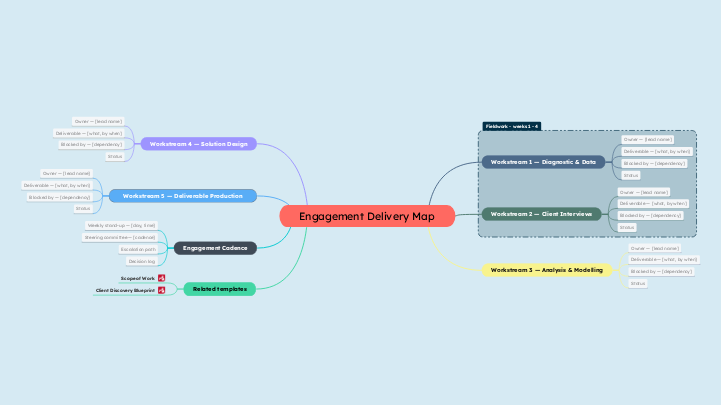
Acerca de esta plantilla
Engagement delivery template
Engagement Delivery Map
Related templates
Client Discovery Blueprint
Scope of Work
Engagement Cadence
Decision log
Escalation path
Steering committee — [cadence]
Weekly stand-up — [day, time]
Workstream 5 — Deliverable Production
Workstream 4 — Solution Design
Workstream 3 — Analysis & Modelling
Workstream 2 — Client Interviews
Workstream 1 — Diagnostic & Data
Status
Blocked by — [dependency]
Deliverable — [what, by when]
Owner — [lead name]
¿Por qué utilizar una modelo de mapa mental Mindomo?
Una plantilla tiene varias funcionalidades:
-
Productos
-
Usos
- Usos generales
- Mapas Mentales para la Educación
- Mapas Mentales para Empresas
- Mapas Mentales para el Desarrollo Personal
- Tecnología Asistida
- Colaboración en equipo
- Briefs de campaña para profesionales de marketing
- Talleres de descubrimiento de clientes para consultores
- Recorridos de onboarding para RR. HH. y L&D
- Gestión del conocimiento
- Matriz de competencias del equipo
- Biblioteca de proyectos
- Roles
- Profesionales de marketing
- RR. HH. y L&D
- Consultores
- Gestión de proyectos
- Planificación de campañas de marketing
- Despliegues de formación de empleados
- Alcance del trabajo
- Organización de ideas
- Árboles de problemas
- Análisis de necesidades de formación
- Beneficios de los Mapas Mentales
-
Soluciones
- Guías
- Hacer presentaciones con mapas mentales
- Aprender con mapas mentales
- Planificar y organizar con mapas mentales
- Priorizar tareas con mapas mentales
- Tomar notas con mapas mentales
- Historias reales de clientes
- Escalar contenido educativo para 11.000 médicos
- Flujo de trabajo en equipo: de la prueba a imprescindible en dos meses
- 10 años sin diapositivas: repensar las clases de arquitectura
- Leer todas las historias
-
Recursos
- Aprende lo básico
- Los 29 mejores Ejemplos de Mapas Mentales
- Programa de Gantt
- ¿Cómo hacer un Mapa Mental?
- Creador de Diagramas de Gantt
- Guías y Soporte
- Tutoriales en video
- Centro de ayuda
- Foro
- Ejemplos y plantillas
- Qué es un Mapa Conceptual
- Creador de Mapas Conceptuales
- Plantilla de Mapa Conceptual
- Plantillas de Diagramas
- Páginas de funciones
- Educación
- Tareas para profesores
- Trabajo & Personal
- Desktop
- El blog de Mindomo
- Precios
- Iniciar sesión
- Registrarse
- Panel de control
Gestión del conocimiento
Beneficios de los Mapas Mentales
Por qué el pensamiento visual facilita recordar y planificar.
Aprende lo básico
Guías y Soporte
Ejemplos y plantillas
Páginas de funciones
 Blog
El blog de Mindomo
Guías, ejemplos e investigación sobre el pensamiento visual.
Ver todos los artículos
Blog
El blog de Mindomo
Guías, ejemplos e investigación sobre el pensamiento visual.
Ver todos los artículos