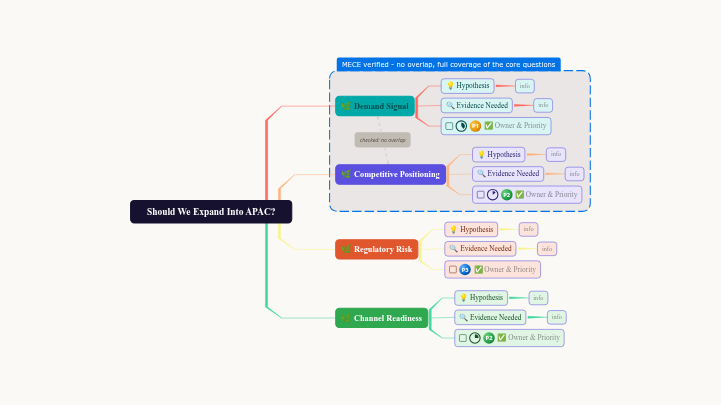
Example issue tree for a market-entry engagement. Every branch carries its own hypothesis, evidence need, and owner/priority - the structure the partner review actually checks. This issue trees template helps consultants, strategy teams, analysts, and project leads break complex business problems into clear, manageable components. It organizes key questions, hypotheses, evidence needs, owners, and priorities in one structured visual workspace. Use this template to frame problems, test assumptions, identify the analyses required, assign responsibility, and prepare for partner or stakeholder reviews. It supports market-entry studies, growth strategy, profitability analysis, operational improvement, and other consulting engagements by making the problem-solving logic transparent and easy to follow. Core question. Every branch below must be a genuine, non-overlapping child of this question — the MECE check that gets run once and re-run every time a branch moves. Can existing partners actually carry this offering to market on our timeline? Medium impact, low effort - quick to validate. Partner capacity interviews; onboarding timeline from the most recent comparable launch. Existing distribution partners can onboard the new offering within one quarter. Add the task owner and priority level Legal review of foreign-ownership rules; precedent from comparable entrants. Current licensing rules allow market entry within two quarters without a local JV. Is there room for a fast mover, or is the field already locked up? Is there room for a fast mover, or is the field already locked up? Competitor share data; win/loss interviews with regional buyers. No incumbent holds more than 15% share, leaving room for a fast mover. Is there real, durable demand for this offering in the APAC region? High impact, low effort - chase that task first. Third-party market-sizing report; win-rate data from comparable adjacent markets. Details about the evidence APAC demand for this offering is growing at 3x the rate of our home market. Detail your hypothesis Los mapas mentales ayudan a hacer lluvias de ideas, establecer relaciones entre conceptos y organizar y generar ideas. Las plantillas de mapas mentales ofrecen además una forma más fácil de empezar, ya que son estructuras que contienen información sobre un tema concreto junto con instrucciones orientativas. En esencia, las plantillas de mapas mentales aportan una estructura que reúne todos los elementos de un tema y sirven como punto de partida para tu propio mapa mental. Son un recurso práctico para crear un mapa mental sobre un tema concreto, ya sea en el ámbito empresarial o en el educativo. Mindomo te ofrece plantillas de mapas mentales inteligentes que te permiten trabajar y pensar sin esfuerzo. Puedes elegir entre una gran variedad de plantillas de mapas mentales de las cuentas empresariales o educativas de Mindomo, o crear tus propias plantillas desde cero. Cualquier mapa mental puede convertirse en una plantilla añadiendo notas orientativas a uno de sus temas.Issue Trees template
Acerca de esta plantilla
Issue trees template
Should We Expand Into APAC?
🌿 Channel Readiness
Add the task owner and the priority level.🌿 Regulatory Risk
🌿 Competitive Positioning
Add the owner and priority level.🌿 Demand Signal
✅ Owner & Priority
Add an owner and priority level.🔍 Evidence Needed
💡 Hypothesis
info
¿Por qué usar una plantilla de mapa mental de Mindomo?
Una plantilla tiene varias funciones:
-
Productos
-
Usos
- Usos generales
- Mapas mentales para la educación
- Mapas mentales para empresas
- Mapas mentales para el desarrollo personal
- Tecnología asistida
- Colaboración en equipo
- Briefs de campaña para profesionales de marketing
- Talleres de descubrimiento de clientes para consultores
- Recorridos de onboarding para RR. HH. y L&D
- Gestión del conocimiento
- Matriz de competencias del equipo
- Biblioteca de proyectos
- Roles
- Profesionales de marketing
- RR. HH. y L&D
- Consultores
- Gestión de proyectos
- Planificación de campañas de marketing
- Planes de formación para empleados
- Alcance del trabajo
- Organización de ideas
- Árboles de problemas
- Análisis de necesidades de formación
- Beneficios de los mapas mentales
-
Soluciones
- Guías
- Hacer presentaciones con mapas mentales
- Aprender con mapas mentales
- Planificar y organizar con mapas mentales
- Priorizar tareas con mapas mentales
- Tomar notas con mapas mentales
- Historias reales de clientes
- Escalar contenido educativo para 11.000 médicos
- Flujo de trabajo en equipo: de la prueba a herramienta imprescindible en dos meses
- 10 años sin diapositivas: repensar las clases de arquitectura
- Leer todas las historias
-
Recursos
- Aprende lo básico
- Los 29 mejores ejemplos de mapas mentales
- Programa de Gantt
- ¿Cómo hacer un mapa mental?
- Cómo hacer un diagrama de Gantt
- Guías y soporte
- Tutoriales en video
- Centro de ayuda
- Foro
- Ejemplos y plantillas
- ¿Qué es un mapa conceptual?
- Creador de mapas conceptuales
- Plantilla de mapa conceptual
- Plantillas de diagramas
- Páginas de funciones
- Educación
- Tareas para profesores
- Trabajo y uso personal
- Escritorio
- El blog de Mindomo
- Precios
- Iniciar sesión
- Registrarse
- Panel de control
Gestión del conocimiento
Beneficios de los mapas mentales
Por qué el pensamiento visual facilita recordar y planificar.
Aprende lo básico
Guías y soporte
Ejemplos y plantillas
Páginas de funciones
 Blog
El blog de Mindomo
Guías, ejemplos e investigación sobre el pensamiento visual.
Ver todos los artículos