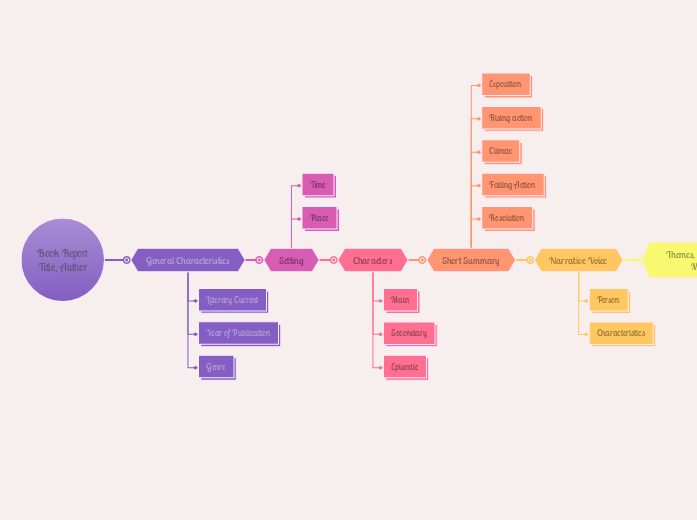
Use this story map template to learn the elements of a book or story. It is a graphic organizer, where you can identify story characters, plot, setting, challenges, and motivation of the main character, obstacles he/she encounters, and how he surpasses them. To name your story, you have to think about the overall message and what you want your audience to understand from the story. Also, make it relevant and easy to remember. The ending of a story is essential. We all know that if the ending is weak, what happened before loses its importance. So make it unpredictable, but fair. A resolved ending answers all the questions and ties up any loose threads from the plot. This is the closure section of the story. Try answering these questions to come up with a closure: This is the moment when the main character surpasses the last obstacle and finally faces their greatest challenge. The middle of the story is where you add layers of complications that will lead to the end. Reveal more about the character's journey. Did their personality go through changes? How did they overcome the challenges? And as you build up the story’s central conflict, make it more personal to that character. Also, from the middle act, you have to lead into the final act. There wouldn't be any tension and excitement in your story if there weren't any obstacles in your character's way. A story is nothing more than a character overcoming a series of difficulties to reach the desired goal. Obstacles usually create suspense and conflict. In overcoming obstacles, there is growth: weak becomes strong; hatred turns into love; sadness into happiness; wrong into right; lies into truth; or evil becomes good. Obstacles Your character(s) need(s) motivation in order to solve the challenge(s). Secondary characters might also have motives that lead them to cross paths with the main character or which might trigger them to help the main character. Why does your character need to confront this challenge? What does he/she expect to accomplish by solving it? Motivation Each story has a main character and that character usually needs to solve a problem or challenge. The character's challenge is the one that creates tension throughout the story. Type in any other challenges which other characters in the story need to face. Other challenges In most stories, there are 3 challenges. The number 3 is a mystical number symbolizing completeness. Try to come up with interesting challenges with which your character needs to struggle. Challenges In the beginning of the story (or the exposition), you will need to introduce the setting and characters. You might also want to introduce the main conflict. This part of the story is important because it gives the reader necessary background information and maybe even a first insight into a character’s personality. The setting (time & place) of a story can change throughout the plot. Sensory details include sight, sound, touch, smell, and taste. These details are important because they create depth in your setting. Sensory details The weather is an important element in your story because it can highly influence the ambiance and the mood of the characters. Catastrophic event Does your story include catastrophic weather? See a few suggestions below or add your own: The time of the story can also change. It can describe the event of a single day or can include an entire year's plot. Anyway, don't forget to mention it. Time of plot Your story can take place wherever your imagination will take you to. Location Characters are essential to a good story. Usually, the protagonist(s) is/are the most affected by the plot. Introduce a character by focusing on their actions, interests, and occupation, as the physical appearance doesn't make a difference in most cases. Type in the name of your character. Other Add other qualities/attributes of the character. Main Goal What is your character's main goal? Character traits Which traits best describe the character's personality? Choose more if necessary: Type of character Choose the type of your chacter: 마인드맵은 브레인스토밍, 개념 간의 관계 파악, 아이디어 정리와 발상에 도움이 됩니다. 마인드맵 템플릿에는 특정 주제에 관한 정보와 작성 요령이 미리 담겨 있어 더 쉽게 시작할 수 있습니다. 주제에 필요한 요소를 모두 갖춘 구조가 준비되어 있으므로 나만의 마인드맵을 만드는 출발점으로 활용할 수 있습니다. 비즈니스든 교육이든, 특정 주제로 마인드맵을 만들 때 유용한 실용적인 자료입니다. Mindomo는 편리한 스마트 마인드맵 템플릿을 제공합니다. Mindomo 비즈니스 계정이나 교육용 계정에서 제공하는 마인드맵 템플릿 중에서 고를 수 있고, 처음부터 나만의 템플릿을 만들 수도 있습니다. 어떤 마인드맵이든 토픽에 가이드 노트를 추가하기만 하면 템플릿으로 바꿀 수 있습니다.이 템플릿 정보
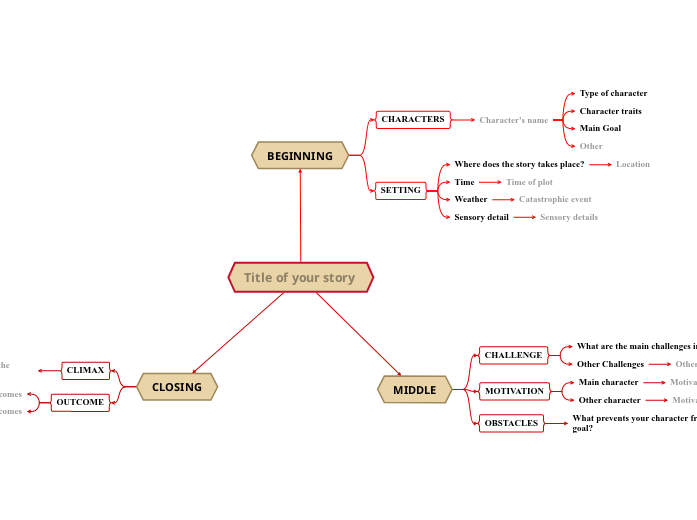
Story map template
Title of your story

CLOSING
OUTCOME
See examples of possible outcomes below:Outcomes
- Have all the problems been solved?
- Is there a clear picture of what happens with each character in the story?
- Has the challenge transformed your main character?
- How do the characters feel in the end?CLIMAX
The climax usually follows one of these patterns:
Type in your answer.How does your main character finally solve the problem?
MIDDLE
OBSTACLES
What prevents your character from accomplishing their goal?
See a few examples below:MOTIVATION
Other character
Main character
See a few examples:CHALLENGE
Other Challenges
What are the main challenges in your story?
See a few examples below:BEGINNING
SETTING
Sensory detail
See a few examples below:Weather
- hurricane, earthquake, storm, etcTime
Where does the story takes place?
For example: in an elevator, in an enchanted forest, etc. Don't forget to give details of the environment each time the setting changes, otherwise, the story can be confusing. Also, mention the seasons as each of them has unique weather and events.CHARACTERS
Character's name
Mindomo 마인드맵 템플릿을 사용해야 하는 이유
템플릿에는 다음과 같은 기능이 있습니다.
-
제품
- 만들기
- AI 마인드맵 생성기
- 아웃라인 프로그램
- 간트 차트 프로그램
- Mindomo 시작하기
- Mindomo 다운로드
- 브라우저 확장 프로그램
- 새로운 기능
- 마인드맵 템플릿
- 모든 기능 비교
-
활용
-
솔루션
-
리소스
- 기초 배우기
- 마인드맵이란?
- 마인드맵 그리는 법
- 가이드 및 지원
- 동영상 튜토리얼
- 고객센터
- 포럼
- 예시 및 템플릿
- 마인드맵 예시 29선
- 개념도란?
- 기능 소개
- 교육
- 교사용 과제 기능
- 업무 및 개인
- 데스크톱
- Mindomo 블로그
- 요금제
- 로그인
- 가입하기
- 대시보드
지식 관리
직무
마인드맵의 장점
시각적 사고가 기억과 계획을 쉽게 만드는 이유