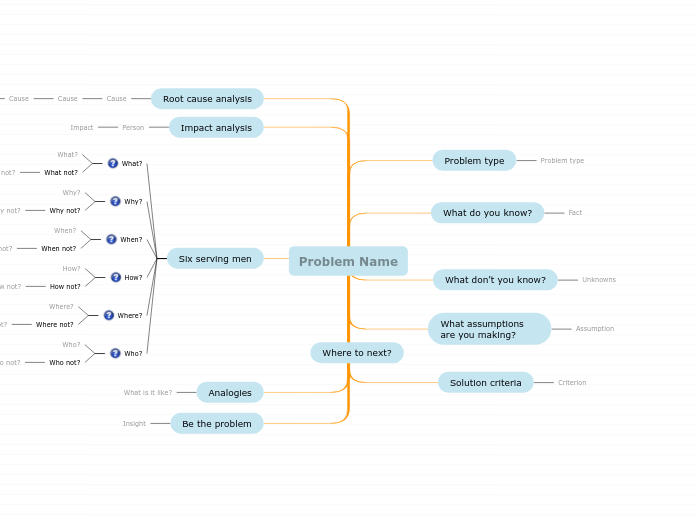

Enter your problem's name and categorize it, whether you want to sort something out, create or just change something. Identify all the information you know as well as the one you don't know about it: include measurements, statistics, surveys or any known data together with uncertain or missing information, anything that will help you frame the entire difficulty. Specify the suppositions you make and think of results in case your presumptions are not valid. Give at least as much importance to the final outcome of a problem, as to the problem state itself. Try out the impersonation technique and be the problem as if it were a person. Once you do this, observe if anything changes, how things are perceived from this perspective, what are the opportunities and obstacles from this approach? Apply the problem analysis method 'Six serving men' and answer openly to each of the six essential questions, both positive and negative to better track the triggers and the situations when the problem manifests itself. The problem description toolbox goes hand in hand with the 5 Whys approach, so include it in the problem's final assessment and go to the root cause of the original issue. Where to next? Name the problem Add a statement describing the problem as if it were a person. What is 'Problem Name' like? Who does not cause 'Problem Name'? Who causes 'Problem Name'? Where does 'Problem Name' not happen? Where does 'Problem Name' happen? How does 'Problem Name' not happen? How does 'Problem Name' happen? When does 'Problem Name' not happen? When does 'Problem Name' happen? Why is 'Problem Name' not a problem? Why is 'Problem Name' a problem? What does not cause 'Problem Name'? What causes 'Problem Name'? Who is affected? How is Person affected by 'Problem Name'? Root Cause analysis Why does 'Problem Name' happen? Why does 'Cause' happen? Why does 'Cause' happen? Why does 'Cause' happen? Why does 'Cause' happen? Add solution criteria Add an assumption Add an unknown factor Add a piece of data Describe the problem type 思维导图可以帮助你集思广益,建立概念之间的关系,组织和产生想法。 然而,思维导图模板提供了一种更容易上手的方法,因为它们是包含特定主题信息和指导说明的框架。从本质上讲,思维导图模板确保了将特定主题的所有元素结合在一起的结构,并可作为个人思维导图的起点。思维导图模板是一种资源,可为创建特定主题的思维导图提供实用的解决方案,无论是用于商业还是教育。 Mindomo 为你带来智能思维导图模板,让你毫不费力地运作和思考。 您可以从Mindomo的商业或教育账户中选择各种思维导图模板,也可以从头开始创建自己的思维导图模板。任何思维导图都可以转化为思维导图模板,只需在其中一个主题上添加进一步的指导说明即可。关于此模板
Problem analysis template
Where to next?
When you have a comprehensive description of the problem, you can move towards finding solutions.
Consider brainstorming as a next step or Share the mind map with your colleagues.Problem Name
Identify the problem or issue in a few words and press Enter. This will become the title of your map.Be the problem
Insight
Analogies
What is it like?
For example, how would the problem behave at a wedding, at a concert, in a supermarket, or underwater?Six serving men
Who?
Who not?
Where?
Where not?
How?
How not?
When?
When not?
Why?
Why not?
What?
What not?
Impact analysis
Person
Type in a name or role of someone who is affected by 'Problem Name'Impact
Rate the impact by clicking an icon:Root cause analysis
For analytical problems, root cause analysis can help to unravel indirect causes of problems, leading to more effective solutions. One way to do this is to keep asking 'Why?' down to five levels, to understand the reasons behind the reasons.Cause
Enter a reason that 'Problem Name' happens.
Enter a reason that 'Cause' happens.
(Level 2 of 5)
Enter a reason that 'Cause' happens.
(Level 3 of 5)
Enter a reason that 'Cause' happens.
(Level 4 of 5)
Enter a reason that 'Cause' happens.
(Level 5 of 5)Solution criteria
Criterion
Make sure you consider:What assumptions are you making?
Assumption
Identify an assumption you are making in both the description of the problem and the logical solution.What don't you know?
Unknowns
Identify information or data that is not known or not reliable, and what you can do to find it. Think about:What do you know?
Fact
Add data or a reference to the problem. Think about:Problem type
Select the problem type or enter your own description.为什么使用 Mindomo 思维导图模板?
模板具有各种功能: