Handle every employee exit without losing knowledge, access, or the chance to learn from it with this Employee Offboarding HR template. Designed for HR teams, managers, and IT and operations staff who handle departures, this template helps track notice dates and who needs to know, capture what only the leaver knows, assign handovers to named receivers, reassign clients and stakeholders, revoke accounts and rotate shared credentials, recover equipment, and run an exit interview that produces something usable. Use it to protect institutional knowledge, close security gaps on the last day, spot patterns across repeated exits from the same team, and decide whether to replace, redistribute, or restructure the role. This employee offboarding template helps HR teams, managers, and IT departments coordinate a clear, secure, and consistent departure process. It brings together exit tasks, knowledge transfer, handover responsibilities, access removal, equipment returns, documentation, and exit conversations in one visual workspace. Use this template to assign owners, track deadlines, protect company information, preserve essential knowledge, and ensure all administrative steps are completed. It supports voluntary resignations, retirements, contract endings, and other employee departures while creating a professional experience for both the departing employee and the organization. Use these controls to keep offboarding timely, secure and consistently recorded. Decide how the work will be covered and whether, when and how to recruit a replacement. Revoke access at the agreed time and recover all company equipment, keys and other property. Hold a structured exit interview to understand the employee's experience and reasons for leaving. Confirm responsibilities, dates and next steps clearly with the employee and everyone involved. Handle the departure with dignity, fairness and discretion from notice through the final day. Use this map to coordinate a clear, secure and respectful employee departure from notice through post-exit follow-up. Decide how the work will be covered and identify any wider workforce actions after the exit. Set a realistic desired start date based on business need and likely recruitment lead time. Assign the person responsible for preparing and approving the recruitment brief. Check recent exits from the team for repeated reasons, managers or conditions. Identify capabilities or experience that will be missing after the departure. Decide whether to recruit, redistribute the work or leave the position open. Capture candid feedback in a structured conversation led by someone other than the employee's manager. Record practical suggestions about the role, team, management or organisation. Ask which realistic changes might have influenced their decision to stay. Capture the employee's own explanation, using their words as accurately as possible. Choose a neutral interviewer who is not the employee's direct manager. Schedule the exit interview early enough for a useful and unhurried conversation. Track every company asset and access item that must be returned or disabled. List any other company-owned items, documents or materials to recover. Record passes, keys or access cards to collect or deactivate. List laptops, phones, storage devices and peripherals that must be returned. Plan the secure transfer or removal of accounts, credentials, email and files. Confirm that relevant files have been moved to an accessible company-owned location. Decide whether email should be forwarded, delegated, archived or closed, and for how long. Identify shared passwords, keys or secrets that must be changed securely. List user accounts and permissions to remove at the agreed time. Reassign important internal and external relationships and make clear introductions. Confirm that the departing employee or manager has made the required introductions. List external suppliers or partners that require a new company contact. Identify colleagues or teams who depend on the employee and assign a new contact. List clients or accounts that need a new owner and note any sensitivities. Assign each responsibility to a named receiver and confirm that the transfer is complete. Confirm that the receiver understands the handover and accepts ownership. Link to or name the location of the supporting documentation. Schedule the walkthrough or shadowing session and record when it is complete. Assign a named person who will take ownership after the employee leaves. Name the task, process or system being handed over. Identify knowledge, access and unfinished work that could be lost when the employee leaves. Record open work, its current status, next action, owner and relevant deadline. Capture processes that currently rely on memory rather than clear documentation. Identify systems where the departing employee is the only administrator or privileged user. List recurring or critical tasks for which no reliable cover currently exists. Record the key employment details, dates and communication responsibilities for the departure. List each person or group to inform, who will tell them and the appropriate timing. Record the agreed category and a factual summary of why the employment is ending. Enter the contractual end date of the employee's notice period. Enter the employee's confirmed final working date. Miellekarttojen avulla voit ideoida, hahmottaa käsitteiden välisiä suhteita sekä järjestää ja tuottaa ideoita. Miellekarttamallien avulla alkuun pääsee kuitenkin helpommin: ne ovat valmiita runkoja, jotka sisältävät tietoa tietystä aiheesta sekä ohjeita kartan täydentämiseen. Malli antaa rakenteen, joka kokoaa yhteen aiheen kaikki osa-alueet ja toimii lähtökohtana omalle miellekartallesi. Se on käytännöllinen tapa luoda miellekartta tietystä aiheesta niin työelämän kuin opiskelun tarpeisiin. Mindomon älykkäiden miellekarttamallien avulla ajattelet ja toimit vaivattomasti. Voit valita erilaisia miellekarttamalleja Mindomon yritys- ja koulutustileiltä tai luoda omia malleja tyhjästä. Minkä tahansa miellekartan voi muuttaa malliksi lisäämällä sen aiheisiin ohjaavia muistiinpanoja.Employee Offboarding Template
Tietoja tästä mallista
Employee offboarding template
Offboarding best practices
Plan succession and the next hire
Secure access and property
Run an exit interview
Communicate clearly
Treat people respectfully
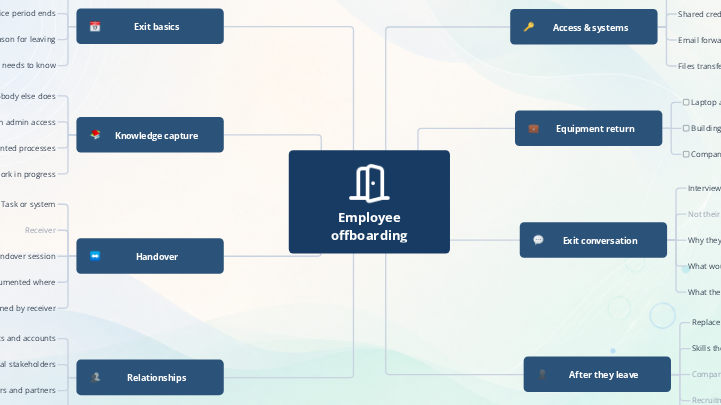
Employee offboarding
After they leave
Target start date
Recruitment brief owner
Compare against last three exits
Skills the team now lacks
Replace or redistribute
Exit conversation
What they would change
What would have kept them
Why they are leaving
Not their manager
Interview date
Equipment return
Company property
Building access
Laptop and devices
Access & systems
Files transferred
Email forwarding
Shared credentials to rotate
Accounts to revoke
Relationships
Introductions sent
Suppliers and partners
Internal stakeholders
Clients and accounts
Handover
Confirmed by receiver
Documented where
Handover session
Receiver
Task or system
Knowledge capture
Work in progress
Undocumented processes
Sole system admin access
Tasks nobody else does
Exit basics
Who needs to know
Reason for leaving
Notice period ends
Last working day
Miksi käyttää Mindomon miellekarttamallia?
Malleissa on useita toimintoja:
-
Tuotteet
-
Käyttötarkoitukset
- Yleiset käyttötarkoitukset
- Miellekartat koulutukseen
- Miellekartat liiketoimintaan
- Miellekartat henkilökohtaiseen kehitykseen
- Apuvälineteknologia
- Tiimiyhteistyö
- Kampanjabriefit markkinoijille
- Asiakastarpeiden kartoitustyöpajat konsulteille
- Perehdytyspolut HR:lle ja L&D:lle
- Tietämyksenhallinta
- Tiimin osaamismatriisi
- Projektikirjasto
- Roolit
- Markkinoijat
- HR ja L&D
- Konsultit
- Projektinhallinta
- Markkinointikampanjan suunnittelu
- Henkilöstökoulutusten jalkautus
- Työn laajuuden määrittely
- Ideoiden organisointi
- Ongelmapuut
- Koulutustarveanalyysi
- Miellekarttojen hyödyt
-
Ratkaisut
- Oppaat
- Tee esityksiä miellekartoilla
- Opi miellekartoilla
- Suunnittele ja järjestä miellekartoilla
- Priorisoi tehtäviä miellekartoilla
- Tee muistiinpanoja miellekartoilla
- Aitoja asiakastarinoita
- Koulutussisällön skaalaaminen 11 000 lääkärille
- Tiimin työnkulku: kokeilusta korvaamattomaksi kahdessa kuukaudessa
- 10 vuotta ilman dioja: arkkitehtuuriluennot uusiksi
- Lue kaikki tarinat
-
Resurssit
- Perusteet
- Mikä on miellekartta?
- Miten miellekartta tehdään?
- Mikä on käsitekartta?
- Miellekarttaideoita opiskeluun
- Oppaat ja tuki
- Video-oppaat
- Ohjekeskus
- Foorumi
- Esimerkit ja mallit
- 100 miellekarttaideaa
- Miellekartat apuvälineteknologiana
- 29 parasta miellekarttaesimerkkiä
- Ominaisuussivut
- Koulutus
- Opettajan tehtävät
- Työ ja vapaa-aika
- Työpöytäsovellus
- Mindomo-blogi
- Hinnoittelu
- Kirjaudu sisään
- Rekisteröidy
- Hallintapaneeli
Yleiset käyttötarkoitukset
Miellekarttojen hyödyt
Miksi visuaalinen ajattelu helpottaa muistamista ja suunnittelua.
Perusteet
Oppaat ja tuki
Esimerkit ja mallit
Ominaisuussivut
 Blogi
Mindomo-blogi
Oppaita, esimerkkejä ja tutkimusta visuaalisesta ajattelusta.
Selaa kaikkia artikkeleita
Blogi
Mindomo-blogi
Oppaita, esimerkkejä ja tutkimusta visuaalisesta ajattelusta.
Selaa kaikkia artikkeleita