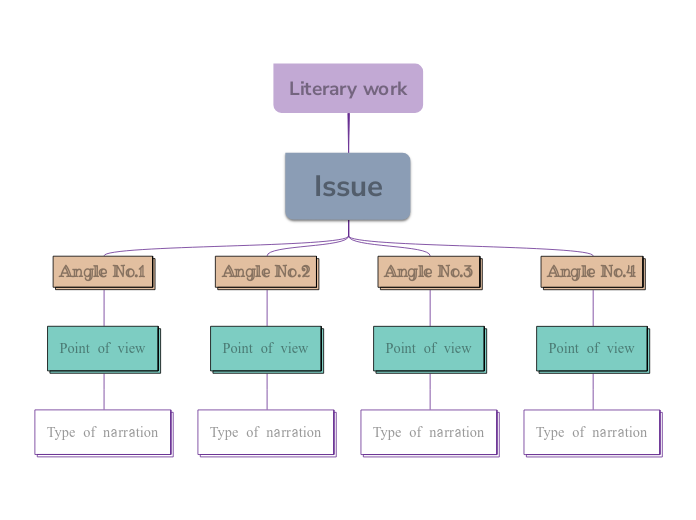

Identifying multiple author’s perspectives can be difficult if you do not organize your ideas. Use this mind map template to look at an issue from four different angles. Type in the name of the multiple-perspectives text. Identify an important issue from the text that is being presented from different angles. Type it in. Decide on the fourth point of view Point of view How is the viewpoint introduced in the story? Whose character does the third point of view belong to? What does the character think, say or do that suggests their perspective on the issue? What kind of narration introduces the viewpoint? Decide on the second point of view Type in a quote that points out the character's position about the issue. How is the viewpoint introduced in the story? Decide on the first point of view you are going to present. Type in a relevant quote that highlights the character's point of view towards Type of narration What type of narration introduces the viewpoint? 마인드맵은 브레인스토밍, 개념 간의 관계 파악, 아이디어 정리와 발상에 도움이 됩니다. 마인드맵 템플릿에는 특정 주제에 관한 정보와 작성 요령이 미리 담겨 있어 더 쉽게 시작할 수 있습니다. 주제에 필요한 요소를 모두 갖춘 구조가 준비되어 있으므로 나만의 마인드맵을 만드는 출발점으로 활용할 수 있습니다. 비즈니스든 교육이든, 특정 주제로 마인드맵을 만들 때 유용한 실용적인 자료입니다. Mindomo는 편리한 스마트 마인드맵 템플릿을 제공합니다. Mindomo 비즈니스 계정이나 교육용 계정에서 제공하는 마인드맵 템플릿 중에서 고를 수 있고, 처음부터 나만의 템플릿을 만들 수도 있습니다. 어떤 마인드맵이든 토픽에 가이드 노트를 추가하기만 하면 템플릿으로 바꿀 수 있습니다.이 템플릿 정보
Identifying Multiple author’s perspectives
Literary work
Example: Bridge to Terabithia by Katherine PatersonIssue
Example: Jesse's drawing talent.Angle No.4
Type in the name of the last character whose perspective on the issue you are going to present.
Example: Leslie Burke, Jesse's new next-door neighbor, and best friend.
Type in a relevant quote that highlights the character's point of view. Try to follow a citation format: author's name, chapter, and page.
Example: I can't get the poetry of the trees,' he said. She nodded. Don't worry,' she said. You will someday. He believed her.' (Paterson, 4. 24)
Choose an answer:Angle No.3
Type in his/her name.
Example: Mr. Aarons, Jesse's father.
Type in a quote and try to maintain the citation format.
Example: 'He would like to show his drawings to his dad, but he didn't dare. (...) He'd thought his dad would be pleased. He wasn't. What are they teaching in that damn school? he had asked.' (Paterson, 2.8)
Choose an answer:Angle No.2
Name the character (it can either be the main character or one of the supporting characters) whose point of view you are presenting.
Example: Miss Edmunds, Jesse's music teacher.
Try to follow a citation format: author's name, chapter, and page.
Example: 'She said he was unusually talented, and she hoped he wouldn't let anything discourage him.' (Paterson, 2. 8)
Choose an answer:Angle No.1
Type in the name of the character (it can either be the main character or one of the supporting characters) whose point of view belongs to.
Example: Jesse Oliver Aarons, Jr., the main character of the novel, a fifth-grader living in a rural Southern area.Point of view
Issue.
Try following a citation format: author's name, chapter, and page.
Example: 'Jesse drew the way some people drank whiskey. (...) Lord, he loved to draw. (...) When he was in first grade, he told his father that he wanted to be an artist when he grew up.' (Paterson, 2. 7)
Choose an answer:Mindomo 마인드맵 템플릿을 사용해야 하는 이유
템플릿에는 다음과 같은 기능이 있습니다.
-
제품
- 만들기
- AI 마인드맵 생성기
- 아웃라인 프로그램
- 간트 차트 프로그램
- Mindomo 시작하기
- Mindomo 다운로드
- 브라우저 확장 프로그램
- 새로운 기능
- 마인드맵 템플릿
- 모든 기능 비교
-
활용
-
솔루션
-
리소스
- 기초 배우기
- 마인드맵이란?
- 마인드맵 그리는 법
- 가이드 및 지원
- 동영상 튜토리얼
- 고객센터
- 포럼
- 예시 및 템플릿
- 마인드맵 예시 29선
- 개념도란?
- 기능 소개
- 교육
- 교사용 과제 기능
- 업무 및 개인
- 데스크톱
- Mindomo 블로그
- 요금제
- 로그인
- 가입하기
- 대시보드
지식 관리
직무
마인드맵의 장점
시각적 사고가 기억과 계획을 쉽게 만드는 이유