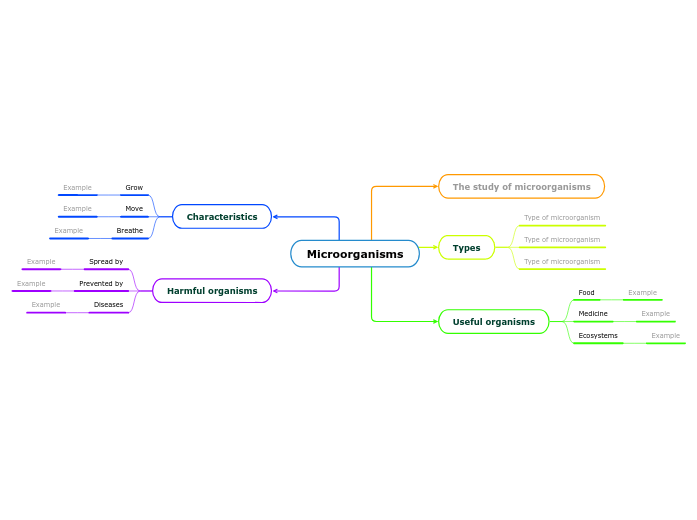
Use this mind map to learn about microorganisms, their types, and their use! Learn about different types of microorganisms and their characteristics. Microorganisms are organisms that are so small and can not be seen with the naked eye. They can be grouped into two categories: useful and harmful. A microorganism is an organism so small that people cannot see them with the naked eye. Harmful microorganisms include fungi, bacteria, protozoa, etc. What diseases can they cause? Give examples of how the spread of harmful organisms can be prevented. Give examples of how harmful organisms can spread. Research about the main characteristics of the microorganisms and give examples! Microorganisms help in the production of many food items, making medicines, keeping the environment clean, in manufacturing, and in research. Microorganisms have a role in waste disposal, agriculture, and nutrient recycling. Give examples of bacteria used in the pharmaceutical industry. Give examples of Microorganisms in food production. There are five types of microorganisms. Out of these five, four can be free-living or parasitic. Name the study of microorganisms. Mindmaps helpen je bij brainstormen, het leggen van verbanden tussen concepten, organiseren en ideeën bedenken. Met een mindmapsjabloon ga je nog makkelijker aan de slag: het is een kader met informatie over een specifiek onderwerp en begeleidende instructies. Een sjabloon geeft je dus de structuur die alle elementen van een onderwerp samenbrengt, en dient als startpunt voor je eigen mindmap. Zo maak je op een praktische manier een mindmap over een bepaald onderwerp, zowel in het bedrijfsleven als in het onderwijs. Mindomo biedt slimme mindmapsjablonen waarmee je moeiteloos kunt werken en denken. Je kunt kiezen uit verschillende mindmapsjablonen van de zakelijke of educatieve accounts van Mindomo, of je eigen mindmapsjablonen maken. Elke mindmap kun je omzetten in een sjabloon door extra notities toe te voegen aan een van de onderwerpen.Types of microorganisms
Over dit sjabloon
Microorganisms
Microorganisms
Microorganisms can be harmful and useful organisms.Harmful organisms
They cause several diseases in human beings, animals, and plants, which can even lead to death.
The harmful microorganisms not only can damage the human body, but also the food we eat.Diseases
Prevented by
Spread by
Characteristics
Breathe
Move
Grow
Useful organisms
Ecosystems
Give examples of these types.Medicine
Food
Example
Types
There is one that can be only parasitic since it always reproduces inside other living things.
After enumerating them, click on the flags below to mark the ones which can be free-living and the ones that cannot.Type of microorganism
The study of microorganisms
Waarom een mindmapsjabloon van Mindomo gebruiken?
Een sjabloon biedt verschillende functies:
-
Producten
-
Toepassingen
- Algemene toepassingen
- Mindmaps voor het onderwijs
- Mindmaps voor bedrijven
- Mindmaps voor persoonlijke ontwikkeling
- Ondersteunende technologie
- Teamsamenwerking
- Campagnebriefs voor marketeers
- Verkenningsworkshops met klanten voor consultants
- Onboardingtrajecten voor HR en L&D
- Kennismanagement
- Vaardighedenmatrix voor teams
- Opdrachtenbibliotheek
- Rollen
- Marketeers
- HR en L&D
- Consultants
- Projectmanagement
- Planning van marketingcampagnes
- Uitrol van medewerkerstrainingen
- Werkomschrijving
- Ideeën ordenen
- Probleembomen
- Analyse van opleidingsbehoeften
- Voordelen van mindmappen
-
Oplossingen
- Handleidingen
- Presentaties maken met mindmaps
- Leren met mindmaps
- Plannen en organiseren met mindmaps
- Taken prioriteren met mindmaps
- Notities maken met mindmaps
- Klantverhalen uit de praktijk
- Educatieve content opschalen voor 11.000 artsen
- Teamworkflow: van proefperiode naar onmisbaar in twee maanden
- 10 jaar zonder slides: architectuurcolleges opnieuw bedacht
- Alle verhalen lezen
-
Hulpbronnen
- De basis
- Wat is een mindmap?
- Hoe maak je een mindmap?
- Wat is een conceptmap?
- Mindmapideeën voor studenten
- Handleidingen en support
- Videohandleidingen
- Helpcentrum
- Forum
- Voorbeelden en sjablonen
- Mindmapideeën
- Tool voor ondersteunende technologie
- Top 29 mindmapvoorbeelden
- Functiepagina's
- Onderwijs
- Opdrachten voor docenten
- Werk en privé
- Desktop
- De Mindomo-blog
- Prijzen
- Inloggen
- Aanmelden
- Dashboard
Voordelen van mindmappen
Waarom visueel denken onthouden en plannen makkelijker maakt.
De basis
Handleidingen en support
Voorbeelden en sjablonen
Functiepagina's
 Blog
De Mindomo-blog
Gidsen, voorbeelden en onderzoek over visueel denken.
Alle artikelen bekijken