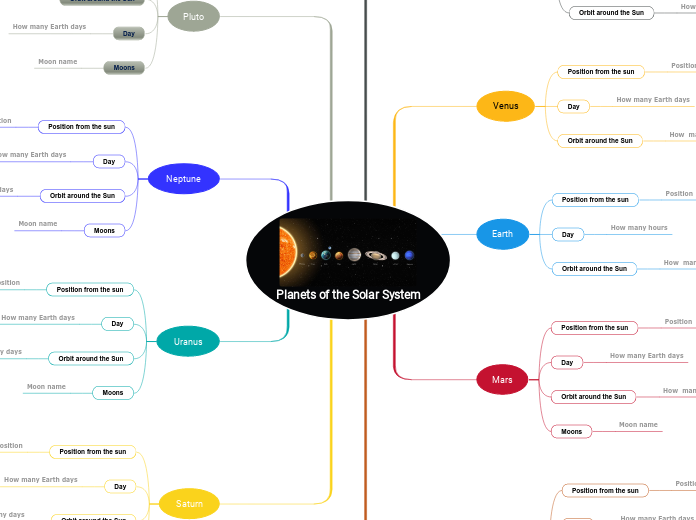
Explore the eight planets of the Solar System and Pluto, a dwarf planet, with this interactive mind map template. Learn about their order from the Sun, rotation periods, orbits, and natural satellites. Read interesting facts about each world, then complete the placeholders to test your knowledge of astronomy. Learn about the Solar System planets and their characteristics like their position from the Sun, the time they need to rotate or spin on their axis, and how many days they need to orbit around the sun measured in Earth days. Pluto was considered the ninth planet until 2006, when the International Astronomical Union reclassified it as a dwarf planet. Smaller than Earth's Moon, Pluto follows an elliptical orbit in the outer Solar System. Its icy surface features glaciers and mountains made of water ice. Pluto also has a thin atmosphere that changes as its distance from the Sun varies. Pluto has five known moons. Find their names and add them to the topics. Pluto is a dwarf planet. Its rotation period is the time it takes to complete one full turn on its axis. Enter this period in Earth days. How long does Pluto take to complete one orbit around the Sun? Enter the duration in Earth days. Pluto is a dwarf planet, not one of the eight planets. Describe where its orbit lies in the outer Solar System instead of assigning it a planet number. The Solar System consists of the Sun and the objects bound to it by gravity. It includes eight planets, dwarf planets, natural satellites, asteroids, comets, and smaller bodies. Explore each planet's position, rotation period, orbital period, and moons. Complete the placeholders using the information you research. Jupiter is the largest planet in the Solar System. This gas giant is composed mainly of hydrogen and helium. Its colorful cloud bands and Great Red Spot—a huge, long-lived storm—are easily recognizable. Jupiter has a powerful magnetic field and many moons, including the four Galilean moons. Jupiter has many moons. Identify the four large moons known as the Galilean moons and enter their names. How long does Jupiter take to complete one orbit around the Sun? Enter the duration in Earth days. A planet's rotation period is the time it takes to complete one full turn on its axis. Research the rotation period of Jupiter and enter it in Earth days. Eight planets orbit the Sun. Count outward from the Sun and write Jupiter's position in the planetary order. Saturn is a gas giant best known for its spectacular rings, made largely of ice particles mixed with rocky material. Galileo initially mistook its rings for objects on either side of the planet. Saturn is composed mainly of hydrogen and helium and has numerous moons. Research Saturn's natural satellites. Enter one moon's name in each topic and add more topics if needed. How long does Saturn take to complete one orbit around the Sun? Enter the duration in Earth days. A planet's rotation period is the time it takes to complete one full turn on its axis. Research the rotation period of Saturn and enter it in Earth days. Eight planets orbit the Sun. Count outward from the Sun and write Saturn's position in the planetary order. Uranus is an ice giant with a blue-green appearance caused by methane in its atmosphere. It rotates in a retrograde direction and has a remarkably tilted axis. Its orbital period is about 84 Earth years, and each season lasts roughly 21 years. Uranus also has faint rings and numerous moons. Research Uranus's natural satellites. Enter one moon's name in each topic and add more topics if needed. How long does Uranus take to complete one orbit around the Sun? Enter the duration in Earth days. A planet's rotation period is the time it takes to complete one full turn on its axis. Research the rotation period of Uranus and enter it in Earth days. Eight planets orbit the Sun. Count outward from the Sun and write Uranus's position in the planetary order. Neptune is the most distant of the eight planets from the Sun. This cold ice giant has an atmosphere with extremely strong winds. It was discovered in 1846 after mathematical predictions suggested its location. Neptune has many natural satellites, including Triton. Neptune has many moons, including Triton, its largest. Find the names of Triton and at least four other Neptunian moons. How long does Neptune take to complete one orbit around the Sun? Enter the duration in Earth days. A planet's rotation period is the time it takes to complete one full turn on its axis. Research the rotation period of Neptune and enter it in Earth days. Eight planets orbit the Sun. Count outward from the Sun and write Neptune's position in the planetary order. Mars is a cold, rocky planet whose iron-rich dust gives it a reddish appearance. Its surface has mountains, valleys, canyons, and enormous volcanoes. Mars also experiences dust devils and dust storms, some of which can spread across much of the planet. Mars has two small natural satellites. Find their names and add them to the topics. How long does Mars take to complete one orbit around the Sun? Enter the duration in Earth days. A planet's rotation period is the time it takes to complete one full turn on its axis. Research the rotation period of Mars and enter it in Earth days. Eight planets orbit the Sun. Count outward from the Sun and write Mars's position in the planetary order. About 71% of Earth's surface is covered by water. Earth is the only planet currently known to support life, and its atmosphere is mainly nitrogen and oxygen. It has one natural satellite: the Moon. How long does Earth take to complete one orbit around the Sun? Enter the duration in Earth days. A planet's rotation period is the time it takes to complete one full turn on its axis. Research the rotation period of Earth and enter it in Earth days. Eight planets orbit the Sun. Count outward from the Sun and write Earth's position in the planetary order. Venus is similar in size to Earth but has a much denser atmosphere, mainly made of carbon dioxide. Clouds of sulfuric acid cover the planet. An intense greenhouse effect raises its average surface temperature to about 465 °C. Venus rotates slowly in the opposite direction to most planets and has no natural moons. How long does Venus take to complete one orbit around the Sun? Enter the duration in Earth days. A planet's rotation period is the time it takes to complete one full turn on its axis. Research the rotation period of Venus and enter it in Earth days. Eight planets orbit the Sun. Count outward from the Sun and write Venus's position in the planetary order. Mercury is the smallest planet in the Solar System and the closest to the Sun. It is only slightly larger than Earth's Moon and has no natural satellites. With almost no atmosphere to retain heat, its surface can reach about 430 °C during the day and fall to about −180 °C at night. Its rocky, heavily cratered surface resembles the Moon's. How long does Mercury take to complete one orbit around the Sun? Enter the duration in Earth days. A planet's rotation period is the time it takes to complete one full turn on its axis. Research the rotation period of Mercury and enter it in Earth days. Eight planets orbit the Sun. Count outward from the Sun and write Mercury's position in the planetary order. Mindmaps helpen je bij brainstormen, het leggen van verbanden tussen concepten, organiseren en ideeën bedenken. Met een mindmapsjabloon ga je nog makkelijker aan de slag: het is een kader met informatie over een specifiek onderwerp en begeleidende instructies. Een sjabloon geeft je dus de structuur die alle elementen van een onderwerp samenbrengt, en dient als startpunt voor je eigen mindmap. Zo maak je op een praktische manier een mindmap over een bepaald onderwerp, zowel in het bedrijfsleven als in het onderwijs. Mindomo biedt slimme mindmapsjablonen waarmee je moeiteloos kunt werken en denken. Je kunt kiezen uit verschillende mindmapsjablonen van de zakelijke of educatieve accounts van Mindomo, of je eigen mindmapsjablonen maken. Elke mindmap kun je omzetten in een sjabloon door extra notities toe te voegen aan een van de onderwerpen.Solar System Planets
Over dit sjabloon
Solar System planets
Pluto
Planets of the Solar System
Jupiter
Saturn
Uranus
Neptune
Mars
Moons
Moon name
Earth
How many hours
Venus
Mercury
Orbit around the Sun
How many days
Rotation period
How many Earth days
Position from the Sun
Position
Waarom een mindmapsjabloon van Mindomo gebruiken?
Een sjabloon biedt verschillende functies:
-
Producten
-
Toepassingen
- Algemene toepassingen
- Mindmaps voor het onderwijs
- Mindmaps voor bedrijven
- Mindmaps voor persoonlijke ontwikkeling
- Ondersteunende technologie
- Teamsamenwerking
- Campagnebriefs voor marketeers
- Verkenningsworkshops met klanten voor consultants
- Onboardingtrajecten voor HR en L&D
- Kennismanagement
- Vaardighedenmatrix voor teams
- Opdrachtenbibliotheek
- Rollen
- Marketeers
- HR en L&D
- Consultants
- Projectmanagement
- Planning van marketingcampagnes
- Uitrol van medewerkerstrainingen
- Werkomschrijving
- Ideeën ordenen
- Probleembomen
- Analyse van opleidingsbehoeften
- Voordelen van mindmappen
-
Oplossingen
- Handleidingen
- Presentaties maken met mindmaps
- Leren met mindmaps
- Plannen en organiseren met mindmaps
- Taken prioriteren met mindmaps
- Notities maken met mindmaps
- Klantverhalen uit de praktijk
- Educatieve content opschalen voor 11.000 artsen
- Teamworkflow: van proefperiode naar onmisbaar in twee maanden
- 10 jaar zonder slides: architectuurcolleges opnieuw bedacht
- Alle verhalen lezen
-
Hulpbronnen
- De basis
- Wat is een mindmap?
- Hoe maak je een mindmap?
- Wat is een conceptmap?
- Mindmapideeën voor studenten
- Handleidingen en support
- Videohandleidingen
- Helpcentrum
- Forum
- Voorbeelden en sjablonen
- Mindmapideeën
- Tool voor ondersteunende technologie
- Top 29 mindmapvoorbeelden
- Functiepagina's
- Onderwijs
- Opdrachten voor docenten
- Werk en privé
- Desktop
- De Mindomo-blog
- Prijzen
- Inloggen
- Aanmelden
- Dashboard
Voordelen van mindmappen
Waarom visueel denken onthouden en plannen makkelijker maakt.
De basis
Handleidingen en support
Voorbeelden en sjablonen
Functiepagina's
 Blog
De Mindomo-blog
Gidsen, voorbeelden en onderzoek over visueel denken.
Alle artikelen bekijken