The Client Discovery Blueprint template helps teams structure client conversations and gather all essential information before starting a project, partnership, or implementation. It guides users through key discovery areas such as business context, stakeholders, current processes, challenges, opportunities, and project priorities. This client discovery blueprint template helps consultants, agencies, sales teams, and customer success teams structure client conversations before starting a project or implementation. It covers key discovery areas such as business context, stakeholders, current state, challenges, pain points, opportunities, scope, and priorities. Use this template to understand the client’s goals, identify decision makers, document existing processes, uncover operational issues, define desired outcomes, and agree on success metrics. It gives your team a clear, organized overview of client needs so you can prepare better proposals, align expectations, and plan the next steps with confidence. Capture everything learned during client discovery sessions in one visual workspace—from understanding the business context to identifying opportunities, priorities, and next steps. Capture ideas for new capabilities, products, services, or ways of working. Explore initiatives that could increase sales, customer value, or market expansion. Identify opportunities to lower expenses, eliminate redundancies, or optimize resource allocation. Explore ways to streamline processes, reduce waste, or improve productivity. Identify improvements that can be implemented quickly with minimal effort and immediate impact. Assess the importance and urgency relative to other opportunities. Estimate the effort, complexity, or resources required. Describe the anticipated business value or positive outcome. Identify the senior leader responsible for supporting and championing the initiative. Influence Level Assess their ability to impact decisions, priorities, or project success. Concerns Capture potential risks, objections, or challenges they may raise. Goals Document the outcomes and priorities most important to this stakeholder. Define how stakeholders will measure success and what outcomes would indicate project value. List ongoing projects, transformation efforts, or strategic programs that may influence this engagement. Document the business objectives, growth ambitions, and outcomes the organization is trying to achieve. Capture essential information about the organization, including industry, business model, structure, and key offerings. Define measurable indicators that will be used to evaluate progress and outcomes. Capture key milestones, deadlines, and implementation expectations. Clarify what will not be addressed to avoid misunderstandings and scope creep. Clearly document the activities, processes, or areas included in the initiative. Define the business results, improvements, or objectives the engagement should achieve. Document known vulnerabilities, constraints, or issues that may impact future initiatives. Capture critical relationships, handoffs, approvals, and external factors influencing success. Identify departments, functions, and individuals participating in the process. List the applications, platforms, and technologies currently supporting operations. Map the current workflows and procedures used to deliver work or achieve business outcomes. Highlight system limitations, integration issues, or technology constraints affecting operations. Identify communication, collaboration, resource, or capability gaps impacting performance. Document pain points affecting customer satisfaction, retention, or experience. Capture workflows, approvals, or dependencies that create delays or inefficiencies. Identify recurring operational challenges affecting efficiency, quality, scalability, or performance. Os mapas mentais ajudam você a fazer brainstorming, estabelecer relações entre conceitos, organizar e gerar ideias. No entanto, os modelos de mapas mentais oferecem uma maneira mais fácil de começar, pois são estruturas que contêm informações sobre um assunto específico com instruções de orientação. Em essência, os modelos de mapas mentais garantem a estrutura que combina todos os elementos de um assunto específico e servem como ponto de partida para o seu mapa mental pessoal. Eles são um recurso para fornecer uma solução prática para criar um mapa mental sobre um determinado tema, seja para negócios ou educação. Mindomo traz modelos de mapas mentais inteligentes que permitem que você funcione e pense sem esforço. Você pode escolher entre uma variedade de modelos de mapas mentais das contas comerciais ou educacionais da Mindomo, ou pode criar seus próprios modelos de mapas mentais do zero. Qualquer mapa mental pode ser transformado em um modelo de mapa mental adicionando mais notas de orientação a um de seus tópicos.Client Discovery Template
Use this template to clarify client goals, identify pain points, understand existing workflows, define success metrics, and align everyone on the next steps. It is especially useful for consultants, agencies, customer success teams, sales teams, and project managers who need a clear, organized overview of a client's needs before proposing or delivering a solution.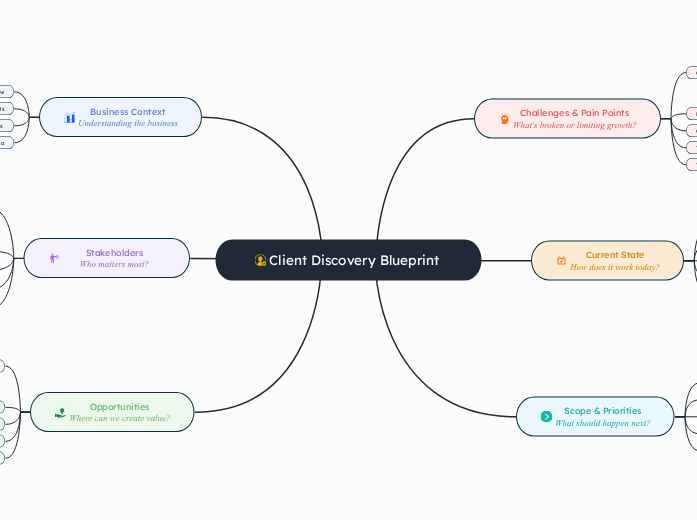
Sobre este modelo
Client discovery template
Client Discovery Blueprint
Opportunities Where can we create value?
Innovation
Revenue Growth
Cost Reduction
Efficiency Improvements
Quick Wins
Priority
Difficulty
Expected Benefit
Stakeholders Who matters most?
External Partners
External Partner
End Users
End User
Project Owner
Decision Makers
Decision Maker
Executive Sponsor
Sponsor
Business Context Understanding the business
Success Criteria
Current Initiatives
Strategic Goals
Company Overview
Scope & Priorities What should happen next?
Success Metrics
indicator....
Timeline Expectations
Out of Scope
In Scope
Desired Outcomes
outcome...
Current State How does it work today?
Risks
risk
Dependencies
dependency
Teams Involved
Systems & Tools
details...
Existing Processes
procedure...
Challenges & Pain Points What's broken or limiting growth?
Technology Gaps
limitation
Team Challenges
challenge
Customer Frustrations
Process Bottlenecks
details
Operational Issues
Impact
Root cause
Symptoms
Por que usar um modelo de mapa mental Mindomo?
Um modelo possui várias funcionalidades:
-
Produtos
-
Usos
- Usos gerais
- Mapas Mentais para Educação
- Mapas Mentais para Empresas
- Mapas Mentais para Desenvolvimento Pessoal
- Tecnologia Assistiva
- Colaboração em equipe
- Briefs de campanha para profissionais de marketing
- Workshops de descoberta do cliente para consultores
- Jornadas de onboarding para RH e L&D
- Gestão do conhecimento
- Matriz de competências da equipe
- Biblioteca de projetos
- Funções
- Profissionais de marketing
- RH e L&D
- Consultores
- Gestão de projetos
- Planeamento de campanhas de marketing
- Implementação de treinamentos para funcionários
- Âmbito do trabalho
- Organização de ideias
- Árvores de problemas
- Análise de necessidades de formação
- Benefícios do Mapeamento Mental
-
Soluções
- Guias
- Criar apresentações com mapas mentais
- Como aprender com mapas mentais
- Planejar e organizar com mapas mentais
- Como priorizar tarefas com mapas mentais
- Como fazer anotações com mapas mentais
- Histórias reais de clientes
- Escalar conteúdo educacional para 11.000 médicos
- Fluxo de trabalho em equipe: do teste ao indispensável em dois meses
- 10 anos sem slides: repensar as aulas de arquitetura
- Ler todas as histórias
-
Recursos
- Aprenda o básico
- O que é um Mapa Mental?
- Como Fazer um Mapa Mental?
- O que é um Mapa Conceptual?
- Guias e Suporte
- Tutoriais em vídeo
- Centro de ajuda
- Fórum
- Exemplos e modelos
- Ideias de Mapas Mentais Criativos
- 29 Exemplos Principais de Mapas Mentais
- Páginas de funcionalidades
- Educação
- Tarefas para professores
- Trabalho & Pessoal
- Desktop
- O blogue Mindomo
- Preços
- Entrar
- Inscreva-se
- Painel de controle
Gestão do conhecimento
Benefícios do Mapeamento Mental
Porque o pensamento visual facilita recordar e planear.
Aprenda o básico
Guias e Suporte
Exemplos e modelos
Páginas de funcionalidades
 Blogue
O blogue Mindomo
Guias, exemplos e investigação sobre pensamento visual.
Ver todos os artigos
Blogue
O blogue Mindomo
Guias, exemplos e investigação sobre pensamento visual.
Ver todos os artigos